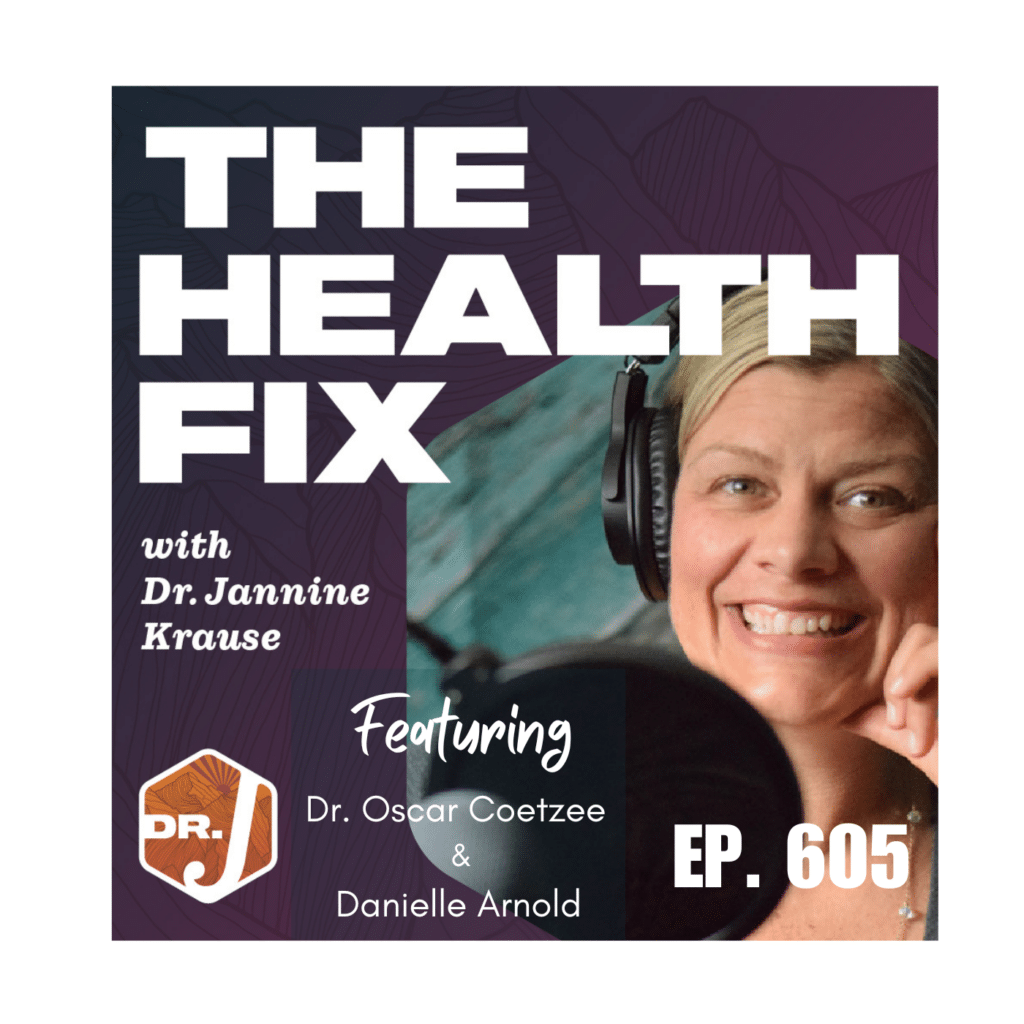
If you’ve been taking probiotics but still struggling with bloating, food sensitivities, anxiety, or stubborn gut issues this episode is going to change how you think about your microbiome.
I’m joined by gut health experts Dr. Oscar Coetzee and Danielle Arnold from the supplement company Designs for Health, and we’re diving into the next generation of probiotics and why most women over 40 have been missing a key piece.
We cover:
- Why traditional probiotics often don’t “stick”
- The real reason your gut may feel worse after protocols
- How your microbiome impacts mood, hormones, and metabolism
- Why diet alone isn’t enough anymore
- The rise of keystone bacteria + anaerobic probiotics
- What to do if you’ve tried everything and still have symptoms
NOTE: If you’re navigating perimenopause, digestive issues, anxiety, or food sensitivities, this episode will give you a completely new lens on healing.
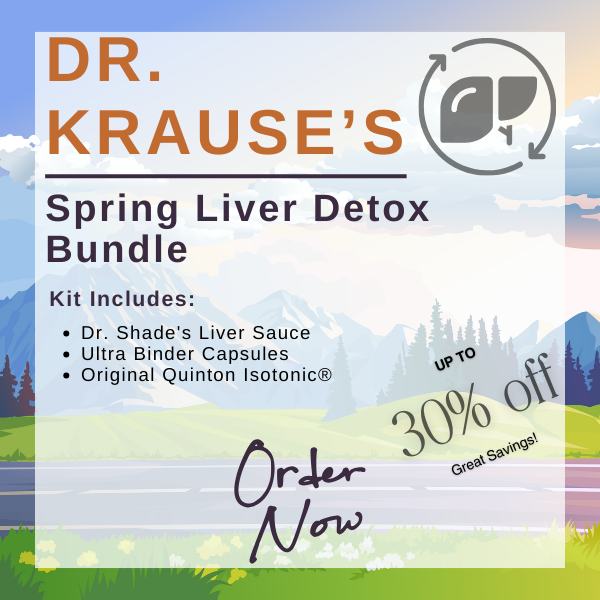
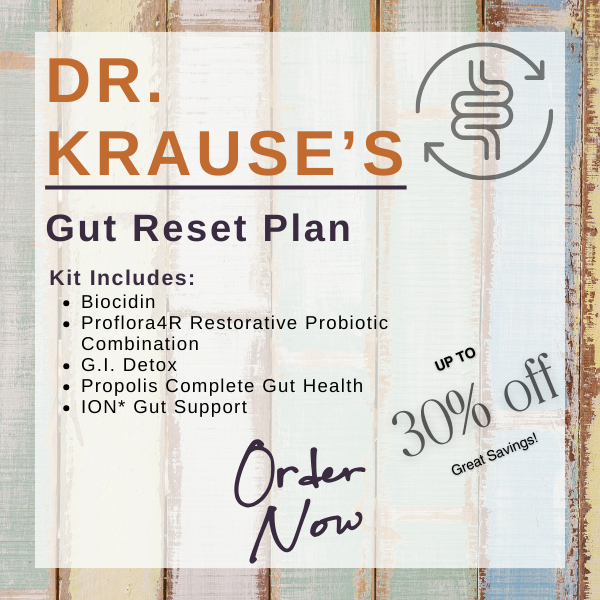
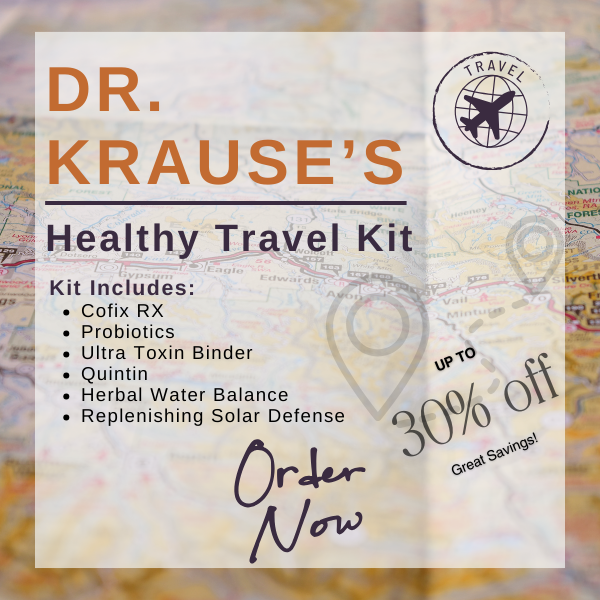
Dr. Krause’s Protocols
Instructions Included
Traveling soon? Looking to detox or reset your gut? Try one of Dr. Krause’s Fullscript plans.

What You’ll Learn
✔️ Why probiotics are temporary (and what actually lasts)
✔️ The difference between traditional vs. next-gen probiotics
✔️ How your gut bacteria influence serotonin, dopamine & mood
✔️ Why “killing bad bacteria” may be making things worse
✔️ The connection between low diversity + hair loss, fatigue & hormone issues
✔️ How to rebuild a resilient gut ecosystem (not just patch symptoms)
Key Takeaways:
- Your gut isn’t broken it’s often underpopulated (too sterile)
- Bloating can be a sign your gut is trying to heal not failing
- Restrictive diets may slow your progress long-term
- You need both:
- The right bacteria (seeds)
- The right foods (fertilizer)
Why Most Probiotics Fail
Traditional probiotics:
- Don’t colonize long-term
- Work only while you take them
- Don’t rebuild the ecosystem
The future of probiotics may be = keystone strains + anaerobic bacteria
These help:
- Restore gut environment
- Improve immune balance
- Crowd out harmful bacteria naturally
Gut + Hormones + Mood Connection
Your gut directly impacts:
- Estrogen metabolism
- Neurotransmitters (serotonin, dopamine)
- Nutrient absorption (iron, B12, amino acids)
Which means it influences:
- Anxiety
- Sleep
- Weight gain
- Perimenopause symptoms
Where to Start
If you’re overwhelmed, start here:
- Support digestion first
- Chew thoroughly
- Consider digestive enzymes
- Increase food diversity
- Aim for more color + fiber
- Avoid long-term restriction
- Rebuild your gut ecosystem
- Focus on foundational bacteria (not just random probiotics)
- Be consistent
- Gut repair = ecosystem rebuilding, not a quick fix
Who This Episode Is For?
This is for you if you:
- Are 40+ and feel like your body has changed
- Struggle with bloating, food sensitivities, or IBS symptoms
- Have tried probiotics but saw little or no results
- Deal with anxiety, mood swings, or low energy
- Want a science-backed, realistic approach to gut health
Resources From The Show
Podcast Transcript
Jannine Krause (00:13)
Hey, health junkies, welcome to another episode of Health Fix Podcast. On today’s podcast, I have Dr. Oscar Coetzee and Danielle Arnold from Designs for Health. They’re part of the clinical education and functional nutrition team for Designs for Health. Now, what’s interesting is Designs for Health has been doing a lot of research lately on beneficial bacteria and this concept of enhancing the gut ecosystem. So what if I told you,
that you could restore your entire ecosystem of your gut using key specific commensals. So these are like friendly bacteria that you have never heard of before that are not in capsules right now with probiotics. Well, these guys are finding it to be true in some of the research that they’re looking at. Now, this is not research. Like it wasn’t initially started with research that they
had done themselves. This was independent research. Because like most folks in the functional and natural medicine community, gut health is paramount. We want to be able to amplify it. And we’re kind of frustrated with the fact that probiotics are not living up to their standards. And the idea of taking a probiotic over and over again and not knowing if it’s really doing anything is frustrating. You’re kind of wasting money. So in this podcast,
Dr. Oscar and Danielle are gonna dive into some case studies. They’re gonna dive into what Designs for Health has been researching and what’s on the horizon. And the concept of using a specific species to help
to help signal the ecosystem of your digestive system to promote the production of more beneficial bacteria so that you don’t have to take beneficial bacteria over and over again as a supplement and wonder if it’s helping. You know it is. So this is an interesting podcast. We’re diving into some research geeky stuff and I love it. So let’s introduce you to Dr. Oscar Coetzee and Danielle Arnold.
Jannine Krause (02:15)
All right, Dr. Oscar Coetzee and Danielle Arnold, welcome to the Health Fix Podcast.
Dr. Oscar Coetzee (02:22)
Thanks for having us, Jannine
Danielle Arnold (02:22)
Thank you for having us.
Jannine Krause (02:23)
Well, I’m excited because Designs for Health has been in my wheelhouse since day one. We were using you guys at Bastyr when I was a young little naturopath and starting to get started. And then I even went into doing some private label for a little bit. And oddly enough, it was on probiotics for sure, because I had this whole gut program that I had created for my patients at the beginning of time. And it seems…
it’s been almost 20 years now. So it was back in the day, but it was what brought me to Designs for Health was the old probiotics. So of course, today it seems fitting that we’re going to talk about that as well. So of course, since I have both of you here, I always like to start things off with how are you two affiliated with Designs for Health? Who’s doing what? And have you guys, do you guys have a favorite probiotic?
Dr. Oscar Coetzee (03:13)
Well, let’s see, my affiliation with Designs for Health has a pretty long history. I actually…
⁓ was one of the faculty members for Dr. David Brady at the University of Bridgeport. And about 10 years ago, so I think he brought me on as one of the scientific advisory board members because of, you know, my expertise and kind of the mental health, nutritional overlap, well as, you know, sports nutrition is kind of the two areas that I really worked with for a while. And from there…
things evolved and we launched our own functional testing and I kind of was the person that launched the functional testing in the form of GI Spotlight, GI Metabolomics and Genomics testing. then from there, they hired me into the position of VP of Education because of my academic background to kind of run the entire education program at Designs for Health. And that’s my current position.
And then, you know, I’ll have Danny to tell you the story, but Danny basically was put in the position now of running the testing and that whole component to the company. But I’ll turn it over to her.
Danielle Arnold (04:17)
Yeah, so I got with Designs for Health because I was a student of Dr. Katia’s at Maryland University of Integrative Health. was his, I begged him to be his intern. He was one of my favorite teachers. I was like, this guy knows how to approach, cause my husband had had MS and so it was like, do the things or else like, you these, you know, you don’t get the benefits if you aren’t doing the things, right? And I felt like a lot of my teachers had been like,
meet your patients where they are and these types of things. And I was kind of like, that wouldn’t have worked for my husband, you know, and that’s why I got into this. So I really liked Dr. Kitsia’s approach. He was just like hard ball the whole time. So I was like, how do I work with this guy? And I think I harassed him so much that he was finally like, okay, fine. Like you can work with me. So I worked with him for two years at his private office or his private clinic. And then I…
You know, we did so much functional testing there that I got a pretty good handle on it. And he got so busy in his new position as VP that he needed someone to come on that he trusted to be able to do some of the functional testing. So I kind of moved into that position. And then as he moved upward, I kind of moved into his position kind of overseeing the clinical education team. Yeah.
Jannine Krause (05:34)
Nice, so it is
true if you are the squeaky wheel you are gonna get some grease some way some way
Danielle Arnold (05:38)
Yeah, definitely.
Dr. Oscar Coetzee (05:41)
If you’re a good quality wheel and squeaky, that’s
even better.
Jannine Krause (05:45)
I would have to agree with you on that one. I would
have to agree with you on that one. their perseverance pays off on that one. Good deal. Good deal. of course today we are slated to talk about probiotics. And of course over the course of this, I’d love to hear from you guys kind of what’s your favorite probiotic protocol or whatnot. And one of the biggest questions, I would say series of questions I get from folks and of course we don’t have to answer them all in one shot, but I’m just going to set the stage here is that
Number one, do we actually need a probiotic? Number two, can your body actually get its microbiome set so that the probiotic, you know, we seed it, we’re good, and we’re good for how long? How long can we be good for? And then what’s the deal with the various types of probiotics and in what kind of situations do we need these particular probiotics? That’s what I get, like spores versus the actual different strains and, you know, it could go on.
and on. So of course, you know, our biggest, I would say, thing we started with, or what I started with, is like there’s this concept of why has the just take probiotic message remained so dominant despite limitations that we know of these probiotics.
Dr. Oscar Coetzee (07:03)
I think for me, I’ll start it from the mental health category. So if we go into the mental health category, and I had several of my students do a lot of research on this when I was implementing quite a bit of the probiotics for mental health. The data is very strong on certain strains of probiotics as far as let’s say anxiety and depression is concerned. If you look at the lactobacillus species, ambiphotobacterium longum in specific, this very strong.
prevalence of data supporting that it has beneficial outcome in anxiety and depression evaluations. However, it’s kind of a transient product, right? So if you stop taking it, it doesn’t have the effect anymore. So you have to consistently take it to have the outcome. So if we just tie that into the mental health picture,
know, these probiotics produce aromatic amino acids and then these aromatic amino acids in the form of phenylalanine, tryptophan and tyrosine convert to neurotransmitters. So that’s where we can kind of get the benefit. And I think the entire industry of probiotics, I don’t want to sit here and say that it’s not helpful. They certainly have messaging ability and they have the ability to make a difference in the human gut. But can they really recede the gut?
in the traditional probiotic form? I don’t think so. And I don’t think the literature is really supporting that. However, if you go into the newer phase of the paradigm shift, where we’re looking at anaerobic keystone strains with some of the technologies that have come about in order to help people insert those into the distal colon, then we can start possibly talking about permanent seeding and grafting.
⁓ and then kind of cross-feeding, know, to help the individuals. So for the listeners, I just want to kind of delineate here. On the one side, we have the traditional aerobic strains of transient probiotics that do a job. There’s enough clinical evidence, not only in the mental health sphere and other areas, that if you keep taking the probiotic, there is a benefit, right? But once you stop taking the probiotic, the data is also supporting that it doesn’t work.
On the other side of the equation, have now more technology that wasn’t available in the last four to five years that can insert bacteria that have a much broader effect on the other ones in the form of the keystones. I’ll turn it over to Danny to add to that.
Danielle Arnold (09:28)
Yeah, I think that people adopt probiotics because it’s easy. You know, I think we live in this world where it’s like, take a pill for every ill and people are used to that paradigm. So I think, you know, they think I need a probiotic, I’m going to go to Walgreens or whatever and grab whatever’s on the shelf. And, you know, I think yikes, Walgreens for a probiotic. But a lot of times, you your gut isn’t like a supplement problem. It’s not like lack of this one supplement that you got from.
Jannine Krause (09:32)
Mm-hmm.
Danielle Arnold (09:55)
from Walgreens is usually an ecosystem problem. And I think that’s what Dr. Kutzee is speaking to is how do we create an environment where the right gut microbes thrive and bringing in those foundational ones, not the ones that just pass on through, but the ones that can actually take up residence are what the next generation probiotics are. So that’s what we’re really excited about is how do we get some of these bacteria that come from the human gut.
and take them as a probiotic so that they can seed the human gut and just feed upwards.
Jannine Krause (10:25)
I think that’s what we’ve been looking for all along. And I think that’s the idea that a lot of people think is going on with these. And of course, being in the industry for as long as I have, I’ve been let down by a lot of different probiotics. You try and then you’re like, And you do a GI map or you do a bioharm, you do some type of stool test and you’re like.
Okay, things are worse. And then patients are like, what gives, you know? Like, do you not know what you’re doing? And I’m sure you guys have seen this too.
Danielle Arnold (10:49)
You
Dr. Oscar Coetzee (10:50)
Right. Right.
Yeah, you you just brought up stool testing, GI-MAP or GI-FX or whatever format of testing you’re using. And here’s an anecdotal piece of data for you. There was some research done at Diagnostic Solutions Laboratories and they were looking at the prevalence of low keystones, right? So about 65 % of the tests that they run come in with low acrimansia. About 35 % of those tests come in with low phycali bacterium prousnici or f-prow.
and then Rosberia, which is another very important keystone, is maybe at 2 3%. But those strains of bacteria that we see that are low could actually have a metabolic and immune effect in the body of up to like 85%. So those strains cross-feed and communicate with a lot of the other strains. So clearly taking a standard Lactobacillus and Acidophilus probiotic is not helping.
this particular strain. The only thing that could potentially do is it does produce lactate and those probiotics produce lactate and that could feed some of these species, but not at the level that is going to reinsert optimization of them. So, we launched an anaerobic strain of probiotic, I don’t know, maybe six to eight months ago and Danielle and I actually published a peer-reviewed journal article on a case report.
where we basically had the pre and post testing of an individual and we inserted this particular strain of anaerobic. And then what we saw was improvement in the symptoms that the patient came to. But what was surprising to us is how it affected all the other keystones. So for the first time ever, I was seeing a probiotic, like you were saying, Janine, that actually made a difference in the GI test. So I gave this person this anaerobic.
for food sensitivity or food allergy reasons, because it’s a major butyrate producer, so we were trying to improve the tight junctions and the permeability issue. But on its own, it took this person’s low acrimansia to normal levels and we didn’t give this person acrimansia. So, we were just sitting there and trying to figure out now, what’s going on here and working with some really smart microbiologists and…
Some people obviously at these laboratories were starting to figure out, okay, well, if you have this one, it’s activating some gene expression on the L cells that’s helping to produce mucin. And then you get the cycle that feeds the acrimansia. So for the listeners, it’s almost like you inserting this one particular entity that then almost wakes up the entire, you know, ecosystem and it’s like, ⁓ thank goodness you’re here. We’ve been waiting for you to get here so that we can all cohesively work together.
So now I think if you were taking another probiotic like a lactobacillus or an acidophilus and those guys are working, you will actually get more benefit from those probiotics when that systemic foundational component of the ecosystem is established. I always use the analogy for me, it’s almost like earthworms. Like if you don’t have earthworms in soil in the ecosystem, none of those plants work really well because they feed the…
the garbage, they work on the nitrogen, they work on the pH levels of the soil that makes the ecosystem work. So these keystone commensas are literally the earthworms. And if they’re not in the right places, then none of those flowers look good. You can still have flowers, you can still have weeds when the earthworms aren’t as optimized, but they’re just not going to be as good looking as they could be when there is a really balanced ecosystem.
Jannine Krause (14:17)
That makes perfect sense. That makes perfect sense. So what I’m hearing, and this might be what some folks might be hearing too, is like, okay, it sounds like a layered approach is what needs to happen here. And I’m curious on the layered approach, are you guys taking it as you use?
Dr. Oscar Coetzee (14:26)
Correct.
Jannine Krause (14:34)
something like the commensal species or keystone species, sorry, that would work on the musin and work on butyrate. And then after that, then you layer in what we know as traditional commensals.
Dr. Oscar Coetzee (14:47)
Correct. And before you hop on this, Danny, we’re also looking at exactly what’s feeding these individual species. Because theoretically, we all think, OK, well, polyphenols, inulin, fiber, you know, they all play a role. We’ve actually found out that with some strains, some of those don’t really work very well, but with others they do. So now we’re trying to get to the specifics of understanding, OK, exactly which strain of fiber polyphenol is working with this commensal.
versus this commensal. So not only can we give you the strain, that is the seed, we’re also giving you the fertilizer and the water at the same time to make sure that it gets to that point of engraftment. So this is all very early stage, right? I mean, this is all paradigm shifting stuff. So at this point, it’ll be interesting to see how long it really takes for that engraftment. Theoretically, you wouldn’t need to be on the probiotic forever because if you…
feed that ecosystem and you nourish the ecosystem, it should take care of itself. However, if your diet and lifestyle goes back to the thing that’s destroying the ecosystem, then maybe you need to get back on the probiotic. But we’re trying to get to make this work the way it’s supposed to work from the ancestral standpoint. Right? Like it’s feeding itself and there’s enough fiber present, you know, for this ecosystem to be in a happy, happy place. Danny.
Danielle Arnold (16:05)
Yeah, I think
that’s a really good point because when you give a probiotic and you don’t give the correct food, it’s like throwing a probiotic in a desert and expecting it to survive. So that’s what we definitely want to do is like give that anaerobic bacteria to build up the foundation, but also give it food while it’s there. And with these anaerobic bacteria, because they do come from the human body, they do have the propensity to engraft, which means become part of the community. So.
That means that you probably need to take it for like three months. And then a lot of people want to talk about like maintenance, you know, like what do I need to do to not get back to that place? And a lot of times it’s you, you know, switching out probiotics. I know you talked about spore biotics and, and lactobacillus and bifidobacterium. And you can, I always like to rotate bacteria. And an interesting thing that I’ve found out in like deep dives of doing stuff with the gut microbiome is your gut microbiome is most active at night. So I like to have people.
take their probiotics at night so that they can kind of feed that environment. like spore biotics are really cool when I’m blind, when I don’t have like a GI map or something, they have a lot of quorum sensing. So basically they can say like, this population is really high and this population is really low. I’m gonna kind of nourish this population over here. So I like spore biotics for those reasons when I like don’t really have an eye as to what the…
environment is doing. just have symptoms. But yeah, we like, I like to rotate probiotics as maintenance when people ask about maintenance.
Jannine Krause (17:30)
Nice. I smile because I’m like, yep, I kind of throw the spores at like when I’m like, well, I don’t have any testing this person’s in, they’ve got some symptoms. Let’s, let’s see what the spores will do. cause yeah, they, they always have some sort of benefit. Now, one of the other things that, you know, is coming to my mind that a lot of folks will wonder about and, we’ve got the mood probiotics like Dr. Oscar had mentioned, and there’s a million supplements online that are like, this is for mood and this is for mood and, really
Danielle Arnold (17:35)
He
Jannine Krause (17:58)
Are they? Yeah, there’s some research on certain strains, if they’re not staying around, then I’ve got a question to go back to, just like Dr. Oscar was mentioning, know, tryptophan, tyrosine, you know, the neurochemical precursors all often see folks have, and particularly, this is more in the case of folks who are having a rough time with perimenopause, and I also see a lot with teenagers. Rough time with the periods, and we do a micronutrient, and they’re…
all like phenylalaninate, you know like all of the neurochemical precursors are low and you know they swear they’re eating enough protein and I you know sometimes I do believe them you know not all the time so it’s like hmm hmm
Dr. Oscar Coetzee (18:38)
Right.
Danielle Arnold (18:39)
Yeah.
Dr. Oscar Coetzee (18:43)
Well, you know, if
Danielle Arnold (18:43)
Yeah.
Dr. Oscar Coetzee (18:44)
you look at that, right, I mean, we’re in a rather compromised state as a world at the moment from a standpoint on
you know, how we’re affecting our intestinal microbiome aromatic amino acids. And again, for the listeners, that would be tryptophan. You know, tryptophan converts to serotonin, so that’s your happy chemical, and tyrosine converts to dopamine, and that’s another kind of overall field of chemical. So if you lower those precursors, there’s a big issue. But for the listeners to also understand, it’s not like your body is just producing these aromatic amino acids. They now still need to get to the brain.
Right? And in order for them to get to the brain, they need to have proper insulin control. So if a person has pre-diabetes or insulin resistance, then the carrying molecule that gets them there is not going to take them there. And once it’s in there, you still need vitamins B6, iron, vitamin C to make all that conversion happen. So if you really dig deep into the whole third leg of the bar stool for me with mental health, which is psychiatry one, psychological therapeutics…
psychologists, psychotherapy kind of intervention, then the nutritional psychology is what I call it. And I think the nutritional psychology is the biggest component that nobody’s looking at, right? So everything that you’re saying, Janine, hey, I’m eating enough protein. Okay, well, that doesn’t mean that you’re absorbing everything that you’re eating. It doesn’t mean that you’re extracting all the iron from that particular meat that you’re eating or the B12 that is required for you to cross it. And now you have early stage diabetes and you wonder why you’re anxious and depressed. You know, if you look at the
statistical data on anxiety and depression, type 2 diabetics are more prone to depression and anxiety because they can’t keep these aromatic amino acids across. And now to add insult to injury, now we have glyphosate and herbicides that destroy this pathway in our guts, folks. That’s called a chikamate pathway. And basically what that is, is how that bacteria converts that tryptophan. Right? So you’re destroying all those things inside of your gut.
Now you have the inability to make it in your gut. Your body is not absorbing enough from what you’re getting. Is it any surprise that we have the level of anxiety and depression that we have in our world? Right. So what is the what is the solution to that? We can’t all move to Mars, you know, and get away from this exposure to all this stuff. But what I will tell you is that we are getting to the point now that we can literally engraft these things even in a competitive environment.
Right? So, you’ll be a lot better off if you’re on a fast food diet, on a processed diet, exposed to, you know, these herbicides as well as low fiber intake, which most Americans are, and taking this thing to help engraft it. You know, so this is maybe one group of supplements that could not only work on the mental health standpoint, but also feed the entire immune system, because there’s so many associations to these keystone bacteria. So, what am I saying?
I’m saying that the reality is that our microbiomes are never going to go back to what they were in an ancestral period, right? We don’t have helmets and worms anymore in our guts like we used to have. And because those things are out of our guts, we have this niche space, we have this gap that’s opened up that the bad guys now come in. So the only way to facilitate an opposing attack on that is to put more of these anaerobes in there so that they can crowd out the bad guys.
because I forgot to tell you that’s the most significant thing that we found in our clinical research is it’s the first time in my life that I’ve actually ever seen the crowding out of an opportunistic bacteria without using an antimicrobial. So literally inserting this anaerobic strain crowded out a significant overgrowth of a histamine producing opportunistic bacteria without using an antimicrobial.
Now we’re doing deeper research on bigger cohorts to see if that is actually a consistency. But that’s the hypothesis. And it will make sense if you understand the niche space that we have and providing. Because the gut wants these things. It wants these things to be present. So if you provide it with the substrates to be there, or the food, that’s what substrate means, that would then fill that niche in and will fill that gap in. That’s kind of the simple analogy of
Danielle Arnold (22:50)
Yeah, and Dr. Kutziya is like the expert in like the gut anxiety space there between the two of us. But I’ve definitely seen intake forms after intake forms where they’re like half filled out by these teenagers and, you know, anxiety and depression are kind of their biggest symptoms. And I can almost guess that like we’re going to run a GI spotlight or we’re going to run a GI map on them and their elastase is going to be to the floor. And that’s
speaking to his point, like, doesn’t mean you’re, or speaking to your point as well too, like, you could be eating all the protein, you could be eating everything that you say that you’re eating, but we eat because we need nutrients, and we eat because our physiology needs all these things, and if we aren’t absorbing those things, that means our physiology downstream suffers, and that physiology downstream includes anxiety and depression symptomatically.
Jannine Krause (23:37)
100%, 100%. I think you guys brought up a couple of things that I think a lot of people are gonna wonder about because when we talk about bugs in the gut, right, you mentioned like we used to have all these helmets and parasites, right? And now it’s like everyone’s on a parasite cleanse 24 seven. Like it is the hot thing. Right, if you have not done a parasite cleanse, you are not in the cool kids club. And the killing is very rampant.
Dr. Oscar Coetzee (23:52)
Bye.
Danielle Arnold (23:54)
I have. Thanks, TikTok.
Jannine Krause (24:03)
And people want these kills and I’ve had to talk people out of like, look, I understand you have gas and bloating and you’ve had it over and over again and you’ve used every bio blah blah blah side. I’m not gonna use brands, but you know, every single thing all the way down the line and you still have gas and bloating. you know, technically you’re still asking me, you know, what’s wrong with your gut? And it’s like, well, I like the idea of stopping killing and trying to support on.
Danielle Arnold (24:29)
Mm-hmm.
Jannine Krause (24:30)
on that side of things because that is a hot topic right now. I’m sure you guys.
Danielle Arnold (24:32)
Definitely and
I think when I yeah, tick-tock and Instagram all these influencers are trying to sell their their Parasite cleanses and everything like that and I get so many people that think that they have a parasite we run a GI map and hardly ever do I see a parasite and they’ve done and a lot of times they go through these parasite cleanse and they feel better and then they feel worse and they feel better and they feel worse and then they still have this residual bloating and a lot of times for me when I see a GI map like that
I will see that they have done so many kill phases that their anaerobes are also to the floor. They also have killed off a lot of their good gut bacteria and you need that bacteria to digest any kind of fiber you put into your system. So you’re gonna have residual bloating if you don’t have the bacteria to break that stuff down. So usually it’s about building back the bacteria that can break down the fibers that you’re trying to introduce it, like the diversity and all the low hanging fruit that we as clinicians try to push at people.
all the colors and things like that, you need to restore before you can even start feeding those guys.
Dr. Oscar Coetzee (25:36)
So, know, what Danny is mentioning, there’s obviously some form of deficiency dysbiosis, right? That we see a lot with low fat assimilation through steatocrit, which is a marker on the test, and ELS-1, which for the listeners is a pancreatic enzyme that’s indicating if you’re producing enough things to help you break down the foods. Let’s just quickly get back, if you guys are okay with us, to the discussion on the worms and the parasite thing. So, interesting data points on that. Again, anecdotal, probably less than…
Danielle Arnold (25:40)
Mm-hmm.
Dr. Oscar Coetzee (26:03)
1 % of all GI tests run actually have a parasite on them and I’m not saying that that isn’t a possibility but in the United States of America the amount of herbicides that we have and antibiotics in our waters, almost no chance you know that you’re gonna have a tremendous amount of bacterial overgrowth. Most people have more sterile guts than the other way around. So interestingly enough if you go back to some less developed countries in the middle of Africa and I’m from Africa so I’m pretty familiar with this. If you go to some of the
the native people there like the Kalahari Bushmen and they look at their guts. Yeah, they have worms. They literally have helmets in them. They’ve literally got worms living in their gut and they have protists. know, these are not things that we see anymore. These protists are also kind of a catalyst in helping you digest and assimilate food. So we’ve literally lost that. The average American does not have any helmets and they don’t have any protists. So again, that creates this gap. So what’s going to happen in this gap?
Well, most people are eating very processed foods, right? So that’s going to feed more of the fungal species and more the opportunistic kind of species. But I also want to make people aware of that the gut is an ecosystem. So if you look at nature and you see a bad piece of land where the soil has been kind of affected by sprays and whatever, the first thing that you see in a year is our weeds. Weeds start coming up and that’s not because they’re bad things.
That’s because they’re trying to show the environment, hey, we’re the stronger, more resilient plant source. We’re going to come in here and we’re going to start doing the right things to the soil. We’re going to start attracting the right bugs after a while and then we can reestablish this stuff. But for some reason, as humans, we’ve now decided that weeds and our gut weeds are also a problem. So the first thing that we do when we look at a stool test and we see an opportunistic overgrowth, we immediately want to do an antimicrobial. Now, maybe that’s just the weeds in the gut telling us, ⁓
I got a problem here. I’m going to start growing because some of these weeds also produce substrates that the good guys can use. Some of them produce acetate, some of them produce lactate. So maybe it’s just a compensation mechanism and that’s the astonishing hypothesis that I think we’re going towards, right? And so if you go back in there and you give the soil what it needs, then those weeds will start to diminish. They’re not going to be there as much as anymore and that’s getting us back to what we discussed earlier.
which is why did this opportunistic overgrowth go away? And for you, Janine, you’ll understand this. So if you look at a stool test, there’s an indicator and a reference range. And the normalcy of this reference range might be an E2, will be, for layman’s terms, explain two zeros. OK, this person was at E9. So that is nine zeros. That’s a bazillion, a trillion, right? That’s a big, big number. And literally that went to a normal number.
Jannine Krause (28:39)
Okay.
Danielle Arnold (28:45)
Yeah
Dr. Oscar Coetzee (28:48)
I couldn’t move that with an antimicrobial the way you did that with an anaerobic cross-feeding engrafting kind of experience.
Danielle Arnold (28:57)
And the way that the
mechanism happens with that is pretty interesting too. And that’s kind of how they all coexist and one plays the security guard, one plays the bully. Is the anaerobic bacteria, it produces so much butyrate that when you burn the butyrate it lowers the oxygen level, it lowers the pH. And the pH, the bad guys, the opportunistic ones that we usually use antimicrobials for, they hate, they love oxygen.
And the good guys, they hate oxygen. So when you lower that oxygen, you kind of choke these guys out. So it’s really fascinating in how the good guys have so much power to crowd out the bad guys.
Dr. Oscar Coetzee (29:34)
And what I forget to mention, I’m sorry jumping again, Janine, but this is very exciting topic for me, right? So one thing that the listeners would have to understand is anybody in these African countries that have the worms in the helmets, there’s no skin condition, there’s no autoimmune condition, there’s no food allergy. So it’s almost like their immune systems have a purpose, right? The immune system is like, hey, this helmet, I’m going to keep you in check. This parasite, I’m going to keep you in check. You take all that away.
Danielle Arnold (29:38)
You
Dr. Oscar Coetzee (29:58)
And at some point the immune system is like, what am I going to do today? I’m just going to attack a gluten molecule or I’m going to attack a dairy molecule or I’m going to start attacking foods that I just don’t feel is kind of a thing that I want here. You know, and I know there’s a very layman’s explanation, but we have become so sterile that our immune systems are completely confused. They really don’t know what to do anymore. So if you give the immune system more particular work to do,
You can, and I’m sure Janine, in your work as an ND, you’ve heard of helmet therapy, right? There’s actually some insertion of helmets in certain countries as a therapeutic. And then the other thing that I’d like to talk about is when we get very sterile, we end up with C. diff overgrowth in hospitals. And what is the remedy for that? Putting poop back into the gut to heal the problem. So you become absolutely the opposite of sterile.
you’re getting a fecal transplant in order to facilitate the competition to crowd out the C. diff. So what is the theory there? It’s not antimicrobial. The theory is crowding out, right? The theory is you’re bringing poop in there that’s crowding out the bad thing. Now there are big issues with fecal transplantation as far as genetic expression things that have come about and some of the other toxicants and I’ll kind of turn it over to…
to Danny for that because with these anaerobes, I want Danny to kind of do an explanation of how they exactly, you know, taken and how that is comparable to a fecal transplant, but it isn’t.
Jannine Krause (31:26)
Yes, please, because yeah, I am not a fan of those. Just seeing what’s happened to some people that have had them in my practice and come in and I’m like, my gosh, that made things so much worse.
Dr. Oscar Coetzee (31:30)
Yeah. 100%. Yeah.
Danielle Arnold (31:37)
Yeah, with the fecal transplant, you get the entire stool, right? So that means that if the stool comes with some bad bacteria that has resistance to antibiotics, then you’ve now taken that on as well too. So there’s a lot of complications, which is why we don’t really do it a lot in America. And you have to go to other countries to get some of these FMTs done. But there’s new technology that’s coming out where we can…
screen a donor just as well as an FMT donor. Screen that donor, screen them higher even than that than what the FMT requires. And then make sure they don’t, and what screening means is like making sure they don’t have any antibiotics within the last 10 years. They don’t have any central nervous system issues. They don’t have any autoimmunity. Their family even deeper doesn’t even have any of these things. They don’t have any cancer history, anything like that.
So then we find a healthy donor within a certain younger age range and we can pull from them and isolate the strains that we want and then culture those strains. So then we’re making like a synthetic poop so that you can pull which strains you want from there and then you can put that back into a supplement and be able to take that. So that’s kind of like the new next generation probiotics.
Dr. Oscar Coetzee (32:53)
That process is known as lyophilization and I’m sure that you’ve heard of that. That’s basically high intensity freeze drying that you’re extracting these microbes. So what you’re getting there is you’re getting the end product but not all the associated confusion that comes with fecal transplant issues. And then also the reason for sometimes going for the younger donors in this is there is pretty good scientific data on if everybody’s into this longevity and anti-aging thing.
Jannine Krause (32:53)
gotcha.
Dr. Oscar Coetzee (33:20)
there seems to be definitely positives to younger gut microbes, inserting them in older people and maintaining that younger appearance of the microbiome. So that’s kind of where all this stuff and this is also anaerobic, right? So this is now the first time that we’d be able to get the anaerobic and Danny hit on the most important thing that everybody should walk away with at the end of this discussion is
Danielle Arnold (33:34)
Mm-hmm.
Dr. Oscar Coetzee (33:43)
These anaerobes that are, in my opinion, an accessory organ system, they shouldn’t be seen as bacteria, they should literally be seen as a lung or a heart or a kidney or something in your body. They have the ability to regulate the oxygen levels very low. And that is the thing that gets rid of all the bad guys. So that’s literally the same thing as the earthworm, you know, that earthworm that lives on the lower tier, likes a more acidic environment. There’s not a lot of…
sunlight going in there and that’s the way they like to live and that’s kind of the exact same thing that you’re creating with us. That you’re creating a non-toxic transplant but it’s not a transplant, you know. And this is…
Danielle Arnold (34:20)
Yeah, and I think
to add on to that too is like the fact that it is coming from a human donor originally, all of these strains grew up together as a community. So that makes them, they know how to, it’s like living in a neighborhood, like you do this, I’ll do this, or living in a family. Like this is your chore, this is your chore, this is my chore. They know these things because they grew up together, they were developed together. So when you pull those strains and you…
re-culture them and then you put them back into the body, they still act as this cohesive neighborhood. You’re not pulling fecalibacterium from somewhere and bifido from somewhere else. Like they came from the same place. So they can, they’re very cohesive and they can engraft a lot easier as well as like an, so it’s kind of like an FMT, but without all the risks.
Jannine Krause (35:04)
Makes sense, makes sense. Of course I’m gonna be like, right, is this in the works right now? Are you guys working on this technology a little bit? And when are you thinking you might get like round one to come out?
Dr. Oscar Coetzee (35:16)
Well, we already have around one hour and we’ve been utilizing it in this publication. Right. So and this is not this is not just us. mean, obviously, this is not something that, you know, was invented by us. This was a huge group of scientific experts with much more brains than me, you know, figuring all these things out. We’ve just been able to get it to a point now where, you know, we’re able to not only have one strain, but
Jannine Krause (35:20)
Okay.
Dr. Oscar Coetzee (35:43)
another five strains and in combination these things are really going to be doing a lot of the work. So lot of these clinical trials have been done in the last five to ten years. So this is not something that is just experimental. This is something that has had all the steps that you need to take to facilitate the proper channels of approval for
what you would perceive as a biohazardous material and how it is, you know, assimilated in animal models, etc. etc. So all that kind of stuff has been done. But we are already to the point now with the last six months of utilizing this one NRO. It’s available now. And then the other ones that I can’t get into the specifics, I’ll come back in two months and talk to you about the individual components of this for.
for intellectual property reasons, but we have the major components of these keystone strains in the second edition that would be in combination with the first one, basically.
Danielle Arnold (36:41)
Yeah, and the first one
is anaerose dippies. So that one’s been out on the market. I often tell my practitioners, stock up while you can, because it’s like one of our fastest selling products since it’s been out. A lot of people have had a lot of great results. Like Oscar and I had published that study where we had used the one strain for a couple of weeks and it had taken out the bad guys. It had reflorished the other anaerobes. It had
knocked his on Yulin back down into a good range. just that one thing was pretty amazing in just that one intervention that we could have used like multi phases kind of trying to fix that woman’s gut. ⁓
Dr. Oscar Coetzee (37:22)
Yeah,
and I think that whole story came from a food sensitivity, food intolerance thing. So the interesting thing about this is that this person was able to eat the foods that she was intolerant to and without any of the side effects. So that’s what the interesting thing was. So, hey, I’ve started to take this thing. My symptoms for my dairy and my gluten sensitivity have gone. My skin reactions are gone. My bloating is gone.
I’m like, wow, that’s quite amazing. know, so let’s dig deeper into the science of this and try and figure out what went on there because we had pre and post data. So that’s how we were able to do that publication because I had, you know, clairvoyant scientific information on this person’s case for a reasonably long time. But it’s absolutely astounding to me how this particular product, and for the listeners, this particular product is a butyrate producer. OK, so butyrate.
is one of the largest butyrate producers of any anaerobic strain in the gut. And this particular strain was originally discovered when people were doing research on food allergies and insensitivities. So anybody that has an issue with food and food intolerances, and I’m not necessarily saying anaphylactic stuff here because that’s not where we’re going, right? We’re talking about the average person that does an IgG test and they have 35 food sensitivities. This is where it seems to do the game.
And I think the way that it’s doing that is not only because it’s fixing that permeability because of the zonulin reduction and the the tight junction improvement and the occludin and the whole association that we know butyrate does. But butyrate also works directly on our immune system. So it calms down a lot of this antigen presenting cell and immunological overreaction when you have proper communication, know, improper, let’s say
wall layers there that makes nothing get into an overexcitable state. Now, if you imagine that and the consequences that that has had, now let’s add five more strains to the equation that do a million other things. You know, now you’re really particularly talking about, wow, is this maybe the foundation? And I’m not a person that is necessarily ever going to say that, you know,
one particular supplement is better than another. I’ve been in this industry, Janine, for 25 years, clinically. This is the most intrigued I’ve been of anything I’ve ever used clinically. I’ve used many things with a lot of success, antimicrobials, binders, supplementation, dietary changes.
I have never seen the needle move this quickly on things without having to change people’s lives the way we need to do as clinicians, because that’s part of the problem. Hey, go on a FODMAPS diet, go on an anti-inflammatory diet, go a gluten-free diet. 99 % of people just can’t do that, right? It’s just really hard for them to do that. Is this potentially the next level of giving you more resilience to be able to have a little bit more of a normal life?
I’m saying it’s trending in that direction.
Jannine Krause (40:14)
Yeah, I would agree with you on that because I mean, having been in the industry almost 20, I you get it’s like you get jaded a little bit. You’re like, man, you know, I’ve tried to get someone to do these different things, you know, I’m trying to support, but there’s only so much you can do. Life happens. And then, you know, we’re looking at the gut. The gut is a difficult bugger, literally. And.
Dr. Oscar Coetzee (40:23)
Of course.
Fuck.
Jannine Krause (40:36)
Not only that, we didn’t even dive into hair loss and gut issues. That’s a whole nother like. But I do think that with the next couple of strangers talking about moving forward, I would be very curious if that can actually move the needle on folks now to the next level with the hair, because I think the hair is a key microbiome issue that we have not even been able to touch.
Dr. Oscar Coetzee (40:56)
That’s
interesting. So what in your assessment that you’ve looked at as a clinician and what particular species or what is your, obviously, know, the malabsorption, anemia, you know, all those stress related factors could play a role with a hair loss. But what do you feel is the component that you would speculate about, Juni, on that hair loss side?
Jannine Krause (41:15)
It looks like,
yeah, it looks like a sterile gut. Most of the time it’s a sterile gut and over and over again, we’re like throwing things at it and it’s like nothing’s sticking. And yeah, it’s a sterile gut picture. Over and over again.
Dr. Oscar Coetzee (41:25)
Thinking. Yeah.
I’m seeing so many of them. I was looking at one yesterday with Danny or the day before, looking at this eight-year-old and I’m looking at his opportunistic category. I’m looking at Pseudomonas, Morganella, some of those species and for people that don’t know, there’s value to opportunistic bacteria. You just don’t want them to be in excess, but you also don’t want them to be completely non-existent. So, I was looking at his picture, he detectively low, low, low, low, low, low, his commensals were low, low, low, low,
There’s not even a weed growing. So that is indicating to you that, wow, that’s not a good picture. At least if there’s some of these opportunities growing, it’s almost telling me like, hey, we’re still here. We’re trying to mediate this problem. Can you please help? When you have a sterile gut, it’s kind of like completely…
Like there’s literally no communication.
Danielle Arnold (42:17)
Yeah, and lot of your gut microbiome good guys, create like biotin, which is really good for your hair. They create B vitamins. So, and then if you have like poor digestive function with that elastase marker that we were mentioning earlier, you’re not gonna get all the nutrients that you need to create some of the hormones that also support, you know, any kind of hair growth or any kind of hormones in general, any kind of physiology like I was mentioning earlier. You need to be able to absorb your
your nutrients, you need to be able to create nutrients in the gut. And if you don’t have those gut buggers that are going to do that, then I can see how outwardly it would be expressed.
Jannine Krause (42:55)
Yeah, I’m excited to try out the new protocols because I’ve kind of been like, man, I don’t know what else to do at this point. You know, we’ve tried the things and I kind of believe too that like if you keep supplementing butyrate, you almost choke out things by putting too much butyrate in as a supplement, not as a beneficial bacteria to create it.
Dr. Oscar Coetzee (43:18)
Very good point. We work with this very sharp microbiologist and he has a completely strong opinion on that. It doesn’t feel like traditional forms of butyrate will, number one, make it to where it’s supposed to go. But number two, when you’re a bacteria in there that makes butyrate, it’s going to make it when it needs to make it. It’s not going to make it 24-7.
Jannine Krause (43:39)
Thank
Dr. Oscar Coetzee (43:40)
Right? So, you have the intelligence back. You don’t have the delivery with a non-stop button. Right? So, that’s the difference. I will say though, when we have a very sterile gut, sometimes Danny and I and our teams clinically would use a little bitrate in the beginning just to induce that hypoxic inducible factor to lower the oxygen level, so that these guys have a happier medium. But it’s a very short term.
kind of an intervention. don’t Danny if you want to go into that a little more. I know that you’re really expert in that area, but I feel that that’s where the help is, but the long-term use of Pieterade, I would totally agree with you. It doesn’t really do it for two reasons. One, you’re consistently influxing something that should be kind of on and off, and two, it doesn’t really make it there.
Danielle Arnold (44:25)
Yeah, we usually use it to seed the environment. Like you said, the hypoxic inducible factor, lowering that oxygen because when we burn that butyrate, it lowers the oxygen. But also it does, butyrate does so many things. You could probably have just a whole podcast on butyrate, but the butyrate also stimulates the MuC2 genes within the goblet cells to produce new fresh mucus. And the mucus layer is actually where a lot of those anaerobes live. Some of them feed off of it like acromansia mucinophila.
it’s mucinophila means mucin loving. So that actually feeds off of the mucus and then produces metabolites, acetate, propionate for the other bacteria to then thrive off of as well too. So butyrate can be a nice cedar and a nice stimulator for that entire process.
Dr. Oscar Coetzee (45:10)
Yeah.
Jannine Krause (45:11)
And for folks who are listening, am guessing, but I want you guys to let me know your butyrate preference. Are we talking tributrin form? To make sure gets further down.
Danielle Arnold (45:21)
Yes.
Dr. Oscar Coetzee (45:21)
Yes, but I
would not just jump on the Tributerin without running a stool test. If you want the safer way to go with butyrate, use the anaerostipes cascade product that is the anaerobe that makes butyrate. That would be, if you’re not going to test, that’s where I’d go. If you’re to test and we come back with low levels, I think Tributerin is a great product for what it’s used for, but we’re also moving into an area or an era where
you know, that product is probably a secondary intervention for the gut now when we have something that’s naturally producing the butyric.
Danielle Arnold (45:56)
Yeah, and if you choose to use butyrate, tributerine is like the best on the market that you can get because what tributerine is is it’s, it kind of looks like a triglycerol. So triglycerol is like has a glycerol backbone with the fatty acids coming off. Same thing with tributerine. It has the backbone with three butyrates coming off of it. And what that means is it needs your own,
digestive capacity from your pancreas to digest it at the correct location. So it doesn’t break away like sodium butyrate, which are also kind of hard for people to take. They’re kind of stinky. They’re kind of gross. Yeah, so people don’t usually buy into taking that every single day, but with the tributerine, it has no taste and it makes it down to where it should make it down to, to where it meets the enzymes coming out of your pancreas and then it breaks it apart and then it can be used in the location, the distal colon.
Jannine Krause (46:47)
All right, so I want to round this out for folks because they might be thinking now like, okay Dude, what where do I start? What what would you guys recommend say someone’s a complete newbie to all of this? They they have maybe some gut issues. Maybe they’re having some gas bloating. They’re like, yeah, I probably should do something I’ve played with probiotics, but never noticed anything Where would I start? What would you guys say in that case?
Danielle Arnold (46:52)
Hehehehe
Dr. Oscar Coetzee (47:15)
Well, I’m going to have to selfishly start with anaerobes, right? Because that’s the whole point of the discussion and the excitement of the paradigm shift. But I would say this. If you are on any kind of isolation diet with reasonably low fiber intake, which is 99 % of all Americans, if you’re eating any kind of processed foods, if you are drinking alcohol, if you are living the standard American lifestyle, you need to take this.
Jannine Krause (47:22)
Sure.
Dr. Oscar Coetzee (47:42)
period. Right? Like this is literally the probiotic that you want to take. And when I say that, it’ll be the single strain and then the five strain coming. Those in combination, we’ve looked at the research on those in combination, cover about 85 % of metabolism and immune function in the body. Okay, so that’s literally covering a lot. So I think if you’re going to go down the road of investing your money the best way and you want to get a probiotic that’s going to have long term effect,
I would go that route. I would say later on, reintroduce some of your older probiotics because you’re probably going to have more effect from them then. You know, you’re going to have, if you’re taking a probiotic for anxiety, a psychobiotic as they call it, I think you’re going to have more benefit from that particular assistance or add-on to the probiotic. Do I believe in the long term that you might need that? Unless the stool test is indicating low lactobacillus and Bifidobacterium, I think…
these commensals kind of populate. As long as the person 80 % of the time is eating a diet that’s not nourishing the flower garden. So if you’re eating colors, fiber, know, whole foods, I think you’re in a good spot. If you reduce the intake of whole foods and 50 % of your diet is fast food and processed food, you need to up your intake of these probiotics.
in order to compensate. So, I literally feel this is the first functional medical supplement that I can provide a person that could be good for the person that I cannot control and they don’t want to change their lifestyle.
Danielle Arnold (49:12)
Yeah, I just want to echo some of that because I think when people, is our hardest job as clinicians is to get people to change their behavior. And if they’re not going to change their behavior, then, you know, an anaerobic bacteria like anaerostippes is a great match for them. We’ve even seen in like carnivore diets, which produce a lot of lactate, have a lot of low fiber diversity. And people are doing that because they have autoimmune or whatever, and it’s actually helping them. But we still need to get some diversity or in their anaerobes.
Jannine Krause (49:12)
Fair enough.
Danielle Arnold (49:41)
are a great source there. But when I hear where does someone start, I think of the person that’s like listening to your podcast and they don’t have the money to go to a functional doctor. They don’t have the money to go to a naturopath. So like where can they start from, from this podcast? And I think, you know, working on digestion is super important. If we don’t digest our food, we’re feeding the bad guys. We’re not getting all the nutrients that we need to support physiology. So digestive enzymes, ⁓ diet diversity, just trying to get as much colors.
as possible and then not over restricting your diet. Like if you’re on a restrictive diet, you need to move back towards diversity, you know, as comfortably as possible, because some people are doing it because it is uncomfortable to eat certain foods, but as comfortably as possible, just bringing back in that diversity because our microbiome loves colors. It loves diversity. So the more that you can just do diet, digestion, and you know, making sure diversity is there is,
the best you can take away from today probably.
Jannine Krause (50:38)
Makes sense, makes sense. And so now of course my clinician brain’s like, all right, so, because my big thing was when’s the five one coming out? now I got to think about, okay, how long? Okay, can.
Danielle Arnold (50:47)
Yeah.
Dr. Oscar Coetzee (50:47)
Very soon. Very soon.
Danielle Arnold (50:50)
Yeah.
Dr. Oscar Coetzee (50:52)
We will, I promise you if you want us back, once we launch this product, I would love to come on and talk to your audience about the individual strains and what they do and specifically how they work. But yeah, think we’re probably, I’m gonna be conservative here. I’m gonna say that two months at the most, right, before we launch it, hopefully within the next 45 weeks. Right now we are…
Danielle Arnold (51:05)
Within a month.
Dr. Oscar Coetzee (51:16)
actively involved with some clinical trials, you know for more publications on these particular strains. So yeah, I mean and the other one’s available now, right? So the baseline of the one strain is available now. It’s called anaerostepes KKCLB101, ⁓ but if you go to our website and you just type in anaerostepes like anaerobic, it will come up as the major probiotic.
And that’s definitely something that person can use if they have like food sensitivities, intolerances, they kind of bloat when they don’t eat. When they eat they are on these specific elimination diets and nothing seems to work, it only gets worse. I think that is a fantastic starting point for anybody and I think that’s where most of us are, right? I mean it’s not like we’re chronically ill, but we have these irritants, you know, like in our lifestyle and quality of life because we…
We cannot digest this or that. And I just want to leave the listeners on this thought. If you have a healthy gut, folks, you should be able to eat anything without a consequence. You should never be bloated and irritated by eating food, even if it is the temporary not great food. Your gut should be able to handle anything when it is. So this whole idea that elimination diet solves the problem or
I’m going on this diet because it makes me feel better. You’re just putting a band-aid on stuff. You’re literally just eliminating the food that might be healing your gut and that’s why you’re bloating because it’s feeding the bacteria. It’s trying to come back. So sometimes the bloating is part of the body’s indication. It’s like, hey, you know, I actually need more of this, not less to fix the problem.
Jannine Krause (52:45)
I like to hear that because, gosh, finally someone else helps me out on this statement. Because I’m like, I’m sorry you’re bloated, but it’s actually a good thing. Sorry.
Dr. Oscar Coetzee (52:49)
You
Exactly.
Danielle Arnold (52:54)
Yeah, it’s self-limiting.
Sometimes you feel a little bit worse before you feel better. And when you feel better, you’ll forget how bad you felt for three days.
Jannine Krause (53:01)
⁓ boy, good times, good times. So I’m excited to be in the clinician. I’m gonna be like, all right, everybody, you gotta get on the anaerob right now. Start there, we’ll put it in the podcast notes. And then by the time you get through one bottle, you’ll be ready for the next round. And we’ll at least know how that helped with you. And then we can carry out at least a good one month exam, I don’t know, test, trial. There we go, there’s a good word. And then you guys all have that till the next round. So, and then.
Dr. Oscar Coetzee (53:26)
Yeah, and
we’ll let you know, Janine, when we published the second phase of the research, we’ve got one trial now on anorestipies. We have another trial on these five-strain commensals in real-life situations, right? That’s the important thing for me. It’s one thing to do it in like a lab. It’s quite a different thing when you have 30 people with IBS and you’re putting them on a protocol and this is the only thing you’re giving them. And then you’re looking at the outcomes in biometric pre- and post-data.
So, once we have all that stuff available, I’ll be happy to share that with you because that brings some clinical validation to the protocols in real life situations, right? Where there are a lot of extrapolations and extenuating circumstances that could influence it, where sometimes these really fine-tuned, dry-and-remise control trials is like very isolated approaches to… And the human body just doesn’t work like that, right? I mean, the human body isn’t just like this one-sided, one-dimensional…
This is why I’m a really big believer in proper case study publications and case serious publications because it really gives people a realistic view of the world. Because Janine is different than Danielle and Oscar and we’re all on the same probiotic. If we have consistent changes in a nutraceutical that we’re taking, that’s valuable, right? Because we’re not figuring all the other…
Differences that we have you know so so if you can see consistencies and changing in the microbiome regardless of what diet you on that’s more powerful for me Than when we’re all on the same diet than we have a change you know that that’s that’s the the things that I’m starting to see here It doesn’t matter what you want. It seems to move the needle in each one of those categories
Danielle Arnold (54:57)
than this strict, yeah.
Jannine Krause (55:06)
I sure like hearing that. I sure like hearing that for sure. And I think a lot of folks are probably like, ⁓ okay. So I can bring back the chocolate and I can have all the coffee I want and I can have the potato chips too.
Danielle Arnold (55:14)
You
Hey, you just mentioned two really
like polyphenols, chocolate, coffee, like Microphone loves polyphenols. Yeah.
Dr. Oscar Coetzee (55:20)
Yeah.
Yeah, when they are in abundance, right? When they’re
not in abundance, those things just create more issues. No, but it was fantastic to be on your podcast. And I really appreciate you taking the time for us to listen. And one thing that you’re never going to find short with me and Danny is passion. Like we literally love what we do and we believe in what we do and we see the clinical application on this, because not only are we involved with Designs for Health, but we still have our own practices. So I’m literally in the battlefield, right? So I’m not just
sitting here as some professor at a university doing research in a lab. I’m literally out there in the combat field with you, Janine, as well as with ⁓ the patients. I listen to your patient base on a daily basis. I listen to their stories and this is just great to have something potentially that could really move the needle.
Jannine Krause (56:12)
I love it, I love it. I’m looking forward to testing out some folks between now and our next conversation and then adding onto it when we’ve got the next release out there. So I can’t wait to put this one out and gosh, thanks guys for taking the time and you guys have heard it here, they’re coming back. So stay tuned.
Dr. Oscar Coetzee (56:29)
Yeah,
we will be back. Thank you.
Danielle Arnold (56:29)
Yeah, thank you for having us.