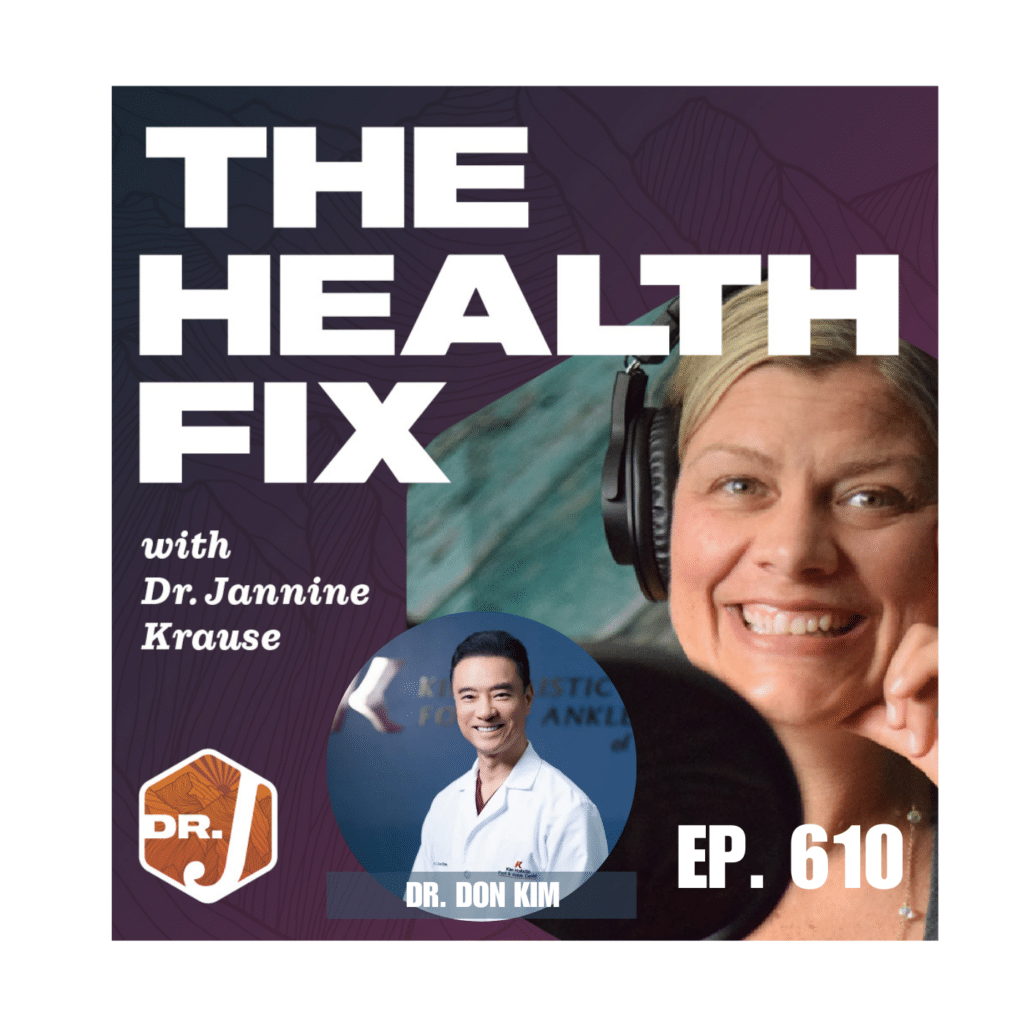
In this episode of The Health Fix Podcast, Dr. Jannine Krause sits down with Dr. S. Don Kim, podiatrist and naturopathic physician with over 30 years of experience, to break down why foot pain becomes more common as we age and what you can do about it naturally.
From hormonal shifts to changes in connective tissue and biomechanics, your feet go through a lot in midlife. Dr. Kim explains how your foot type (flat feet vs. high arches) impacts everything from posture to joint pain and why ignoring your feet can accelerate aging in the entire body.
You’ll also learn about his “Walking Cure” program, designed to gently rebuild strength, improve circulation, and reduce pain without aggressive exercise.
Plus, we explore cutting-edge therapies like PRP, hyperbaric oxygen, and laser treatments that can help regenerate tissue and support long-term healing.
If you want to stay active, mobile, and pain-free well into your 40s, 50s, and beyond this episode will give you a whole new way to think about your health from the ground up.
Dr. Krause’s Protocols
Instructions Included
Traveling soon? Looking to detox or reset your gut? Try one of Dr. Krause’s Fullscript plans.




What You’ll Learn in This Episode
- Why foot health is foundational to total body wellness
- How to identify your foot type (and why it matters)
- The biomechanics behind flat feet and high arches
- Root causes of heel pain and plantar fasciitis
- Holistic and regenerative approaches to healing
- How the “Walking Cure” can improve mobility and longevity
- Innovative therapies like PRP, hyperbaric oxygen, and laser treatments
- The connection between chronic disease and foot dysfunction
Timestamps
00:00 – Introduction to Dr. Don Kim
02:30 – Why foot health impacts your entire body
06:15 – Understanding foot types: flat feet vs high arches
12:40 – The real causes of heel pain
18:20 – Dr. Kim’s “Walking Cure” explained
25:10 – Regenerative treatments beyond surgery
31:45 – PRP, hyperbaric oxygen & laser therapy
38:20 – Neuropathy, diabetes & foot health connection
44:00 – Practical tips to start healing your feet today
About Dr. Don Kim
Dr. S. Don Kim is a podiatrist and naturopathic physician with over three decades of experience. As Medical Director of Kim Foot & Ankle Centers since 1991, he has developed deep expertise in heel pain and mobility restoration. He is also the founder of K Wellness Center, where he integrates holistic therapies to address chronic conditions such as diabetes, neuropathy, and fatigue.
Connect with Dr. Jannine Krause
Website: https://doctorjkrausend.com/
Our Partners




Podcast Transcript
Jannine Krause (00:01.1)
Dr. Don Kim, welcome to the health fix podcast.
Don (00:04.432)
Thank you for having me. Wonderful to be here.
Jannine Krause (00:07.426)
Well, feet are, I would say I have a foot fetish of sorts. I grew up with small feet. I still have a four and a half size foot. So finding shoes has always been a little bit of a trick for me. And I’ve lived in a land between kid shoes and adult shoes. And depending on price, sometimes I always went towards the kid shoes, which I know wasn’t the best route for me. So I’m super curious because I love feet. I work on feet as an acupuncturist. People think I’m weird.
What is it about feet? What brought you to feet? What drew you to the feet?
Don (00:40.058)
Okay, well, I was looking to be a surgeon. I wanted to do surgery and I always was interested in fixing things and whatnot. in my college years, my roommate came to ran into my dorm and said, Hey, did you know that there’s something called being a foot doctor? I said, really? What is that all about? So he was telling me, so I went to this job. It was a job fair at school. And then I said, okay, well, I’m going to go visit some foot doctors locally. So I went to visit three foot doctors and they absolutely loved
what they were doing.
And they were just phenomenal. were just so happy. I’ve never seen doctors because prior to that experience, I went back home, which is Guam. I worked at a hospital assisting doctors in the OR. And I happened to be working with a urologist. And unfortunately, poor guy, he was divorced and he just didn’t have time. And he was a pretty miserable guy. And then he said, you could do surgery, but don’t do urology because you’d be on call all the time and you’d be having terrible family life.
And so I was a little bit disarrayed. You know I was going like, should I be a surgeon or not? And all that. And then when this opportunity came to learn about podiatry and I said, my god this was just amazing. Because these three doctors that I went to visit they just absolutely, absolutely loved being a podiatrist. Not only that, they said if they have to do it again, they’ll do it again. So I said, okay well this is kind of what I really wanted to do. So I don’t have a foot fetish or anything but over the years I got to like treating feet but I don’t necessarily have liked the feet per se.
Jannine Krause (02:11.374)
my goodness, you know, I figure it’s not a prerequisite, but something in life that you mentioned that I think for a lot of people, they’re holistic health and that’s how you’re working with the feet, that a lot of people, know, what they’re called to in life, what their purpose in life really matters, and I think it has a big impact on our overall health. And I would say that, you know, I’m sure you guys are also telling folks as the holistic part of working with the feet, you know, it’s your foundation, is your foundation solid?
Don (02:11.662)
you
Don (02:39.036)
Exactly, exactly. Well, that’s that’s where we start. I usually tell them your feet are like tires of your car. You’re to have a beautiful body. You can have a beautiful engine, is your which is your heart. But if you don’t have flat tires, you’re not going anywhere, basically.
Jannine Krause (02:52.716)
Yeah, you know, and interesting you mentioned flat tires because of course I’m going to weave it over to flat feet and all the different feet things that are going on. And I’ll probably weave in a little bit of my family history and some of my weird things with my feet. But I think for a lot of people, you know, especially active folks.
Don (02:58.396)
You
Jannine Krause (03:10.924)
they find that when they’re younger, the flat feet don’t really make as much of a difference for most people. But then as we get older, it’s like we need to regenerate how our feet work. And of course you’ve got a program which we’ll talk about. But what is it about flat feet? And we’ll get over to the other side of feet, because that’s another story. But what is it about flat feet that degrades over time? How do we end up having trouble? And what are we regenerating when it comes to flat feet?
Don (03:36.604)
Well.
We don’t particularly regenerate flat feet. I usually regenerate the chronic pain issues. But flat feet are functional. This deformity, a lot of it is genetic obviously. If you have flat feet in your family, you most likely will have flat feet. So when that happens, one of the main arch area, there’s a little joint on the arch called the tail and navicular joint, happens to be one of the three ball and socket joints. So if you look at the whole body as a holistic podiatrist, I look at the whole body and your shoulder and then your hips.
And then this little joint on the arch called telenovelular joint are ball and socket joint. So I have a 363 degree motion. It’s really flexible, really good. But that’s where all the problem comes. Your shoulder problems and your hip problems and then your foot problem comes because this is very unstable. So you’re kind born with a little bit flexible feet and then over time as you get older, like you said, when you’re younger, you don’t weigh that much. But as you get older, you have more weight on it. So it started collapsing more.
when that happens that joint unlocks the entire 26 bones of the whole foot. That one joint. And because of that it gets flatter and then all the problems happen. When it gets flatter it gets wider. You get the bunions and then you got tailors bunion. You got the hammer toes. You got all of that happening because your feet are very flexible. So your foot has to do two things. When you first hit the ground it has to flex to absorb the shock and then has to lock up and then you can propose forward but you just
unlocked and you’re not able to tighten up because it’s too flexible so you can’t propel so you’re tired standing too long you cannot walk any distance and it becomes even more problem as you get older especially if you’re doing sports you’re walking a lot you want to exercise all those become a problem because it’s too flexible of a feet and then there’s a lot of misinformation out there about shoes right and I tell people I said well should I wear this shoes that shoes
Don (05:36.111)
Okay, it really depends on your foot type. And just like anybody else, we have different personality, we have different foot types. We have a flexible flat feet type, which is a lot of people that I see because they’re common problem.
Jannine Krause (05:47.747)
Yeah.
Don (05:48.157)
A lot of people don’t know about it is that you have a very high arch, the opposite end of the spectrum, which is high arch and you’re walking on the outside of the foot. That creates knee pain, hip pain, back pain, all of that as well as the flat feet. That’s just as bad as being flat is having really high arch, which happens to be a very rigid foot, which is a very stable and strong foot, but it’s just too rigid where it doesn’t absorb the shock too well. So they get lot of plantar fasciitis, got heel pain, they got tendonitis. A lot of those things come
because your body just cannot handle too much pounding every step they take especially if they happen to be you know exercising walking or even running then you’re then you’re putting about double or triple amount of pressure per step when that happens that too much you know lack of absorption makes that whole thing too stiff and all the tendons and muscles and everything else suffer from from that disability of having you know too rigid of a foot so either way depends on your foot type you have to first figure out
what kind of foot type you have and then you can really figure out what shoes are best for you. You can’t just say, I like those, you know, no insult, nothing on it. Well those are great shoes to strengthen your feet but if you have a weak feet to begin with then you’re gonna be suffering. So my answer is depends.
Jannine Krause (07:05.878)
Yeah, you you just brought about so many different things now that my mind didn’t think about. Like ball and socket joint of the tail and ovaricular, right? You know, I have long since forgotten that. It’s been almost 20 years since I took anatomy and physiology and I’m like, wait a minute, that’s right. That’s right. And I think a lot of people aren’t thinking about that. And then when you go to the feet, so what you mentioned because…
Don (07:11.183)
You
Jannine Krause (07:30.058)
anybody out there now can be an Instagram or whatnot influencer, right? And so they’re like, the best shoes are the zero shoes, you know, and they’re in it, like you said, be strong. Now, so how how do you go about telling someone what kind of foot they have? Because there’s kind of the in between between. Yes, you walk on the side of your your foot really high arches, which I am going to say that is me. And then my husband’s feet, which are like he’s almost like
Don (07:56.272)
The other way. The other side. Yeah. Yeah. Right.
Jannine Krause (07:57.166)
Like he’s almost walking on the inside of his ankle, right? So how do people figure out the in between, between those? What do you do? How do you do that?
Don (08:04.475)
The simplest way is to put some water at the bottom of the foot and have a white paper and then put like an imprint on it. If you got the whole foot connected, then you’re flat footed. But if you got the ball of the foot and the heel separated, then you got high arch. Okay, that’s how you do it. And everybody in between, right? So, more smaller your ball.
And then the heel area, higher your arches, right? And then I assume, almost with 100 % certainty, you’re walking on the outside of the foot.
Jannine Krause (08:31.083)
Okay.
Jannine Krause (08:36.672)
Okay.
Don (08:36.699)
And when that happens, you’re literally dancing while you’re walking. So you’re doing one of these numbers. So that creates a lot of hip pain and back pain because it’s too much side to side motion. You’re just trying to go forward, but you’re going side to side a lot because there’s a lot of movement going on this way. Flat foot on the other hand, you’re flopping this way. So a lot of people, first thing they do is, you know Charlie Chaplin? He walked like this, right, Charlie? Because he was flat footed.
Jannine Krause (08:58.924)
Yes. Yes.
Don (09:03.067)
Because when you flat footed and try to walk this way, it’s really painful. So to avoid that, they walk this way, so you’re not really walking, you’re just kind of waddling, you see? And that’s how I usually tell it. have a, if I walk like that, they have flat feet right away, right? And then if they have a lot of swaying motion, okay, then usually have a high arch foot. But I can tell by having somebody stand there and looking from behind, you’re looking at the heel. When you go like this, that means you got high arch. When you go like this, that means you got flat feet.
Jannine Krause (09:32.724)
Okay, okay. And so for those of you who are listening, we’re gonna have him explain what he just did. For those of on YouTube, you just saw it. So with standing behind someone with your fingers, will you explain kind of how if someone was gonna imagine what’s going on?
Don (09:48.484)
Yeah, so basically you have somebody stand straight. You can actually draw a little line on the heel. That’s what I usually do. Then it’s not going to fake your eye, right? Because sometimes you just can’t see too well. Then you hold the heel this way and bisect it, meaning put a couple of dots on there. Then you can tell where this line goes. If it goes this way, that means you have high arch and you’re walking on the outside. If it goes this way…
Jannine Krause (09:54.592)
huh.
Don (10:14.779)
then I’m talking about the right foot, say. If you go this way, that means you’re flat-footed. But usually you can tell on the side, when you look from the side, you don’t see a whole lot of arch there, then obviously you got collapsing or flappy. And then obviously if you got really big arch there, then you know they’re usually walking on the outside of the foot.
Jannine Krause (10:31.832)
Gotcha, gotcha. Just for fun, do you ever just sit and watch people walk back and forth when you’re waiting for folks? Just curious if I’m the only one that does that.
Don (10:42.427)
all the time. I can’t help it. And then I start predicting what kind of problem they have because a lot of people are limping right? Then I go, that the heel pain or is there an Achilles tendon problem? Is that ball of the foot? I can usually tell.
Jannine Krause (10:45.004)
Isn’t it fun?
Don (10:58.681)
I can usually tell. it depends how they compensate. I can usually tell what problem they have. I want to just say that I wanted to like tell them something. I said, well, if they’re really severely like limping, and I said, well, I know a good food doctor. If you live over there, go over there or, you know, come to see me or, know, whatever. Right. Because that’s a big problem. Another as a holistic practitioner. Another thing that I do is what I’m in the restaurant. My wife hates that she keeps. Well, why are you looking at them?
Well, I want to see what they’re eating. want to see. Well, number one problem, a lot of people, as you know, I don’t want to get to that. We’re talking feet today, but just on that because I’m watching these people eat and they drink a lot of water or fluid while they’re eating. No exception. All the overweight people, they drink a lot of fluid. They keep wanting refills on their water or tea or whatever drinking because I can predict 100 percent certainty they’re drinking a lot of water.
Jannine Krause (11:38.126)
you
Don (11:52.93)
where you eat because that’s one of the main things they do. Number one, they’re eating too fast. On top of that, they want to wash it down. But when they do that, they dilute your digestive enzymes so that it doesn’t break down all the food very well. So they tend to gain weight. And they’re eating too fast, too. anyway, just because you’re talking about watching people, right? Those are two things that I do. I watch people walk and then I watch people eat, what they’re eating, what they’re drinking. That just comes with a territory, I guess.
Jannine Krause (12:21.238)
I, you know, you’re not alone. You’re not alone. I do it too. I do it too. man, it’s so interesting. I mean, it is interesting because so much of our habits, you know, can be very telltale. And I tell my patients, if I had a camera and I could follow you around for 24 hours, I could learn a lot that you probably don’t want me to necessarily know, but I could call you out on a lot of things. And that’s…
Don (12:22.283)
You too,
Don (12:44.347)
Yeah, know what I do is sometimes I kick the patient out and I talk to their spouses.
Because they tell me everything because they, you know, unfortunately, a lot of my patients, they lie about what they eat or what they do or, you know, are they staying off their feet as instructed? They don’t do that, right? And then then then then I realize they’re not getting better. There’s something that they’re doing that’s really not progressing our treatment plan here. Right. So I said, well, could we could you go to the bathroom for a second? I had to talk to your, you know, your husband or wife and especially the wife. When the wives come, obviously they have a lot
to say right. They’re not happy about a lot of things but especially they want them better right they want them back to work they want them making money you know supporting the family right so so they’re they’re they want to really tell me everything right so that’s one way I get all of their information.
Jannine Krause (13:24.61)
Uh-huh.
Jannine Krause (13:39.958)
my gosh, it’s so true though. You’re so right. Like that is the secret. That is the secret. the spouse. Or sometimes the kids will call out the parents too. That’s even a fun one. Yeah.
Don (13:47.196)
Oh yeah, yeah, kids do, yeah. But kids don’t remember the details. Kids basically know, they tell the truth, you know. They even say it like right away. But if I really want to know the nitty-gritty of what they’re doing or what they’re not doing, I mean, that’s like the, you know, I don’t need to take history, okay? They just tell me everything.
Jannine Krause (14:05.482)
it. I love it. So true. So when we’re looking at the feed, I think a lot of people don’t realize, you know, because unfortunately, medicine, we’ve compartmentalized everything, and and we kind of treat still to this day, even though everyone knows better.
but we still compartmentalize. And this is one of my biggest beefs that I have with the podiatry industry, because we’ll bring someone in and they’ll be like working just on the foot. And obviously you’ve already talked today about looking at the whole body and you have your regeneration program. Let’s talk about like how do you approach, you you talked about what you’re going to do for an exam. How do you move forward in your approach with, with regenerating the feet? Because I don’t think a lot of people, I think a lot of people think regeneration of the feet might mean
surgery, you know, or maybe we’re doing injections because I know you do PRP and some of the other different things. So give us a little more insight because I think a lot of people are like, hmm, okay, foot regeneration. What are we doing here? Like what other fun, what other fun things are you doing?
Don (14:51.929)
No.
Don (15:02.755)
No.
Yeah.
So over the years I realized that a lot of my patients weren’t getting better from all the things that we were doing allopathically. Obviously I was trained as a foot doctor so that’s what I’ve been doing and about 30 years ago I went into a problem because I started doing lot of surgeries and I realized that a lot of my patients just weren’t getting better. They were still limping after months of coming to see me and then their bones wouldn’t heal and the scars were thick and they just weren’t getting better so I got into a depression going hey I’m a horrible foot surgeon.
I need to quit. I got into total depression because I inherited a pretty large practice. So I got busy with surgery right away in the early career of my…
training. I mean, I thought I was pretty well trained, but apparently I wasn’t because I had so many complications. So one day I pulled all the 50 charts around, you know, they’ve been coming for a while. So these sticks or charts were really thick. So I was literally buried under this chart, mountain of charts. And I started looking through all the charts and trying to figure out what did I do wrong? All these people. And then several hours later, said, Hallelujah. I started like so happy and I go like, it’s not all my fault. I can say there are times that
Don (16:15.121)
I didn’t do the surgery right and they didn’t hear whatever that I didn’t do it correctly. But majority of the time I operated on sick patients.
They were hypertensive. They were diabetic patients. They’re cancer patients. They’re overweight patients. They’re multiple medicated patients. When I worked on these patients, they never got better. So I was so happy that I went right back into depression because I’ve been doing all the things that I learned how to do. I’ve been doing therapy. I’ve been doing cortisone shots. And I’m doing all the things they’ve been telling me how to do, but I still weren’t getting them better. So what do I do? So that’s when I started researching. I started reading different medicine of the whole world.
You know Ayurvedic medicine and Chinese medicine into Korea medicine into Greek medicine and I studied physiology I studied everything I can get a hold of I started finding answers. How can I get these patients healthier? So that when I do surgery I get really good outcome and I look really good, right? So that became my sole purpose of doing that and I have years and years of studying and I wrote my first book about 16 years ago like 12 years to write the first book and
Jannine Krause (17:14.571)
Thank
Don (17:26.109)
and I published it and I started teaching it and I, you know, having seminars and people, a lot of people came and said, well, you’re a foot doctor, why are you talking about health, right? So I said, okay, well, you’re right though. I’m a foot doctor after all, right? I know, you know, other things now, but I’m still a foot doctor. So I went back to school, to the natural medicine school. I became a natural path. And then I started really having some more things to say about how to really get people healthier. So when I created this program,
I put together how I get these people healthier. So a lot of people come to me. So let’s say, for example, they have really severe arthritis of the ankle. This gentleman came in, he fell from the roof, so he broke his ankle, broke his heel bone. So he had multiple, you know, like staples on him and he broke his ankle with a motorcycle accident. his ankle had like 11 pins and the plates and then he had his ankle joints left. that would have arthritis developed so he couldn’t even walk. So I said he wanted he’s retired. So he wanted to do a lot of things around the house.
I said he came to me and said well, can you help me? I’ve been to three four doctors and they said I need to they need to fuse it or put an implant on there but I don’t want any more surgery because you know, I have already too many surgeries this but I’ve been suffering with this for over 30 years now. Can you do something? I said, okay. Well first I need to get you healthier. You’re a little bit overweight
Jannine Krause (18:43.202)
Mm-hmm.
Don (18:44.812)
you’re taking these medications, you’re just taking cholesterol medication, blood pressure medicine, you know, the people that most people take. So I need to help you kind of calm everything down, like information and all of those. So I created a program, like a diet program. I obviously haven’t read my book. I’ve created some videos for him to watch. And then I slowly detoxing him. We use homeopathic detox and get rid of all the toxins. And then I had my health coach that I trained. She teaches them how to do all this. So I won’t even do any of my injections until they’re ready to accept.
my treatment because you’re not quite ready because it’s not it’s different from Cortisone Orange or even surgery that your body just doesn’t have a lot to do with it. Obviously surgery requires a lot of healing power but you know they just do it without all of that and hopefully they’ll get better but in the meantime I get them well first and they ask me so when are you gonna when are you gonna start your shots and I said well hold off a second
You’re not ready. You’re not ready. And some people don’t. They get really mad. I want the shots right away. want whatever you’re to do, do it right away. No, we need to get you well first. So I created this, I call it 9 Secrets membership program. It’s a membership program. I get them, put them on the supplements. I do a detox, homeopathic detox. And by the way, when we do this, they’re losing 20 pounds a month.
all healthfully. It’s an amazing homeopathic stuff that I’ve been using for a long time. So they do that and I put them on a hyperbaric oxygen treatment. Why? Especially not everybody, but if I feel that their injury has been there for long time and it’s like chronic scar tissue issue where oxygen cannot get to the area, as you know, without oxygen nothing heals, right? So I give them extra oxygen to the area. I put them in an oxygen tank with a red light therapy, which also increases circulation to the microcirculation to the
Jannine Krause (20:22.573)
Right.
Don (20:29.754)
area. And then I do that IV treatment also. And what that does is that we give micronutrients. We give calcium, magnesium, myoscoctet, which has all this, you minerals and then glutathione to detox their liver and all these other organs. And then after doing that for a month or two, then they’re finally ready to receive my injection. And and that’s what I do. So so I kind of prepare them first, which is what I realized over the years. If I don’t get them well and I
do things, then they’re going to get better. So that’s kind of what I do.
Jannine Krause (21:03.906)
I mean, 100%. I I respect your honesty. I I definitely came to a place in my practice too, where was like, people aren’t getting better. What am I doing wrong? Right? What is the problem? And it’s like trying to throw even natural treatments at folks if they don’t have the foundations down. It’s like you’re just wasting time.
Jannine Krause (21:29.417)
did we lose the internet?
Jannine Krause (21:34.414)
Shoot.
Don (21:54.843)
you