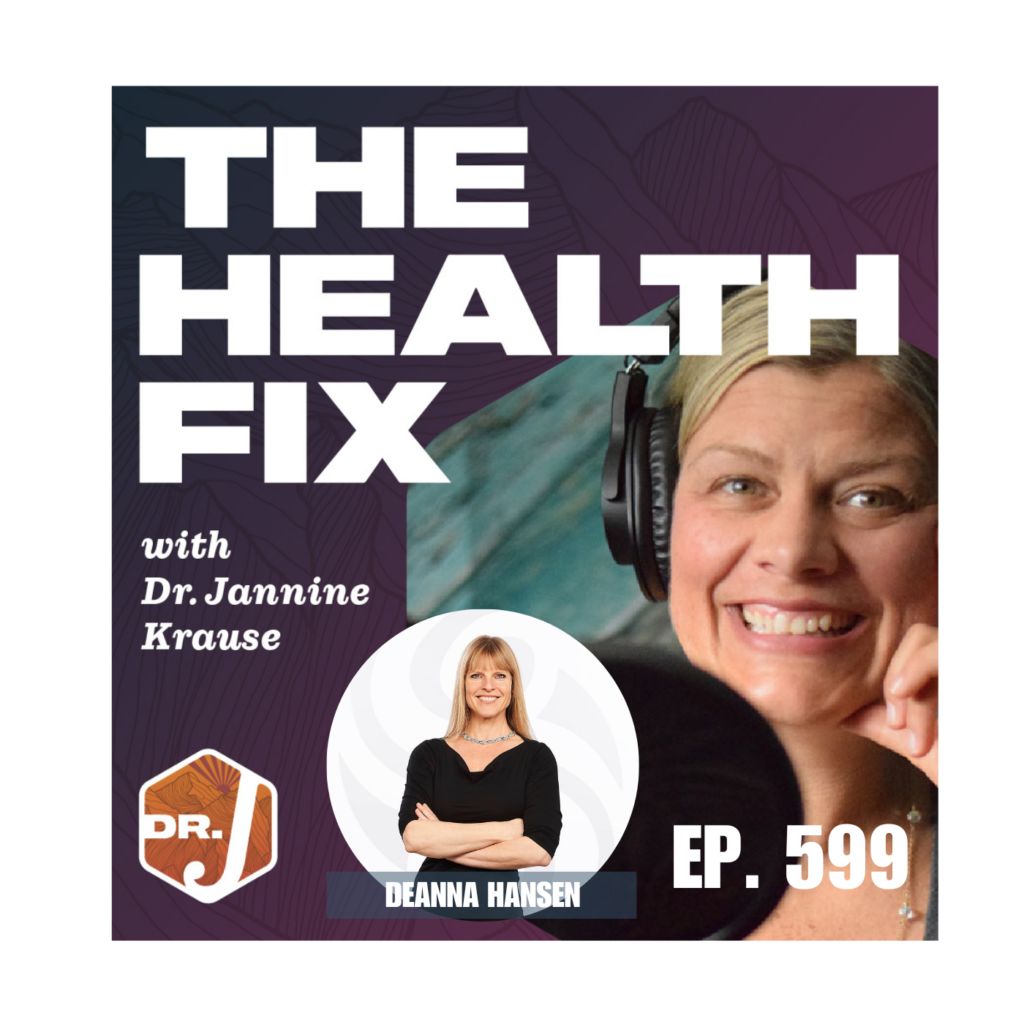
In this episode of the Health Fix Podcast, Dr. Jannine Krause interviews Deanna Hansen, fascia therapy expert and creator of a global fascia decompression method. Together, they explore how fascia acts as the body’s communication system and why compression, not damage, is often the true driver behind chronic pain, stiffness, and accelerated aging.
Deanna shares her personal journey from athletic therapy to fascia-focused healing and explains how breathing, alignment, and decompression can dramatically improve pain, mobility, posture, and overall well-being.
This episode is a must-listen for anyone dealing with chronic pain, poor posture, restricted breathing, or age-related body changes and for practitioners looking to understand the body beyond muscles and joints.
Dr. Krause’s Protocols
Instructions Included
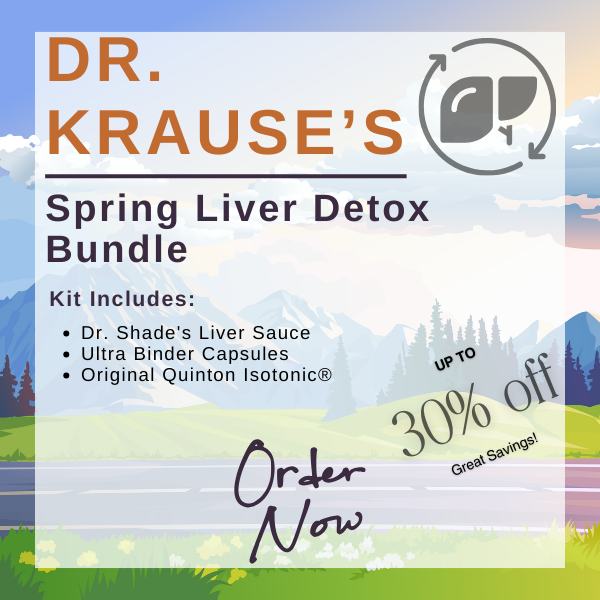
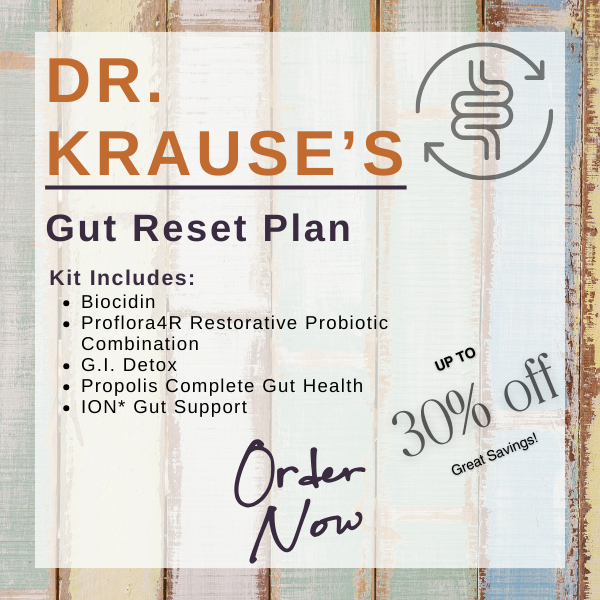
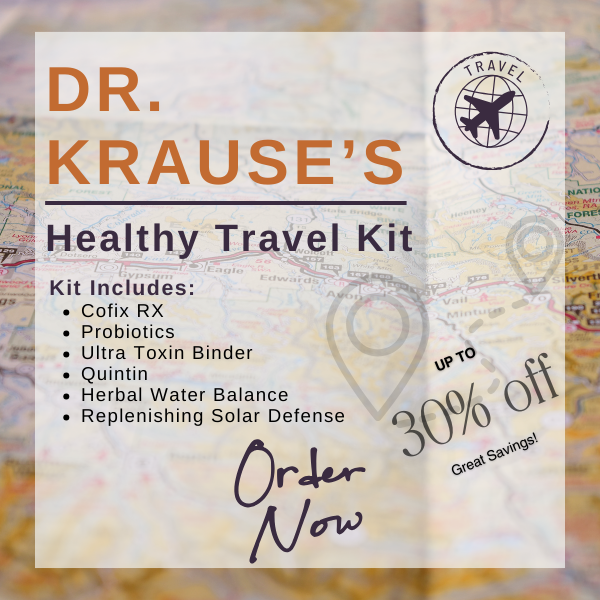
Traveling soon? Looking to detox or reset your gut? Try one of Dr. Krause’s Fullscript plans.

🧠 What You’ll Learn in This Episode
- What fascia is and why it plays a central role in chronic pain
- How compression and tissue “ballooning” create dysfunction in the body
- Why pain is a signal, not something to fear or suppress
- The role of the diaphragm and proper breathing in healing and alignment
- Deanna Hansen’s three pillars of fascia decompression
- How posture and alignment impact long-term health and aging
- Simple self-care techniques to support fascia health at home
- How tools like the Block Buddy can enhance fascia therapy
- Why fascia therapy can improve issues like cellulite, stiffness, and mobility loss
🔑 Key Takeaways
✔ Fascia is the body’s primary communication network
✔ Chronic pain is often caused by compression, not injury
✔ Breathing mechanics directly influence fascia health
✔ Proper alignment helps prevent pain and degeneration
✔ Consistent self-care can create lasting change in how your body feels and moves
🎯 Resources From The Show:
- Deanna Hansen’s Website – Block Therapy
- Experience what it is like to decompress your fascia with only your body weight and towel. 9 Part Full Body Fascia Series with Deanna
👍 If this episode helped you, like, subscribe, and share it with someone who needs to hear this.
🎙️ New Health Fix Podcast episodes drop weekly—stay tuned for more insights on healing from the inside out.
Our Partners




Podcast Transcript
Chapters
00:00 Introduction to Fascia and Its Importance
02:57 Deanna’s Journey: From Athletic Therapist to Fascia Expert
05:52 Understanding Fascia: Aging and Its Effects
08:42 The Three Pillars of Fascia Decompression
11:49 Breathing: The Key to Health and Well-being
14:53 The Role of Tools in Fascia Therapy
17:50 Pain, Fear, and the Body’s Signals
20:56 Self-Care Techniques for Everyday Life
24:01 The Importance of Feet and Proper Alignment
26:47 Addressing Common Issues: Cellulite and Compression
29:59 Conclusion and Resources for Further Learning
Jannine Krause (00:01.55)
Deanna Hansen, welcome to the Health Fix Podcast.
Deanna Hansen (00:04.77)
Thank you so much, Janine. It’s a pleasure to be here.
Jannine Krause (00:07.794)
my goodness. I love talking about tissues of all kinds in the body, but particularly the fascia tissue, because it’s just so much part of my world as an acupuncturist, but I see it being so much the link to what a lot of folks need to get out of chronic pain. But also, as you talk about so much this collapsing in of our ribcages and how that affects our organs and so many things.
So of course, I like to start these podcasts off with, know, like when was the first time you realized that fascia could be constricted? And there might be an issue here linking a lot of folks together with pain and other things.
Deanna Hansen (00:52.046)
Great question and I’m gonna take us right back to my story when this whole work really began for me. So I’m 56 years old now and when I was 30 years old I had gone through some major life changes that resulted in pretty severe anxiety attacks. Prior to that I had trained to become an athletic therapist here in Canada which is like physiotherapy but we’re focused on working with elite athletes. And I was doing the work that I was trained. I was working out like crazy. I was dieting. I was doing the whole thing but the harder that I was working
the more compressed, ballooned, and toxic my body was becoming. So on top of the physical things that weren’t moving in the right direction, there was also this deep sense of failure. Like, I’m doing the stuff. Like, why are the rules of weight loss not applying to me? So it made some changes at the age of 30.
One of those was actually starting yoga, which was a fascinating moment in time for me as well because the first time I ever had a class, I had a great instructor that every 30, 45 seconds, she would be reminding us to breathe. And every time she would remind us, I was aware I’m holding my breath. So here I am in this anxiety attack and I actually was terrified. I thought I was gonna die because I was so locked in fear. I couldn’t find my breath. So for some reason, I intuitively dove my hand into my abdomen. Now, I never touched this area.
This where I carried my 50 extra pounds of weight at the time. I was ashamed of it. I didn’t touch it, let alone let anyone else touch it. So now here I am diving into this tissue and the first thing I felt was pain, but the pain brought me back to my body and I knew I was breathing so I was safe. And then I continued to explore in the tissue with my hands and it felt marbled with scar tissue, even though I hadn’t had any injury or surgery in that area. And suddenly I’m like, well, no wonder when I’m coming home from a run,
dripping wet with sweat, my belly would still feel cold. So the first evening I spent intuitively exploring 30 to 45 minutes. And what was really noteworthy was how calm I felt because I had a severe issue with anxiety. And so now I’m feeling this centeredness in my being. And…
Deanna Hansen (02:58.462)
What was so fascinating though was under my fingertips feeling this and then connecting to the fact that when I’m working on clients, I’m tapping into their scar tissue and I’m really good at breaking it up. But again, I never even thought of working in this area. So the second night after I did this exploration, when I stood up, I felt taller and I went and I looked at myself in the mirror and I started to cry because my belly was flatter than it had looked in years. So this became my daily practice. I would work on my patients all day, come home and work on my body. And within two weeks,
My chronic low back pain was going away. My neck pain was improving and overall I just felt hopeful and excited about life for the first time in I I mean probably since I was a child So I started flipping my patients on their backs I started working in their bodies in this similar way and within a couple of years people started saying like you need to be teaching this
And this is really where the connection to the fact that I’m working in fascia really awakened for me because I’m like, wow, like I don’t even really know what I’m doing. I’m just going with the flow with my hands. So I started paying attention to the pattern that my hands were taking. I started doing some research and it all started to tie together. And that was the awakening of me diving into this world of fascia. So that was about 2002. And since then it’s just been a continuing wonderful exploration of learning how to change my own personal
body, share those techniques with other therapists and then block therapy, the self-care version of that so people all over the world can do it.
Jannine Krause (04:27.912)
my gosh. You know, when I was reading through your book, your story really resonated with me and I think it resonates with a lot of, especially the fit folks who have like the belly and the bum, you know, and the hips. And when you feel them, and this is something I will have people do quite a bit, like feel the areas. Are they warm? Are they cold? And you know, I definitely have had that where like my whole body’s sweating except for my belly and my hips.
And of course, if you tie it back, right, you look and you go like, I have chronic low back pain, you know, I have this pain, I have that pain. But then there’s also that component, like you mentioned, of just being stuck.
Just being kind of closing in on yourself and you mentioned in your book something fascinating I wanted folks to kind of think about this is this is the the movie it I believe and and the characters where the characters are younger You know, we’re free open we danced we played outside until the you know Sun went down and now it’s more like everybody’s this and on their phones and playing video games and how the characters had changed when they did the remake and I
Deanna Hansen (05:20.056)
Yeah.
Jannine Krause (05:38.118)
I because I work on body work, you know in my practice I’m seeing it too. So many of the population and even us folks who are getting older are all like wound down on ourselves.
And so you talk about unwinding and you talk about a couple different things there and one of the biggies and this is something that as I was reading your book in the last couple weeks I of course I think this happens and it’s probably happened to you before too. You tend to see people that are dealing with the things that you’re reading on or researching on and I’ve seen a lot of functional scoliosis in the last week and different types of curvatures that aren’t you know weren’t there when they were born.
Deanna Hansen (05:56.44)
Crazy.
Jannine Krause (06:23.532)
and all of a sudden developed. So I would love to talk a little bit about this unwinding, scoliosis, and kind of how it all plays out in, I would say aging since most of my podcast listeners are between 35 and 55 or older. Share with us some of this concept.
Deanna Hansen (06:41.442)
So I think this is a perfect time to talk about fashion.
itself and really what happens as we go through this aging process. So fascia is really the cell membrane of every cell interconnecting every cell. So it’s the communication system in the body. It has a number of components, but it’s primarily comprised of two proteins, collagen and elastin. When these proteins are in balance, it supports proper cell alignment. And the reason this is important is because we need space in and around the cell for ease of flow of nutrients in.
well as the removal of toxins and debris away. And if that’s the case that we have this perfect balance of these proteins and we’re perfectly aligned, we should be able to go through time without accumulating pain, aging or dis-ease in the body. However, that’s not the case because we’re constantly being pulled down by gravity. We’re dominant on one side. We have past traumas, whether physical, emotional, mental, spiritual traumas that add up over the course of our lifetime. How do we use our body all day long?
Are we at a computer crunched forward? Are we doing manual labor? Do we play sports? Do we play instruments? All of these things add up to create the patterning that we currently have in our body. And so what happens to this balance of proteins? The collagen is that structural piece. The elastin allows us for mobility.
So again, when in balance, have a great body that can do whatever we want it to do. But as we go through time and we start tipping off balance, it’s the collagen proteins that starts to migrate to areas of need. So for example, if I’m always sitting at a computer slouched over, my body’s designed to be upright. And there’s this unconscious migration of the collagen to create false walls or false floors like scaffolding on a building. And in a moment of time, that’s a benefit.
Deanna Hansen (08:34.384)
chronic patterning then these adhesions which are those collagen fibers migrating they will grip to everything including bone with a force of up to 2,000 pounds per square inch.
That’s an incredible force holding us down out of alignment. And as they build up and become denser and denser, they block blood and oxygen flow to cells and they also keep the area stagnant. So we’re ripe for disease. And that holding pattern pulling us off balance is causing parts of the body to overwork when that’s not their job. We have proper postural foundations that if we maintained in our body, we would have that proper cell alignment. But again, we’re not really trained on how to use this thing from the
Jannine Krause (08:46.296)
Wow.
Deanna Hansen (09:15.984)
So by the time we awaken, we’re not conscious breathers, we’re not breathing with the most important muscle, the diaphragm. We’ve patterned into grooves that become deeper over time and that’s really what aging is. It’s falling, it’s compression.
Jannine Krause (09:16.889)
race.
Deanna Hansen (09:33.795)
fascia compression. So my work is all about fascia decompression, putting the space back into the body that time has taken away and there’s three pillars. The first one is getting to those areas of density where those fibers, those collagen proteins have bound and working through them and we do that with our tools. So we have a block baby and a block buddy. These are the two main tools and the reason that they’re made of wood and of this specific size
and shape is because when we’re working in the body and we lie on the tool we’re teaching you how to navigate melting through the layers of fascia so we can get to those deeper adhesions all the way to the bone and bone and wood are similar in density. So if we’re using something porous like a fascia roller and we’re rolling on the surface layers that’s all we’re doing is we’re really impacting those surface layers but we are rooted at the bone.
and that’s where we want to get to. So we need something similar in density to bone for that. Also, we don’t move on the surface. We stay in position and then we teach you to very slowly shear using your breath as your guide, which is our second pillar.
teaching people proper diaphragmatic breathing. And I’m going to go into the diaphragm a little further once I explain the three pillars. So when we open up space through the first pillar, through the creating space, we then direct blood and oxygen into that space. And those cells that have been starving, they take that oxygen, they become lighter and integrate. And then the third pillar is maintaining that space, understanding proper postural foundations so that we can use the body in a balanced and symmetrical way. We should have about 60 % of our body weight on our heels, but the
average person has well over 80 % on the balls of their feet as they move forward and twist out of alignment. So the first pillar, again we stay there’s only two rules in block therapy. The first one
Deanna Hansen (11:27.456)
we stay in position for a minimum of three minutes because we can’t rush through melting adhesions. The second pillar is again inflating the space by directing the blood and oxygen there. So here’s where it’s a great time to talk about the significance of the diaphragm and why it’s so important to make this muscle conscious. So the diaphragm is the foundation of the rib cage and when we’re inhaling
it moves down in the body. When we exhale, lifts. And if it’s working properly for us, we’re giving the organs, the heart and lungs a continual massage. This movement up and down adds energy to this space so that we can support proper digestion. We can keep the liver a proper temperature so we don’t have fatty liver disease, so that we can keep the pancreas functioning so we don’t end up with metabolic disorders and so on and so on. Now, the challenge with breathing is pain, fear and stress cause you
to reactively hold the breath. So like a deer who survives an attack will shake. So it’s moving the negative energy out of the body. But when we encounter stress, whatever it may be, any kind of trauma, we reactively hold.
And if we don’t release that, like the deer who survives, then we age from that perspective. So now I have what you could call a frozen diaphragm, like a frozen shoulder. I might have some mobility in my shoulder, but if I don’t have full range, it’s going into freeze mode. Same with our diaphragm. If this muscle is not working and we’re starting to collapse in on the rib cage and bind with that 2,000 pound per square inch, those adhesions in through here, now when I’m doing breath work,
Even if I’m consciously working my diaphragm, I’m only accessing what’s available.
Deanna Hansen (13:13.312)
So with this work, we want to create all of this muscle to be functional so that we can properly feed and clean all cells in the body. I mean, the diaphragm, again, it puts us into the parasympathetic nervous system, which is key for rest and digest, for healing. It also keeps your brain frequency in a relaxed mode. If we’re breathing through the muscles of the upper chest, like the majority of people, even when we’re not in a stressful situation, the brain is in a stressful frequency. So understanding how to breathe diaphragm
is really the key to long-term health. And we can feed the body up to 600 % more oxygen breathing this way because we are pulling the air more deeply into the lungs, which is where the majority of the alveoli, the oxygen receptor sites reside at the base, not up at the top. So if I’m a…
shallow mouth breather, I’m not bringing that air nice and deep to actually create that optimal absorption. They’ve also shown 84 % of weight loss comes through proper exhalation, which I was so thrilled to hear because it took me back to my 20s when I’m working out and suddenly it’s like, well no wonder I wasn’t breathing properly at all. So it didn’t matter how many calories I was burning or you know or eating because I was frozen in my body.
So those are those first two pillars. And then that third pillar, again, is understanding proper postural foundation. So even as you’re sitting here, just notice, where’s the pressure on your sit bones? Do you have pressure on one side more than the other? Like ultimately, we want to be balanced in our body and use it properly. And when we apply all of this work, we support the fascia, which basically supports every system in your body because, again, fascia innervates every single cell.
So whether it’s nerve fibers, blood vessels, muscles, tendons, ligaments, organs, bone, it’s all innervated by fascia.
Jannine Krause (15:06.21)
Wow. So of course that opens up a lot of different questions for me. One is what’s the material of wood? What kind of wood do you use in your blocks there?
Deanna Hansen (15:13.71)
great question. So these are made here in Winnipeg. I actually have a factory here. And Winnipeg is ripe with trees. We have these beautiful Dutch elm trees that are, you know, 100 years old, super tall, but Dutch elm disease has been rampant. So these trees are getting cut down, but the disease is in the bark. So we are using this material to repurpose the trees so that we can help people all over the world heal.
Jannine Krause (15:43.502)
That’s really cool. When you said Dutch Dome, I’m like, no, yeah, that’s the tree’s this. Yes, wow, okay. And I think a lot of people are using foam blocks, foam rollers, different things of that nature. And it does make sense that we would want to give some, for the compression type of therapy, we would want to have something that is not gonna have any give. Now, of course, at the same time, people are gonna be like, isn’t that gonna be painful?
Deanna Hansen (16:08.714)
And what a great question.
So the thing with this work is a couple of things actually. First of all, you’re in control. You’re doing this for yourself. So we teach you lying down. You can do it on a bed. We also teach chair classes if you struggle getting up and down from the floor. But because you’re the one in control, the second rule is your breath is your guide. As long as you’re breathing in a relaxed way, you’re feeding and healing your body. If anything hurts so much that it’s causing a stressed breath, that’s your body saying it’s too intense and then you can work in other directions.
about this. We’re not causing the body pain. What we’re doing is as we melt through the layers we are bringing the deeper pain up to your conscious awareness so that you can then address that and move through it. And pressure overrides pain. So once we start connecting into this process those pressure fibers are larger in diameter than the pain fibers. So with that conscious breath and the pressure
And it’s all done very slowly, very intentional. There’s nothing fast and aggressive. I always use the term persuasion versus force. That’s what this is really about, is persuading the body in a gentle but consistent way to melt through those adhesions. And the adhesions basically equal pain because the adhesions are what are blocking the flow of nutrients to the cell. So now your cell is just speaking. It’s giving you information. We’ve been trained to believe pain is a bad thing and to avoid it or mask it. But really we want to move into it.
and through it so we can move beyond the system and the patterning that’s creating the pain in the first place and we can transform our body to a new alignment and a new level of lightness and being.
Jannine Krause (17:48.044)
And you know, I think this is one of the things that’s hard to explain to folks because yes, we’ve been kind of brainwashed to think that pain is bad.
But at the same time, like you’re mentioning, and the cells are speaking, and this is kind of something that I would love for you to kind of dive into a little bit too, we talk about trauma stuck in the body. We talk about the cells being able to speak. We talk about the fascial tissue really, if it’s decreased in circulation. mean, Chinese medicine were taught that if there’s a decrease in circulation to any tissue, that tissue has the potential for disease, but it also has the potential to send warning signals over and over again, which…
Deanna Hansen (18:24.589)
Yeah.
Jannine Krause (18:25.73)
goes back to the pain concept there.
Deanna Hansen (18:29.738)
Yeah and then so when you are moving into that pain on purpose it is so incredibly empowering because as you meet it and then you exhale it out of the body as you melt that layer of adhesions and then you you’re taught to continue to move to those deeper levels and to become a pain seeker. Now you’re making friends with the bully.
You know, we’re caught in a pain fear cycle and pain is really not the problem. I mean, yes, if you have horrendous chronic pain, it’s debilitating, but it’s the fear of the pain that really drives people into negativity in their mind, into depression, anxiety, all of those things. Because if we don’t understand it, then it becomes the scary thing that can turn into…
something different than what it is, where if we can just meet it and we understand we now have a process to address it, now that pain fear cycle, the fear is taken out of the equation and pain is simply a signal like the baby crying.
And really that’s all it is, is your cell is just saying, hey, mom or dad, I’m squished, I’m hungry, I’m dehydrated, I’m exhausted, I need some love and attention, just like a baby would when they’re crying. when we can change our perspective on the signal, even anxiety, because I used to say I have anxiety. I I had it all the time. Now I don’t say I have anxiety. I say I’m feeling anxious because I know that if my cells are giving me that signal of anxiousness,
I need to stop, need to connect my breath, I need to do something for myself. And now I know the process of what to do. So I don’t like to label, and that’s why I don’t even like using the word disease. I like dis-ease. Disease sounds like a permanent thing. Dis-ease means…
Deanna Hansen (20:09.37)
We don’t have that ease of flow and all we need to do is create some shift and change in our breath and our patterning so that we can improve that optimal flow and then the body knows what it needs to do as long as we support the body’s needs.
Jannine Krause (20:24.516)
So of course one of the questions I’ll get, and this is something I’m sure you get as well, because you’re saying, we gotta go slow, we gotta take our time, and someone might be thinking, well, in the moment, how can I use the block therapy if I’m rushed? If I have to do something next? You know, like on the go kind of thing. So.
On average, how long do sessions take with the self therapy, but also like on the fly of something, like if you are starting to feel a little anxious, how long might it take on average to help someone to kind of come out of that feeling if you do a little work? Okay.
Deanna Hansen (21:01.592)
Three minutes, so.
The very first position we teach, no matter what area of the body is the focus, is the belly position. So we lie on the belly. We teach you how to move the breath in the belly into the tool. So that’s bringing your awareness to not being an upper chest breather, but a diaphragmatic breather. And as soon as you do that for three minutes, not only are you turning on the parasympathetic nervous system, so right away you’re feeling calmer, you’re also creating more space in this area because pressure over time
heat. So the adhesions that have locked me in this forward negative alignment, we start to get some energy here and then as we start to pump that space with breath, I lift, I lift, I lift, I lift. So even in three minutes people often feel a little lighter in the ribcage. They feel that sense of calm.
So that’s something that people can do every single day. You can use a rolled up towel. You can use a hardcover book. Depending on the amount of pressure and tension in your abdomen, you can even just lie on the floor and use the floor as the prop to breathe into that space. It’s really about training where the breath should be coming from. we have, mean, most of my classes in my membership are 30 minutes. If people can commit 30 minutes a day in three weeks, you’re going to see tremendous changes in your body.
Some people become so addicted to this, they’re like four to six hours a day. But it doesn’t take much. It’s the consistency. Consistency is key over the amount of time. So doing a 90 minute class once a week or 15 minutes a day, the 15 minutes a day, because it’s all about changing and creating habits. And what’s really exciting about this as well is as you go through this journey, you also learn other parts that you can apply to your life without having to take more time out. Even just simply sitting here.
Deanna Hansen (22:53.482)
I could be seated, crunched over, falling over to my left side. That’s going to create a lack of breath. It’s going to create more development of adhesions. My aorta is going to be stressed because now I’m crushing down on the heart and I’m creating this twist.
to the main artery, leaving the heart to supply the body. So simply being aware of alignment is another thing we can do. Anatomical position is palms facing forward. Everybody’s walking around with their palms facing the back of the body. We all have internal rotation of the arms and that in itself is driving the rib cage down. So being aware of some of these little things, where’s your tongue placement? How are your feet placed? We’re like a building. So we wanna have a proper solid foundation so we can support the
Jannine Krause (23:24.067)
Yeah.
Deanna Hansen (23:40.673)
those cells up the chain. As soon as we start tipping off balance and we’re unconscious of how we stand, then our foundation, it skews and then that creates a twisting and a tension up the chain. And the feet are outside of the breath, the feet are the most important area to focus on because they are the furthest from the breath. So with that 2,000 pound per square inch seal of those adhesions, they get most locked into the feet.
So even if I did have a frozen shoulder and I was getting treatments, every time I take a step, I’m going to be pulled back into the patterning that created that negative alignment for that joint, and I’m not going to really get to the root of the issue. So it’s understanding the cause sites to the issue, which is all part of the education that you gain when you dive into this work.
Jannine Krause (24:28.098)
love talking about the feet because they are such our foundation and like you had mentioned earlier, know, a lot of us are weight on the balls versus weight on the heels. And I see like a lot of women as we get older, we will have bunions showing up. We’ll have different things show up with the feet. Plantar fasciitis, all of those things. And of course it’s very common right now to be like, it’s just your estrogen, just take some estrogen, we’ll call it good. And then…
Sometimes people feel a little better, but it’s not the optimal, usually in most cases. How does this work for the feet? Tell us a little bit about how do you work on the feet? What’s your go-to?
Deanna Hansen (25:08.386)
Well, first of all, I’m gonna share here that you don’t need the tools to work on the feet. In fact, one of the things that I share with everybody, and if all you do is this and focus on that three minute breath, your life will change. So the toes are the eyes of the feet. And they’ve actually shown now the connection between longevity and toe strength. Because so many people, after the age of 70, they don’t have toes working very well, they’re balance falters, they fall, they break a hip, and then boom, now you’re, now you’re.
Jannine Krause (25:29.7)
Yeah.
Deanna Hansen (25:37.185)
changed your future, essentially. So what we want to do is we want to have toes that are active for balance, for walking, all of those things. So working between each toe, you can use a finger, you can use a pencil, you can even get a cord or a string and wrap it around if you have mobility issues. Three minutes between each toe to the point where you feel it.
And you want to focus on the exhale more than the inhale. So I always say exhale for a count of six, inhale for four, breathing in and out through the nose. You do that between every single toe. And now you create more of the toe because the adhesions over time, as we fall forward, those adhesions start to migrate between the toes. They create the twisting, they create the bunion, they create the hammer toes, all of that stuff. And then the toes aren’t active in our stance. So after you release off,
of them. If you simply stand and it’s great to do it in front of the mirror so you can see how your feet are aligned. You don’t want a foot to be externally rotated. You want them to be forward underneath your hip joint. So not a wide stance and slightly bent knees. And then if you grip the toes for 10 slow exhales, it’s like you’re pumping up the tires. We basically are walking around on flat tires.
and we want our toes to be, or our feet to be engaged and have that spring in the step. But without the toes, now you’ve got little clubs that you’re walking on and then tension gets created through the rest of the body to hold you up as opposed to using your toes to keep us properly aligned. So that’s a great thing anybody can do.
right now. And similarly the hands, they’re the next furthest from the engine and we can do the hands in less of the time because you can just, the webbing between the thumb and the index finger, you push and we want to bring the arms down to about belly button height so you’re not stressing with your shoulders. But you want to move in three minutes, same between the second and third, between the third and the fourth. So I’ll do this sometimes when I’m on a zoom meeting, like nobody has to see what I’m doing and yet
Deanna Hansen (27:43.111)
unbelievable the changes in your shoulders, in the alignment of your neck, in the tension in the jaw because this is going to release that patterning that we got pulled into by being unconscious of proper alignment of our upper body and it just it’s fascinating how quickly by doing some of these self-care techniques makes a difference in your life.
Jannine Krause (28:06.244)
Yeah, the acupuncture points between the fingers are traditionally for going up into the neck and to the head. you know, it’s awesome to see the connection. I think, you one of the biggest things for me and one of my roles that I want all my patients and clients to get is self-care tools. Because you can’t come in and see me all the time, you know, it’s, gotta have these things. So one of the things that happens as we get older is we shrink, right?
And maybe there’s compression fractures. I’m like well 2,000 pounds of torque on the body I’m like well that would make sense and and here’s a little personal story. I was goofing around at my friend’s Chiro clinic when I was in Washington last time and I realized I used to be 5’2 and a quarter I am now 5’1 and a half and I’m I’m not even 50 yet and I’m like my gosh
And so reading your book at that time with this, was like, I’m totally torqued down on myself.
Deanna Hansen (29:05.718)
And so here’s the thing, so now you have the diaphragm. When we exhale fully, it lifts. The exhale is the counter force to gravity because every action has an equal and opposite reaction. So gravity’s constantly pulling us down. The full conscious exhale lifts and balances that force.
but people aren’t connected to the exhale. So this muscle, this diaphragm becomes weak over time if we’re not exercising it consciously. And then the weight of the rib cage and everything above causes us to come crashing down into that core space. And then again, we get locked in with those adhesions and then our breath becomes less. So now maybe 20, 30 % of your body is getting properly fed with oxygen. And think of blowing up a balloon. When it’s fully blown up,
It’s round, it glows, it almost defies gravity. Take half the air out of the balloon, it’s wrinkled. We attract dirt and debris in the creases and it gets heavy and falls to the floor. So those are your cells without proper breath.
where if we can turn that breath back on and get through those adhesions that are blocking flow, now we can bring those cells that we’re ultimately slugging around and bring them back to life to integrate them. And this is where exercise comes in. It’s so important to recognize, you know, being in the gym and doing repetitive concentric contractions to create a dense muscle, that’s really pulling you out of alignment. And what you’re doing is you are asking whatever number of cells you have available to stretch
So maybe again, you’ve got 20 or 30 percent of those cells being fed and now you’re putting a force on them to expand and become stronger Where if you think about what is required for ATP production, it’s oxygen So when we can melt through those adhesions and get that breath into those cells now We are recruiting more of the cells for strength So again, like we’re I mean I was included like we’re designed to think we have to force the body to do what we want it to do we really need to
Deanna Hansen (31:05.392)
the body back to balance so that it can function optimally with the breath.
Jannine Krause (31:11.05)
sense? Makes sense. Now you’ve described the different layers and I think for a lot of folks they’re gonna be like how do I feel that? So how do you teach on feeling the different layers as you’re working through the fascia?
Deanna Hansen (31:25.098)
So density is really what we’re going after. We want tissue to be nice and soft. If we don’t have a contraction, we don’t want to feel hard and a calf is a perfect way to feel it, right? Like if you go down and you palpate your calf right now, it probably feels a little like concrete where it should be soft and malleable when it’s not contracted. So that’s the first thing is when we’re getting into areas of density, that’s the goal is we want to melt through those adhesions. And then as we start to melt and we start to shear,
It softens, we feel that tool sinking more deeply into the tissue. We’re getting increased range of motion. We’re getting connected to the pressure fibers so the pain starts to change. So it’s lovely and then each time you get up…
and you start moving. Like let’s say for example I’ve been working on my shoulder area. Now I’ve melted the adhesions that have been holding that shoulder in whatever alignment it’s in. So now I suddenly have that greater range of motion as that oxygen is getting into that space. I actually feel lighter and that’s something people say all the time is they feel lighter. They can lift the rib cage up. They can stand more easily on their heels. So many people share after they start this process and not very long after they’ve increased in their height. So I would
I would venture to say if you dove into this for three weeks in the full body program, you would increase your height in that period of time.
Jannine Krause (32:48.598)
Challenge accepted. So you guys heard it here. I am going to try it out because yes being short already My my grandmother was 411. I am NOT going for that I actually want a little taller and I think it’s one of the things that likely that’s why a lot of us get the belly and I wanted to kind of bring that back out because So many people are like I’m doing all the things I’m eating right my digestion is good Why is this belly still here? And this is a great example of why
Deanna Hansen (32:50.221)
Hahaha.
Deanna Hansen (32:59.746)
You
Deanna Hansen (33:17.228)
Yeah, and I mean it’s like you know, so say we’re after 40 years old or older or whatever age it starts to hit where you haven’t changed anything but now you’re getting that spare tire and we think we’re accumulating fat. It’s not fat. It’s compression and ballooning. It’s displaced fascia and now we don’t have this engine giving the energy to the organs so we’re not absorbing nutrients effectively. We’re not eliminating efficiently so then we start to get a backup of waste and then we start to create inflammation and we attract other things.
Parasites they create waste and then we continue to expand so I always say compression ballooning and the toxic nature of our body is really the issue as opposed to Fat when I was in university and exercise physiology I learned there’s only two times in our life when we increase the number of fat cells when we’re babies and at puberty Otherwise if our size is changing there’s other reasons for that and this is really what it comes down to This structure that we live in we don’t consider it to really be the key to life
term health. I live here in Winnipeg and I mean it can be a couple of weeks ago it was minus 47 degrees Celsius with the wind chill. I mean it was ridiculous. I could have all of the best most expensive equipment in my space but if my window breaks and I don’t have a way to repair it I will die.
because I will freeze to death. So our cell membranes, they’re the key to health because the body knows what to protect and how to keep them clean and properly fed. But if that cell membrane is not intact because we compress and we fall out of alignment, then the cell itself is struggling to get what it needs. And again, it becomes toxic because of that lack of available flow.
Jannine Krause (35:00.9)
And course every woman’s gonna be like, so you’re telling me I can get rid of cellulite? That’s gonna be the vanity question of the day that I get.
Deanna Hansen (35:05.708)
Yeah.
Deanna Hansen (35:11.52)
So energy moves in waves and spirals and including how our body goes through time and how it ages. again, if I have correct alignment and I have equal pressure on both feet and I’m keeping my knee slightly bent and I’m observing proper postural foundations, then I can move through time and my cellular structure will be as it should be. But again, that’s nobody’s reality. If I start shifting my weight over to my left side, I’m right side dominant. So most people tend to shift over to the left side to keep that right
side free for action. And then as I start winding down toward the earth, the tissue, those collagen fibers, proteins, will grip onto bone to create stability.
but energy flows in waves and spirals. There’s no straight lines in nature, so they spiral and grip, spiral and grip, and that’s what creates those dimples. But more importantly, it’s an indicator that now we have adhesion blocking flow to cells on the other side. So through this work, we get in again to those adhesions where they grip at the bone through this whole process. And most importantly, we teach people how to bring their center of gravity back to balance and symmetry so we don’t continue to fall into those negative patterns.
Now, I do want to share this is a self-care journey, right? So if you don’t do the work and you don’t become conscious of what your body’s doing, you can block all you want, but you keep not breathing properly and you fall into those negative patterns, gravity is going to direct how you age. But we have this incredible opportunity to age in a completely different way with a different perspective and consciously and even better, undo time, put the space back into the body that time has taken away.
Jannine Krause (36:54.212)
It’s fascinating and I know a lot of people right now are like, okay Deanna, please tell us where where can we get your info and how can we join into your membership or do the program and so give us the details and of course guys the book here too We have that for unblock your body so that you can learn a little bit on it But I think courses I would want to see videos I think here just to know like what am I doing hands-on?
Deanna Hansen (37:18.52)
Yeah.
And we have a free gift for you. So everybody gets a nine part series who chooses to take it and using a rolled up towel. And the rolled up towel is really efficient. We show you how to roll it up so it’s nice and dense. And in that nine part series, you get to the rib cage, you get to the full body. We teach you some of those postural foundations so you really get a deep sense of what fascia decompression is all about. And then from there, if you choose to take that next step, if you’re nurtured to go through that campaign.
If want to just go right to my website, it’s blocktherapy.com where you can find all of my stuff. I even have a newer tool, the face paddle. Well, it’s called the block paddle. We do use it for other parts of the body, but right now I’m in the middle of my 21 day facelifter challenge. It’s incredible to be able to get to the different architecture of the face and to really get into those areas where we have those issues. It’s fantastic at rejuvenating facial symmetry.
and promoting cellular regeneration. So you can find that on my website as well. People love it.
Jannine Krause (38:27.35)
Of course, I’m like, okay, now now you’re going to get a whole bunch of folks because of course, the jowls are an issue. You know, some of the smile lines, forehead wrinkles and I’m always like anything we can do to not have to have the Botox is is good. Now, you also showed us your block buddy there. What’s the block buddy for? What kind of thing? OK.
Deanna Hansen (38:40.791)
Yes.
Deanna Hansen (38:44.994)
Yes.
So the BlockBody is the main tool. This was our very first one. So this is the one that was designed for the full body work. The baby came after as one for kids. However, most people want both if you can manage it because we have double blocking classes in my membership. Some positions might feel more comfortable with one or the other. One of my favorite positions is the side waist position. I never used to have a waist. I was so compressed with my rib cage. And then doing this position has become a favorite. But if you’ve been
Jannine Krause (38:54.264)
There we go.
Deanna Hansen (39:17.2)
because you haven’t been breathing, it takes some time to get that. So the little guy might feel a little more comfortable in some positions. In other positions, this guy will go deeper than the buddy. So yeah, most people like having both tools.
Jannine Krause (39:30.582)
Okay, okay noted noted because yeah, I’m see I like tools. I’m a tool person if I start seeing tools I want to know what they all do. I’m intrigued. I love it I can’t wait to dive in and guys We will definitely have the gift for you in the podcast notes at dr. J Krauss nd.com. So check that out. Such good stuff. Deanna. Thank you so much for bringing this to us
Deanna Hansen (39:53.711)
My pleasure. Thank you so much for having me. It’s been so much fun