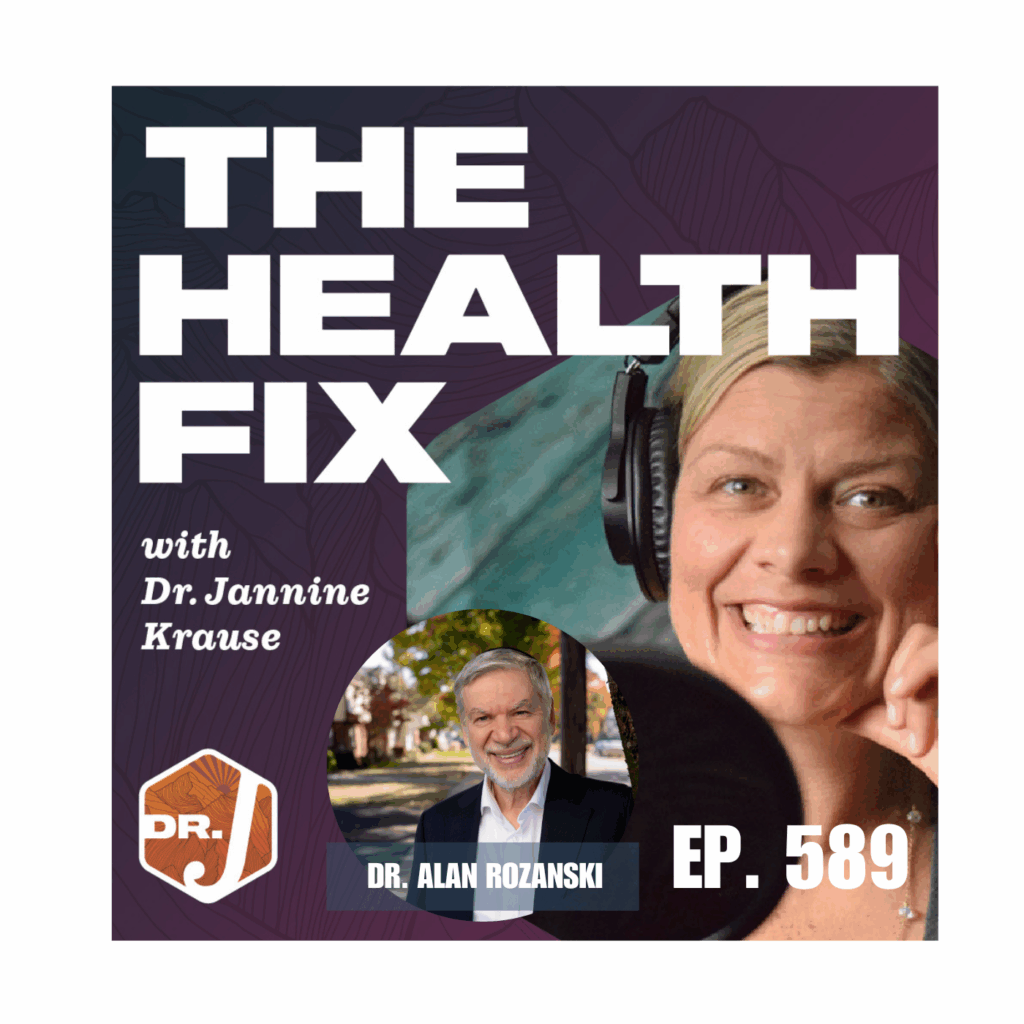
Discover how your thoughts, emotions, stress levels, relationships, and daily choices shape your heart health. In this episode of The Health Fix Podcast, Dr. Jannine Krause sits down with world-renowned cardiologist and behavioral medicine pioneer Dr. Alan Rozanski to explore the powerful connection between the mind and the heart.
Dr. Rozanski breaks down the science of behavioral cardiology, revealing how psychological stress can mimic or worsen heart disease, how lifestyle patterns influence cardiovascular aging, and why social connection and purpose play a central role in longevity.
We also dive into his groundbreaking research on the Six Domains of Health, a holistic framework that blends physical, emotional, cognitive, spiritual, social, and stress-resilience factors to create true vitality.
Whether you struggle with stress, worry about your heart health, or simply want to live with more energy and resilience, this episode will reshape how you think about wellness.
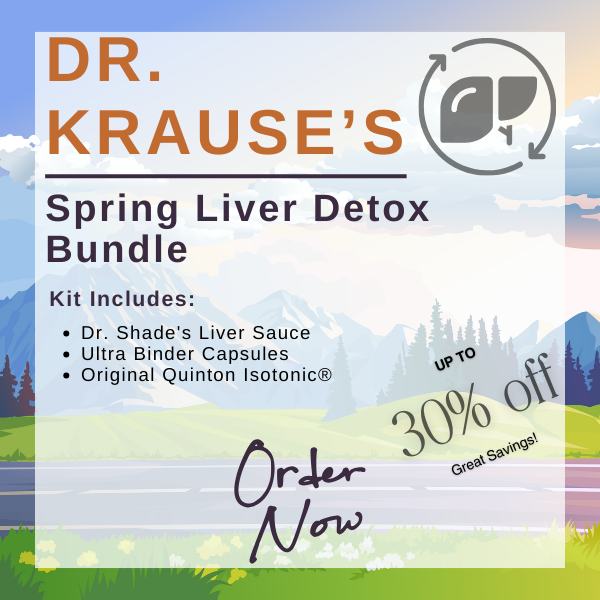
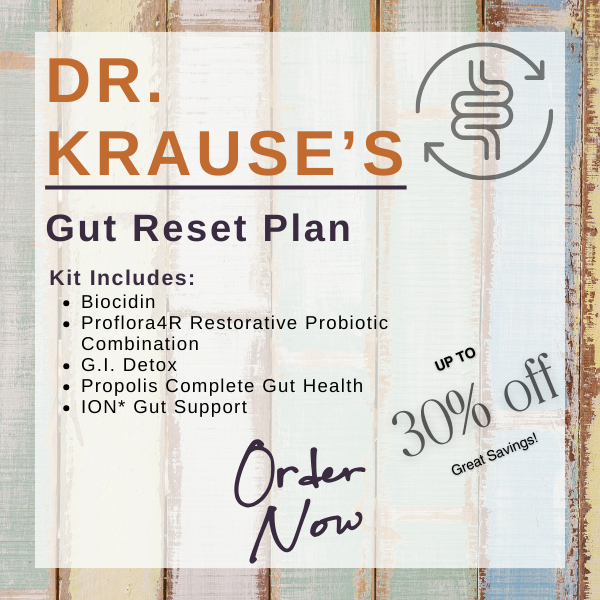
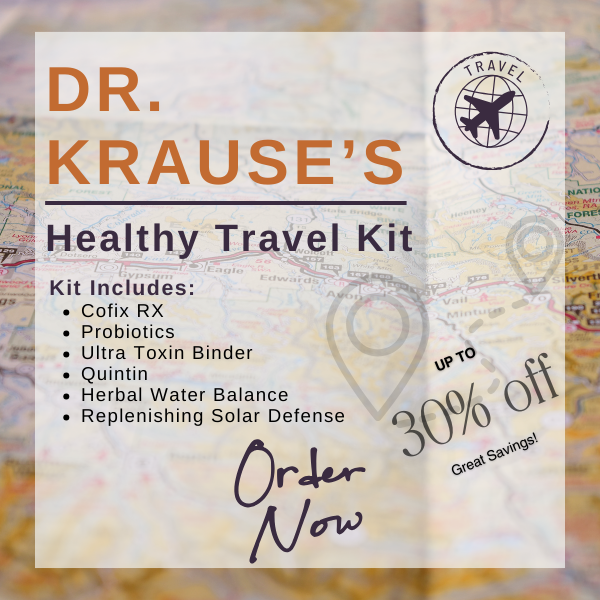
Dr. Krause’s Protocols
Instructions Included
Traveling soon? Looking to detox or reset your gut? Try one of Dr. Krause’s Fullscript plans.

What You’ll Learn
- How psychological stress impacts heart function
- Why chest pain must be evaluated carefully
- The link between emotions and cardiovascular health
- How social connection protects long-term heart vitality
- The Six Domains of Health and how to apply them
- Holistic strategies for reducing stress and supporting heart health
- How behavioral cardiology changes the future of medicine
About Dr. Alan Rozanski
Dr. Alan Rozanski is a leading cardiologist, researcher, educator, and pioneer in behavioral cardiology. His early research established one of the first strong links between psychological stress and heart disease, leading to a MacArthur Foundation Sabbatical Fellowship and collaborations with top behavioral medicine experts.
He has led major integrative cardiology programs at Cedars-Sinai and Mount Sinai in New York, authored over 300 peer-reviewed papers, and developed the Six Domains of Health framework for understanding true vitality.
Learn more about his work at alanrozanski.com
To read Dr. Alan’s 2023 paper on assessing lifestyle risk factors to enhance the effectiveness of cardiac testing. Click HERE.
Our Partners


Podcast Transcript
Chapters
00:00 Introduction to Behavioral Cardiology
02:54 The Connection Between Stress and Heart Health
05:50 Evaluating Chest Pain: The Role of Testing
09:02 Psychological Factors in Heart Disease
11:43 The Six Domains of Health
14:47 Social Connections and Heart Health
17:45 The Importance of Purpose and Stress Management
27:52 Creating Community in Health Programs
29:48 The Rise of Lifestyle Medicine
32:43 Understanding Sedentary Behavior and Its Impact
38:24 Incorporating Exercise into Daily Life
46:27 Diet and Stress Management Strategies
51:23 The Importance of Purpose and Vitality in Aging
Jannine Krause (00:01.186)
Dr. Alan Rosanski, welcome to the Health Fix Podcast.
Alan Rozanski (00:04.452)
Thank you. It’s pleasure to be here.
Jannine Krause (00:07.778)
Well, when I first was asked to have you on the podcast, I saw behavioral cardiology and I was like, yes, please, please help me and help so many folks in my practice. So of course I first have to ask, know, cause it brings me back to the basics of medicine. What brought you to wanting to be a doctor? What’s the story? How’d you end up here?
Alan Rozanski (00:32.868)
That was almost predetermined. My dad was a doctor and he was a tremendous role model. So my brother and sister and I all became doctors. I knew I wanted to be a doctor since I was five years old before I could even think about it. But it was the right choice.
Jannine Krause (00:48.288)
Nice, nice. And I’m sure you’ve probably learned about all the psychology background and if we’re doing life that wasn’t what we really wanted to do, how that affects us. So I’m glad to hear that you are loving every minute of it. That’s so important. Now, of course, behavioral cardiology. lot of folks are gonna be like, when did you first realize that connection?
Alan Rozanski (01:04.07)
this.
Alan Rozanski (01:15.206)
This was totally by accident. mean, it is true that actually my dad was a psychiatrist. So in early life, I thought I’d want to be a psychiatrist. But once I got to medical school, I got exposed to cardiology and I had a love and a passion for that right away. was so much we can do for patients. But I really loved taking a history of chest pain in patients and figuring out is this really angina or is it something else and so forth.
So I went into cardiology and I didn’t have any interest in psychology from that point on. However, after I finished my fellowship, I got into a technical field called nuclear cardiology, which is where you image the heart doing stress.
One day there was certain research coming out, I could explain it to your audience if you like, but it caused me to look at, instead of just exercising patients, when we exercise, then we look at the wall motion of the heart, and everything should be more vigorous with exercise. But if you have a blockage in one of your cornea arteries, one of the walls subtended by the blockage will start to close down.
We began to wonder, what would happen during mental stress? So we devised a protocol with patients and we put them under a series of mental tasks. But one of them was to simply ask him to speak about the personal stress in their lives. And that turned out to be voila, amazing, because the second patient we did remember the patient quite well. He was about to lose his job and he’s talking about this stress. And as he’s doing that, you know, about a third of his heart stopped moving.
while he was having this conversation about his stress. and this we’ve seen in lot of patients and it’s been reproduced. By the way, this is just something you see in people with advanced heart disease, not in normal people. I just want to make that clear. So that was my aha moment. From then on I began to study the mind-body relationship and that’s been a 40-year journey.
Jannine Krause (03:25.004)
Yeah, yeah, I see. We’ve gotten in, we’ll definitely in the podcast notes link to your research because you have that strong link that you developed there between the psychological stress and heart disease. So of course I’m gonna be like, okay, the heart had areas that stopped. And a lot of people when they’re under stress,
will tell me they feel like their heart’s squeezing or they feel like something is sitting on their chest, much like what’s described in an anxiety attack. Would that type of what you witnessed in these books, would that give that squeezing feeling or that pressure feeling or can it develop differently for folks?
Alan Rozanski (04:03.942)
you
Well, classic angina, which is chest pain that’s usually described as sub stern and a kind of a squeezing or a heaviness in the chest, can also be induced by emotion. There’s no question about that. The pain can be atypical because it can be in your arm, for example, instead of your chest. Now.
The first thing that’s most important to say about all that is that heart disease can come on all of a sudden. The symptoms can come on all a sudden. It’s a disease, it’s a silent disease for decades. So when you first have pain…
and you’re not sure what it is, first thing you do, just like an airplane is about to take off, and even if there’s one light going off, the airplane pilot says that’s probably nothing, he doesn’t say it’s nothing, it’s always checked out. So you gotta check out pain if you’re not sure by calling your doctor or going to an emergency room. Let me just state that. But it is also true that…
Stress can cause symptoms like we would see with angina. And it can be very typical. It can occur with rest. And it can be for even hours at a time. And it’s kind of interesting because you can get pain in your ankle. You can get pain in other parts of the body. But what happens is that we pay attention to symptoms that we attach significance to it.
Alan Rozanski (05:38.246)
So if you’re developing pain and it’s in your left arm, you may say, uh-oh, maybe this is heart disease, and worry about that, and that can cause a whole cycle. But if it had been occurring in your right arm, you’d say, well, that’s my right arm. I’m not attaching significance to it.
Jannine Krause (05:38.254)
Mm-hmm.
Alan Rozanski (05:53.654)
So the upshot is that this is one of the challenges and that’s why you often need a doctor because the pain could be a manifestation of heart disease and there’s so much we can do and we wouldn’t want to miss any symptoms for it. But on the other hand, stress symptoms can cause anything in the body practically. So they can cause chest pain, arm pain and so forth.
Jannine Krause (06:16.974)
Okay, so of course being a doctor myself, my first thing is yes, if someone has chest pain, we’re always gonna send them over to cardiology, we’re gonna get an EKG, we’re gonna get that first look, and then maybe a halter monitor, something of that nature for those who are listening, like what’s a halter monitor? It’s a way we can look for more than a week at what’s going on. Now,
when we send someone for those kind of things and I’m curious as to your opinion, is that the best way to really in the moment look at things and then if that comes back negative then how do we evaluate from there when folks may be told, your EKG is normal, no big deal, but they want to know if something’s brewing?
Alan Rozanski (06:58.22)
So there is a general approach. The first thing is to always rule out that something acute is going on. And that would be with an electric cardiogram and measuring enzymes, cardiac enzymes and so forth, making sure there’s nothing there.
Then we usually will do something non-invasively with the patient, which could be today as simple as a calcium scan to look if there’s any corneal calcium in the heart. Or we have something that’s a non-invasive angiogram of the heart today called a corneal CT angiography study, which is with very low dose radiation exposure.
quickly done and gives amazingly beautiful pictures. Or we might do a stress test. And that stress test might be a simple stress test, or done with echocardiography, or done with nuclear imaging. There are wide variety of options that are available. So what we would end up doing, probably in a younger person, is getting some measurement that looks at whether they have atherosclerosis or not.
And if they do, we would look at the lipids and we would look to see, and we have many good ways to arrest the progression of the atherosclerosis. So that’s one thing we would do. On the other hand, it could be you having symptoms and what you have on these scan findings may be true, true, and related. So in other words, you may find that…
do somatosclerosis and might benefit from medication, lipid-lowering medication, for example. But that may be the cause of your pain. So you have to be more holistic and look at the patient broadly.
Jannine Krause (08:41.538)
Great, great way to state it, and that’s definitely the way I want folks to be thinking too, is we have to look at the whole body, not just the heart, but definitely somewhere to start, because I am asked often, hey, I went to my doctor, I went to urgent care, because my chest pain, nothing came back, what are our next steps? So definitely the calcium arteries going, the CICTs, those are great places to go. Now, of course, I’m gonna turn now to the psychological side of things.
And also look at pain too, because you mentioned you could have pain in your ankle and it could be the start of a cardiovascular type of situation. Now for folks who listening, they may be thinking like, my ankle is this, is this something, what is going on there? How would you explain the ankle pain related to the heart to someone that is maybe a woman over 40 trying to figure out what is going on here if my ankle’s pain?
Alan Rozanski (09:09.35)
Okay.
Alan Rozanski (09:37.99)
Well, I don’t think it is related to heart disease. What I meant to say is that we’re going to attach more significance to pain, pay more attention to it, if we think it might be it might be an underlying heart disease. So you’ll pay more attention to pain on your left arm than you will in your right arm. And certainly, compared to your ankle, if it’s your ankle, you’ll know that it’s something musculoskeletal. So that was my point with that.
Jannine Krause (10:02.744)
Okay. Okay. I was starting to think like, there something, of course my brain’s going towards clots and you know, peripheral artery disease and things of that nature, but I’m like, okay, is there something I’m missing? All right, good, good. We’re not missing anything there. So psychologically then speaking, do you think like, because of your research, I’m guessing you’re gonna be thinking this way, but I always think of it putting someone under a sort of stressor to provoke the heart.
Alan Rozanski (10:07.906)
Yeah,
Alan Rozanski (10:16.56)
Okay.
Jannine Krause (10:32.704)
a little bit because sometimes we’ll have folks go in for testing, nothing shows up and they get really frustrated because they’re like, it does happen. And even on a halter monitor, they may not catch more than just a, let’s say PVT PVP, PVC, sorry, something of that nature, which is for folks listening to premature ventricular contraction. Do you think like it might be wise for folks to push for a stress stress test or what do you think?
Alan Rozanski (11:01.03)
Well, the reason we do stress tests is that you can have the buildup of plaque, this blockage in the cornea arteries, and the body has all these compensatory mechanisms. And you can develop, for example, collateral blood flow. And it can be beyond the…
stenosis beyond the blockage of getting supply from collaterals vessels which have formed from above the blockage to below the blockage. So the reason we stress people is that we want to we know that people who can have advanced heart disease may have normal blood flowed rest, normal wall motioned rest and so that’s why we perturb the system. So we want to increase micro oxygen demand and when that happens the cornealities have to dilate.
to meet the demand, but if you have a significant blockage, it can’t. So now if you, for example, look at the wall motion, that’s when the wall motion will start to slow down under stress, where it didn’t do at rest. So that’s the concept of why we do stress testing. When do we need to do it? Well, this is a clinical decision by…
cardiologists, not every person who has chest pain by any means needs a stress test. If the pain is more typical, if it’s more middle-aged as opposed to a younger person, we’re going to do that. There is a movement in cardiology today among younger people to start with anatomic tests like a calcium scan or a CTA study which is a corneal angiogram, non-invasive again.
a CTA study. And then if those are normal, you would generally not do a stress test. So it could save doing that. When people are older and…
Alan Rozanski (12:51.234)
atherosclerosis tends to be quite prevalent. Sometimes you might, a stress test might be the first test you do. So there’s no specific one formula. It depends on considering the nature of the chest pain, the nature of the patient’s age, their risk factor profile, and also the patient’s need to know.
In other words, the doctor may suspect this is not heart disease, but the patient may need to know that they don’t have it. And that reassurance can be extremely valuable for people. that’s the mindset, if you will, of a cardiologist.
Jannine Krause (13:30.072)
Great to hear how it flows because I think for a lot of people it’s kind of a mystery, right? Like what are they thinking? But the need to know side of it, I will often see that, especially in athletes who wanna make sure they’re not doing some harm to themselves.
Alan Rozanski (13:36.944)
Sure.
Alan Rozanski (13:47.814)
sure.
Jannine Krause (13:48.843)
Now, I have a question about the psychology. Officially, I’m getting to the psychology now, I promise. Electricity of the heart. I’m guessing you’ve probably looked quite a bit into the electricity of the heart and how much just the organ itself can respond to someone’s belief state and whether they’re in a depression state or they’re just thinking in negative spirals that are stressing them out. Tell us a little more about what you’ve seen there.
Alan Rozanski (14:19.654)
Well, that’s very interesting. I personally didn’t do that work myself, but in the era that I was looking at factors like depression and work stress and social isolation, this relationship to heart disease, there was a person in Boston at the
Bernie Lau, he had, gee, he lived till 99. I really regret not having ever met him, but he did a tremendous amount of work looking at the relationship between psychological stress and the propensity to…
caused the potential for arrhythmias. So the actual electricity, kind of the heart, can be affected when people are under stress. He showed that. And he did lot of work experimentally in animal models with that, showing that this was so. So there is a relationship that can be had between psychological factors and arrhythmias as well.
Jannine Krause (15:19.128)
Wow. And this is something that definitely when I’m working with clients and trying to help them to get through the, okay, we’ve got through the test, nothing’s wrong. Now we gotta move to this side of things and really start to dive in. I’m curious at Mount Sinai, you have your history of your preventative rehabilitative cardiology program at Cedar Sinai. So I’m curious now, what are you doing over at Mount Sinai there in Manhattan?
How are you working with folks? How are you convincing folks that there’s really nothing wrong? It’s okay.
Alan Rozanski (15:54.742)
Well, I’ll tell you, on a personal level, I’ve had a very unusual career because I started off in conventional cardiology, then nuclear, then I, after I did this initial work, I had a two-year sabbatical from the Cartho Foundation to study health promoting and health damaging behaviors, at which time I was actually on campuses of many medical centers around the country, meeting people at that time, this was in the 1980s, who were
doing novel work in behavioral medicine, which was just beginning as a formal discipline at that time. So I came back to CEDARS and then I started the Preventive and Cardiac Rehab program and that was fantastic. An amazing experience for me over like six years. But then family reasons, my parents were getting older and I thought I needed to move to New York.
So I actually went back to New York, back in nuclear cardiology, got involved in training up fellows in administrative positions, eventually became chief of cardiology. And then after that, the last number of years, I have been really integrating all of this in terms of lifestyle medicine curriculum I’m trying to develop for the public. So I’ve really had five or six careers in one.
Jannine Krause (17:12.526)
Makes sense, makes sense. Now of course you had mentioned, you know, a little bit about the social aspect of how that affects the heart. You have your six domains of health and I’m guessing that’s involved in what you’ve been, you know, putting together in terms of your program for the public. Will you speak a little bit to folks in terms of what kind of things should we be thinking about for our psychological health to protect our heart?
Alan Rozanski (17:27.59)
Yes.
Alan Rozanski (17:41.402)
Well, that’s a great question. I’ll summarize this in a minute or two, because I’m sure you have a lot of questions. But I do think it’s important to put the framework together.
Jannine Krause (17:50.296)
you
Alan Rozanski (17:55.11)
The research I did looking at the effects of acute stress led me to look at the effects of chronic factors such as depression and social isolation and undue work stress and its relationship to heart disease. The data was coming out in 1980s epidemiological hardcore data indicating that when people were suffering in those ways they were at increased risk for heart disease. No question. Back in the 1980s in fact there was a lot of skepticism that depression could be a hard risk factor.
accepts it because the data is so profound. So I became interested in looking at this in a very objective way. And I said, wait.
We don’t have to debate anything. Let’s just look at what the body testifies as to what’s healthy and unhealthy. Anything that promotes longevity, anything that protects the physiology, anything that decreases your risk of disease, that’s healthy. So exercise does that, a good diet does that, adequate sleep, healthy sleep does that. Whereas, let’s say, something like smoking or being sedentary or just being on a very bad diet, those things are unhealthy, objectively. So that’s in the physical.
domain.
But then it turns out that, the quality of your thinking affects your health too. We know that optimists, and this data now is very reproducible, optimists live longer than pessimists. They have less heart disease. There’s data with gratitude showing similar findings. So there is the cognitive piece. Then in terms of the emotions, I just mentioned with depression, the body really goes haywire with depression. Basically, all the major physiological systems start to become dysfunctional.
Alan Rozanski (19:34.424)
People who are happy actually have less disease, they live longer. So there’s the emotional piece. Then the fourth domain would be in the social domain. The people who have a, we’ve known this since the 1970s, that people have the largest social network and have higher quality relationships also live longer, have less heart disease. That data’s pretty reproducible.
fifth domain would be your sense of life purpose. And that is a newer area of study. mean, the hard data on that came out about 15 years ago. But again, reproducible. We’ve actually done a meta-analysis of about 11 studies which we showed that where people who have a high sense of life purpose live longer, again, less heart disease. And the sixth area is how you manage stress. And that’s a bit of an interesting area because it turns out that there is something called
toxic stress, but we do thrive best with a moderate amount of stress, not when we have no stress. No stress is usually associated with lack of life goals, boredom, and so forth. whereas if we have stress that’s good, it’s stress that’s usually something challenging, something that’s building us, something where we have a sense of growth, sense of increased self-esteem, confidence, optimism. So those your six domains of health right there.
Jannine Krause (20:54.944)
A lot of them are in sync with what we’ve seen with the Blue Zone studies and what I’m hearing from a lot of folks that are studying aging in general. And it makes sense. I think what I run into, just being a practitioner myself, is that negative thought, the pessimistic kind of thought process. A lot of folks are isolated as well, unfortunately, or their social networks are kind of also negative. So I’m very curious.
In your programs and what you’ve seen with research, how are you helping folks to really change their mind? Some folks call it rewire, maybe we call it changing their mind, reprogramming. How are you suggesting folks work on that?
Alan Rozanski (21:40.198)
Great question. So think about it like this. Of course there would not be any one single answer, right? There are these six domains of health, which means there six on ramps to improving your sense of well-being and health. By the this gets into a larger question. What do we mean by health? How do you define it? You know, everybody intellectually understands health is not the absence of disease.
But I’ve gone around, I actually go to medical paper on this. It’s when I went about two years ago, I really put a whole lot of thought into that. How do we define health? And basically what I said is that the medical system…
understands on an intellectual level that health is not the absence of disease, but it works as if health is the absence of disease. And by the there’s nothing wrong with that. We have such, we don’t have enough doctors in this country. And if you’re going to a urologist or you’re having some abdominal pain, you want a doctor focused on what’s that problem. When you go to the doctor, they play detective. They’ll do what we call a review of systems. They’ll ask about all your bodily systems. ask if you have headaches, if you’ve had nausea, vomiting, diarrhea, chest pain,
shortness of breath. And we’re so well trained in that we can zip through all of that in a minute. Okay, but we’re trained to be detectives. But what is health? You know, to say health is…
This is like saying that happiness is the absence of depression. Just because you’re not depressed doesn’t mean you’re happy. It means you’re just not depressed. Health is a sense of vitality. It’s a sense of, it’s a pleasurable sense of feeling energetic. And when you have, by human nature, because we have this inner desire for meaning and purpose, when you have a strong sense of vitality, most people want to be…
Alan Rozanski (23:36.238)
active, they want to do things with that. So that’s a subjective measure of good health, that I feel vital, I feel energetic. And that’s the tip-off that you can ask yourself, hmm, how energetic do I feel these days? If I’m not feeling energetic, what’s off? It’s something in one of these six domains. Maybe you’re lonely, maybe you’re very stressed, maybe you are being very pessimistic.
very, and maybe you have a bad diet and haven’t been exercising, and that’s affecting your vitality. The good news is that once you see that, hey, wait, I can do better with this, you got these six honor ramps, if you will. And once you begin working in one of those areas, it usually leads to some improvement in the others. What we call like a virtual cycle, positive virtual cycle.
Jannine Krause (24:25.696)
Okay.
I think it makes perfect sense. I think it makes perfect sense that we need to look at, you know, not just one area, but all the different areas like you’re mentioning. You know, one of the things I bring up a lot on my podcast, my dad’s gonna be 90 this coming year. He had a quadruple bypass about 15 years ago. He has it in his head that he’s getting to the point where that bypass may not last any longer because they told him, you know, that time frame. But yet, I still am around bugging him.
Alan Rozanski (24:40.944)
Great.
Jannine Krause (24:57.22)
And so I think he has a little sense of purpose to hang out with me, but he also has quite a social group. The guy goes and meets with friends for coffee. He goes, most people wouldn’t promote this, but he does go to the bar and hangs out with his friends. Now, in your programs, are you looking at everyone’s kind of individual settings?
maybe after they’ve come out of a bypass surgery or something of that nature? And is that how you’re integrating? Because I’ll tell you, when he did this 15 years ago, it was basically like, okay, let’s ride the bike, let’s do this. And he’s like, let me get back to my property and I will do my own things. But there was no, know, hey, get out with your friends, do these things. He already did it. So I don’t know if they didn’t educate or what happened on that.
Alan Rozanski (25:43.206)
Sure. Well, first of all, I would say that when you talk about programs or program in hospitals, to tell you the truth, most of these things we’re talking about are not addressed by programs in hospitals. Hospitals are dealing with patients coming with chronic problems. And a lot of these things that it’s on the responsibility of a person to understand
Jannine Krause (25:58.85)
Okay.
Alan Rozanski (26:10.234)
what promotes vitality, and that’s a lifelong opportunity. And as you get older, it’s always an opportunity to be better there. However, there are some specific programs such as Code Equal Ehab. And I will tell you something related specifically to your dad, because the fact that he has friends and he’s doing this at age 90, this is one of the most powerful things you could wish for your father to be doing.
I first became aware of this when I was like the third week, fourth week, when I started the cardiac rehab program at those maybe two months into it at Cedars. And we were a very small program. And as a result of that, we had very small amount of space. The patients only had like barely 35, 40 minutes at a session. And we needed a whole hour. And so I campaigned for larger space successfully.
And as soon as it was built out, what we did is we reassigned the patients into our slots. The next day, I go into my office and as get off the elevator, I am mobbed by a series of yelling, loud patients. It was actually a very dramatic moment. And finally, when things calmed down, I was able to have them talk to me and they were angry.
because they had bonded with each other in the time slots they had. And if someone wasn’t showing up, someone else was calling them, hey, why didn’t you make it today? Now, when that happened, I went to the nurses and I said, why didn’t you tell me about this? I was new on the job. They didn’t know. They didn’t know that the patients were doing this. But this was such a profound imprint upon the importance of social support.
that when we finally were able to expand the program tremendously, and we did, we eventually got this whole 13,000 foot floor, we built out a lot of extra space for the patients to just come in and hang out before the session, after the session, and encourage that, because we knew that was part of health. And that certainly, as people get older, a huge part of health.
Jannine Krause (28:30.03)
I look at it now and a lot of people will join group programs, a lot of people will join the gym and meet with people at the gym at the same time. They go because they like who’s there at that particular time. Or like my father, he goes to the bar because he likes who’s there at that particular time or the coffee shop. And so it sounds to me like having this kind of bonding experience.
within a rehabilitative center or whatever it may be, may be one of the secrets to help folks kind of bond over what they’re experiencing.
Alan Rozanski (29:05.039)
It’s one of the secrets.
Jannine Krause (29:06.722)
Yeah. Yeah. And so what what do you guys have something at Mount Sinai?
Alan Rozanski (29:11.43)
There is actually, there are some very good programs at Sinai. There is a cardiac rehab program there. There is a wellness program there. I think there’s a lot of practitioners in different, and Monsanto is a big healthcare system. It’s about six hospitals and there’s a lot of attunement to all of that. There’s no question about that.
Jannine Krause (29:32.847)
I find that with our, you know, I kind of went a little virtual back and forth and obviously with COVID a lot of stuff ended up going virtual, but I find that I really enjoyed the one-on-one connection and I think a lot of patients do love to come somewhere and meet. And right now with the way the world is, we have a lot of online group programs, but I’m thinking that the in-person, probably if we’re looking at how the heart might respond, I’m gonna bring this back to cardiology for everyone that’s like, wait, what happened to your heart?
heart might respond better to having the interactions with people in person.
Alan Rozanski (30:08.048)
Well, that’s absolutely true. And I am very encouraged. First of I’m an optimist by nature. But I’m very encouraged by what I’m seeing. There’s a whole new field called lifestyle medicine. And this field has become very popular very quickly. And these are physicians who are dedicating themselves to working in a practice setting with patients where they’re advocating for better, you know,
health habits, exercise, resistance training, is so important, explaining to patients better how to deal with a diet, explaining that you could actually reverse diabetes with an aggressive lifestyle program, and dealing with the stress component, which I think is extremely important as well. So this is a whole new subspecialty. That’s really great news.
Jannine Krause (31:02.19)
Yeah, we definitely need I mean, I think a lot of people know what they need to do They just don’t do it and it seems that if you’ve got a crew of people to to support you It works just so much better
Alan Rozanski (31:14.566)
Well, you know, that’s part of the human condition, as you just say. You know, we’re all in that, that there’s things we all know that we should be doing that we’re not getting to. It may not be in the health arena, it might be in some area, but that is part of the human condition. And one of the reasons why it’s so prevalent with health is when you think about it, gee, you you’ve got a busy job.
or you may be a homemaker or you have other things, but with your children, and they press upon you. And there’s a certain urgency or importance that comes to mind. And you can have your health as important, but it’s never today the most important thing to do. So today, you don’t get to it. Tomorrow, that same thing happens. In other words, health is something that…
feels important to us but not urgent. And unless you’re intentional about it, you may put off these things you should be doing for months, years, and decades. And actually, that is what happens. And when you think about it, even though we know, for example, that being sedentary is really unhealthy, and we can explain why, your body doesn’t have an alarm system about it.
If you’re just on a chair, you get used to it. It’s not like hunger or thirst or sleep. That’s how I’m sleepy. You feel it. But if you’re just being sedentary, there’s nothing telling you, I’m being sedentary. If you tune yourself to it, you’ll feel it. And people, by the way, who get used to exercising regularly,
They are quite aware when for one reason or another they have been sedentary for a while, they’re missing some of the vitality.
Jannine Krause (33:06.606)
100%. I can tell you myself and my father included, the two of us will be going, man, we gotta go do something today. know, it’s been sitting around too much. So I’m curious though, because I think a lot of people maybe do question, you know, we’re in a space where a lot of us are at desks all day. We have to work, right? We have to sit and do those things. What kind of impact is being sedentary having on the cardiovascular system? Like what demands does it put on the system?
And how can we, know, what kind of folks are like, what are you recommending to folks if they do have to sit for work, what kind of things can they do to kind of maybe negate or like counter a little bit of those effects of being sedentary?
Alan Rozanski (33:50.765)
a wonderful question, or actually a couple questions here. So let’s break that down. What does sedentary behavior do? It’s not just that you’re not being physically active. Being sedentary means that you’re gonna be at increased risk for developing inflammation, insulin resistance. Beginning at age, you think by age 30, we’re losing a certain amount of muscle.
mass and strength per year. In your 30s, it’s probably about 3 to 8 % of your muscle mass per decade. And after age 60, it accelerates. Well, that’s for the general public. If you will be doing resistance training, if you will be exercising, you will reduce that rate of decline.
And that’s going to make a big difference as to whether when you’re 70 or 80, you’re getting out of a chair freely, whether you’re holding up your grandchild or things like that. Exercise also affects the brain. Organically, it affects the brain in terms of a
protection against dimension and cognitive function. And in terms of our psychological wellbeing, exercise has been shown in actually randomized control studies where they compared it to antidepressants to be as effective in causing an acute reduction in depressive symptoms, which is pretty impressive data. This was worked out by Jim Blumenthal at Duke University in three…
know, randomized controlled studies, NIH sponsored. So that’s, but there’s a lot of data that supports that. So being sedentary is unhealthy. Now what can you do about it? Well, the great news is even doing a little bit makes a huge difference. There is the biggest difference in terms of the bank for your buck is going from nothing to something.
Alan Rozanski (35:49.208)
It turns out because there’s an exponential decline in mortality risk and disease risk once you start moving. So if you take someone who’s sedentary, and that’s been my work over many years, dealing with sedentary people, if you can get those people to commit to 10 minutes of a brisk walk per day, you will…
get somewhere between 10 and 20 % decline in mortality risk over the follow-up period, let’s say over the next 10, 15 years, which is paralleling the effects of using, let’s say, statin for preventive measures in people with heart disease. In words, it’s a powerful effect. There’s new data showing that resistance training
also has that kind of benefit in terms of not losing, as I say, muscle mass, in terms of well-being and health outcomes. So what you can do if you’re very busy, as we all are, is you can actually break up your exercise or resistance, you know, exercise into what we call snacks. You can have exercise snacks or resistance snacks or activity snacks. And there’s data that has actually…
Even many doctors don’t know this. In 2018, there was a change in the physical activity guidelines for Americans. That comes out for every 10 years. And before then, there was this notion that you had to get exercising within 10-minute bouts, had to be least 10-minute bouts to be beneficial. Based on newer data, because now we had accelerometer data, we know that’s no longer true. We know that any amount of physical activity that you do contributes to your health.
decreases mortality risk and heart disease risk, which means that gee, if I go to the shopping center and I park furthest from the entrance as opposed to navigating to find the closest entrance, first of all you probably get in the store just as quickly, but that little trek of five minutes is contributing to your health. If you’re taking the stairs instead of the escalator, it’s contributing to your health. And you can take, let’s say can’t go to the
Alan Rozanski (37:59.672)
Well, you can do simple resistance snacks. You can do barbell exercises. You can do bands. can do just… You go from a sit to stand in your chair. And that’s actually something that’s a very good exercise. You go from sitting to standing. You can have your hands over your chest, and you’re going from sit to stand as quickly as you can, and you do that for, let’s say, a minute.
That’s a resistance exercise and it also breaks down the sitting. You see, we now know that prolonged sitting promotes insulin resistance and inflammation and breaking that up decreases the risk of sitting as a risk factor for heart disease. So these little things we can do and should do that promote our health.
Jannine Krause (38:46.35)
So important. I like what you mentioned about the insulin resistance because a lot of people will tell me, well, doc, I don’t eat that much sugar. My diet’s pretty good. But then I’ll be like, well, what do you do for work? Oh, I’m a computer programmer. Well, how much time are you sitting on the computer? And that’s a huge, huge factor, I think, this day and age, even as doctors. And so, of course, I’m going to ask you, you know, obviously you probably get to sit a little bit with patients and then you’re up and moving for your day.
How do you get in your exercise snacks? What are you up to? What’s your favorite? Do do the chair, squat and stand? What are you up to?
Alan Rozanski (39:22.95)
You know, see, there is a balance here that people have to say for themselves. Am I psychologically a person who’s going to do that? You know, exercise next. So I talk about that. Or, you know, am I the sort of person who would do better just going to the gym and, you know, taking out an hour and whatever. I love going to gym. I like going to the gym. feel the minute I walk in, I feel the beat.
You know, you’re among people. Even if I don’t know people, it still feels social. But you get to know people. So I’m a gym guy. But by the way, the data shows that if you’re in the, if you go to the workout, but you’re completely sedentary the rest of the day, that’s not as healthy as still walking around and being active the rest of the day. So I am not intentional about it.
But you know what, I’m just thinking about it in terms of the exercise part. I’m pretty good on unintentional snacks. I will park further away from the entrance to the stores. I will walk to the post office often, not today, it’s like 16 degrees outside here in New Jersey.
But especially in the spring, summer, and fall, I’m pretty active during the day as well. So I don’t have to be intentional about it. It’s just by nature. But if you’re not, you can be. And you can start small. Start with five minutes a day.
That’s how I start with patients with sedentary. I say, you give me five minutes a day? And they’ll say, Doc, that’s all. But many people don’t get to do that because it’s still, I got all these other things to do. I’ll start tomorrow. And then the inspiration wears off. That’s part of human nature. We’re all there in that way.
Jannine Krause (41:25.134)
Oh my gosh, yep, we certainly are, we certainly are. Now of course I think folks are probably also kind of wondering, like, all right, you’re a cardiologist, you’ve seen the nuclear studies, you’ve seen the combination of what goes on with stress in the heart, what are you doing for stress management? What are you doing for diet? Because that’s the number one question so many people ask me, is it individual or do I need to go carnivore, do I need to go vegan, do I need to go this, that, and the other?
What is your take on it?
Alan Rozanski (41:57.094)
Well, obviously two very different questions, right? Stress management, diet management. Which one do want first?
Jannine Krause (42:00.11)
Yep.
Jannine Krause (42:05.41)
Whatever you’re called to go for. I know I have so many questions for you.
Alan Rozanski (42:09.22)
Well, the diet management part is actually simpler in a way. You can make it very complex.
It’s unfortunate, I think we’ve created a message in society which makes this very complex to people. Should I be vegan? Should I be low carb? Are eggs good? Are eggs bad? Is butter good? Is butter bad? so forth. When you look at this, first of all, a lot of this is clean the forest from the trees. I would say we have…
areas where we are clear this is very healthy food and we have an area where we’re clear that it’s very unhealthy. The highly processed foods that are very high in sugar and starch content, the cakes, the candies, the soft drinks, that’s really unhealthy. The highly processed meats, the pastrami and so forth which are highly salted and highly processed, that’s unhealthy.
On the other hand, are you getting the good nutritious stuff you need, the vegetables, the fruits, the legumes, the nuts, you know, it’s important to have, especially getting old enough protein and so forth. So is there enough of that in your body? The fact of the matter is, is that…
The data shows that Americans get about 60 % of their calories from highly processed foods. And it’s close to that in children too. Now not all highly processed foods is unhealthy. And why do we have that in the first place? Because first of all, if you go back to 1949, if you were making pudding, you were like sitting in front of a pan and…
Alan Rozanski (44:07.086)
You know, and was like a two-hour fare. In 1950, there was instant pudding. Voila! You know, the convenience of it made it a hit overnight. But, you know, over time, we developed microwaves and all these highly packaged foods, and people don’t have time, you know? And so you have to make an equation, you know, how important this is. What I say is, again, I use this concept of power, the first step. Two things I’d say about diet is one,
Jannine Krause (44:34.771)
you
Alan Rozanski (44:37.286)
Do you have the healthy stuff in there? If not, can you start putting some more of that in? Don’t worry about the negative stuff first. Worry about putting in the good stuff first. And having large salads. There’s a lot of people with stress eaters, I am myself. I know that I do a lot of cognitive work. And especially if I happen to be home for some reason, because I’m…
At work I’m always distracted, but at home I know I’m going to eat more. So I actually get bags of lettuce and I put some olives, some raisins, some nuts on it. And I’m feeding that desire to munch that way. So it’s a healthy snacking. So is that something in the guidelines? These are strategies you figure out. The other thing I’d say about diet is just pay attention.
to how you feel about it. How do you feel if you go off like sugars for about a month, you know, get off those protein bars that people, you know, claim to be healthy, but a of those are candy bars. But go off that for a month and then see, gee, how do you feel when you had it again?
and pay attention because if we pay more attention to how we feel after we eat, I think it’ll give us more of a clue to that. One other thing I’d say about that is that this was classic work done by a guy named Robert Thayer about 30 years ago. He actually took people and he measured how they were feeling in terms of tension and energy. And then he gave them a candy bar on one occasion and he had them do a brisk five-minute walk on another occasion.
And he had them remeasure their energy and tension level afterwards and then like an hour, two hours later. And what he found was, gee, after the candy bar and after the…
Alan Rozanski (46:31.846)
risk walk that they did. They felt more energetic. But about an hour later, they were crashing after the candy bar, but their energy stayed up after exercise. So if you can try to do that once a day and see how it works for you, you might be surprised. I’m feeling tired. I want my quick fix.
course I’m going to go for the candy, but especially I feel tired. But that tiredness is the lies, the fact that if you exercise you will actually feel more energetic. So you can try that too. So those are some general tips in terms of the diet portion. You want to go to the stress portion?
Jannine Krause (47:11.746)
Let’s go for it. I love your tips for the diet portion. Yes, I’d love to hear what you’re doing for stress management.
Alan Rozanski (47:14.468)
Yeah.
Alan Rozanski (47:20.842)
Yeah. So the stress management piece is also very interesting. The general rule with stress management is that you want to, the stress can throw us off and you can make an analogy between the body and physically and psychologically.
So your body has what we call homeostasis. If your heart rate of blood pressure get elevated for whatever reason, the body has mechanisms to bring it back to normal pretty fast. And the goal is, how does it do that through multiple regulatory mechanisms? Well, if you’re under stress, if you’re thrown off balance, how do you get back to baseline? So it turns out the more coping skills you have,
the larger your repertoire and the more you’re able to flexibly switch from one to another, the better you are as a stress manager. you know, putting in things and building a repertoire of stress responses is good. So I have on my website, I have some blogs on this where I talk about these six buckets of stress management basically. There could be the physical things which are, you know…
meditation, could be yoga, could be exercise, deep breathing, and those sort of things. Then there’s the cognitive piece, learning how to reframe stress, because very often we’re blowing things up. Then there’s the emotional regulation part. Turns out that when our moods are down, very often our problems seem to as larger than when our moods are up.
But yet when our moods are down, our problems create a sense of urgency like we want to solve them. And that’s the wrong time to solve them. For example, you had some issue with your spouse and it’s late at night.
Alan Rozanski (49:13.094)
That’s not the best time to resolve the problem often. Very often it’s best, and that’s not a Narang Klaid rule, but generally it’s better to wait till you are feeling better, and very often the problem doesn’t seem like a problem anymore. So that’s kind of learning like emotional timing. So that’s a kind of stress management response. It turns out having multiple sources of meaning. So if something is, let’s say, not working your job, and it’s not the end all or be all of your life, then you have
other things to tap into, that’s a coping mechanism as well. So there are different ways to cope with stress and it’s a lifetime of work and working on developing your stress repertoire is a great thing to do.
Jannine Krause (49:59.887)
It’s so important. I wish it was part of the curriculum in grade school. I do.
Alan Rozanski (50:04.806)
me too. You know, I mean, we learn geometry, trigonometry. I think learning more about health in school would be great. It would be really great, absolutely.
Jannine Krause (50:20.77)
you have grand kiddos that you’ve shared any of this with?
Alan Rozanski (50:24.038)
And with who? yeah, well, my grandkids are young, but my children have heard a mouthful.
Jannine Krause (50:25.442)
Grandkids, do you have any grandkids?
Jannine Krause (50:34.094)
Well, hopefully, hopefully it’s sunk in. Hopefully it’s sunk in. So, Dr. Rosanski, what’s next for you? What are you going to, what are you researching next? What are you up to? What’s, what’s next for you on the horizon?
Alan Rozanski (50:38.561)
yeah. yeah. Yeah. Absolutely.
Alan Rozanski (50:48.614)
I’m having a ball right now with what I’m doing, you know, in terms of the last few years. I had been writing medical papers all my life, and I’m still doing that. I’m still doing a lot of academic research. And I had not, it was kind of fortuitous where I started, you know, just interacting more with the general public, with the lectures and things like that. And one thing led to the next, and led me to develop my website.
And doing podcasts with people like you, I mean, it’s an absolute joy. And I think we’re in a time where there’s so much more that people can do and want to do. People are living longer, but there’s a lot of chronic illness. And what I say is you can’t have the same physical energy as you get older, but can be every bit as vital and energetic. And when you hear people like…
who was a Tig Van Dyke who just turned 100 years old. That to me gives me lot of pleasure to see. You said your dad is 90. That gave me pleasure. And I want to see people. I have a friend who’s like 74 and he’s got a negativity about his health. And I’m doing a lot of personal coaching with him. And I said, look, my goal with you is I want you to be highly vital when you’re 94. And he was just thinking about retiring. And I said, no, you can’t retire. I mean, people can retire, but you can’t retire. You need to be
Jannine Krause (51:51.342)
you
Alan Rozanski (52:13.35)
vital and energetic and have a sense of purpose. that’s what’s in it for me right now. I I want to reach out more to the public and just share 40 to almost 50 years of medical work and work in psychology and what I’ve done.
Jannine Krause (52:30.742)
So it’s so important and definitely, you know, lifting up our colleagues and friends. I think we do get to a point where a lot of folks will be dreaming of retirement and they’ll talk about how they’re going to do nothing. And then unfortunately what we see and I’m sure you’ve seen as well, people retire and then they pass away, you know, soon after retiring. And I don’t want that for anybody.
Alan Rozanski (52:54.15)
Yeah, well what I’ve seen is friends who retired and then two years later they were absolutely looking for or had to get back into the ring somehow. It’s like going to the beach and the first morning you’re there and like, it’s great. But after like a half day, how much can you lie in the sun? You’ve got to go out and do things. That’s us as human beings. We thrive when we have things to do.
Jannine Krause (53:22.062)
Well said, well said. Well, Dr. Allen, I’m so glad that you’re able to come on and share so much information with us. Now, of course, we got to tell folks about alanrosansky.com. That’s your main website. And if someone is in the Sinai hospital area, the system, can they find you? How do they find you? How does it work to work with
Alan Rozanski (53:43.428)
Well, you know, I have been more in the administrative end, and I still am running our stress laboratory to some extent, you know, but there’s more people doing that now. And I’m still a fellowship director. So I’m not, I don’t have a private practice at this point. But, you know, I’m also active on LinkedIn. People can connect with me if they like there, and happy to talk to people and…
Jannine Krause (54:12.918)
Awesome. I’m thinking about some colleagues of mine that might want to hang out with you and learn kind of the lay of the land out there. So we’ll definitely make sure that we put the notes there and get linked to you on LinkedIn as well. Well, thanks again for your time. I really appreciate it. Thanks for coming on.
Alan Rozanski (54:17.638)
Okay.
Alan Rozanski (54:21.295)
Sure.
Alan Rozanski (54:27.236)
Sure.
Thank you so much. This was a pleasure. Thank you.