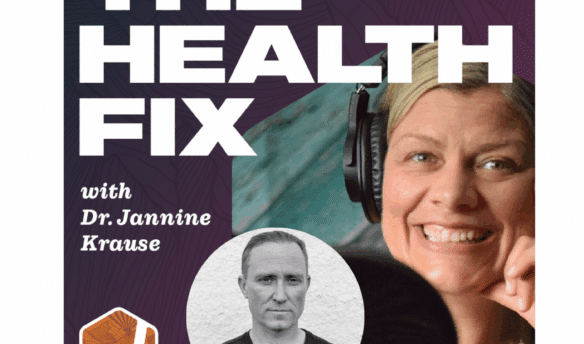
In this episode of The Health Fix Podcast, Dr. Jannine Krause sits down with Brenda St. Louis, Accredited Financial Counselor, Financial Therapist, Certified Money Coach, and founder of REWIRE, to explore the powerful and often overlooked connection between money, the nervous system, and overall health.
Brenda brings decades of experience in personal development, somatic therapy, and financial education to this conversation, revealing why money stress is rarely about numbers and almost always about emotions, conditioning, and survival patterns.
Together, they unpack how unresolved money trauma can drive chronic stress, dysregulated nervous systems, impulsive financial decisions, and even physical health challenges.
Dr. Krause’s Protocols
Instructions Included
Traveling soon? Looking to detox or reset your gut? Try one of Dr. Krause’s Fullscript plans.




What You’ll Learn in This Episode
- Why money stress is a health issue, not just a financial one
- How the nervous system influences spending, saving, and financial decisions
- Common emotional triggers around money and how they show up as self-sabotage
- Brenda’s concept of money archetypes and how they shape your financial behavior
- How inherited family patterns and generational beliefs affect your relationship with money
- Why many high-earning individuals still live paycheck to paycheck
- Simple awareness shifts to create financial calm, clarity, and confidence
About Brenda St. Louis
Brenda St. Louis is an Accredited Financial Counselor, Financial Therapist, Certified Money Coach, and Trauma of Money Facilitator, with CFP training through BCIT. She has worked in personal development and human potential since 1996 and has focused specifically on the emotional side of money since 2009.
As the founder of REWIRE, Brenda helps individuals including average to high net-worth earners — break free from money stress, emotional overwhelm, and limiting financial beliefs. Her multidisciplinary background as a massage therapist, voice actor, motivational speaker, and published author gives her a unique somatic and intuitive lens on financial healing.
She is a co-author of the Amazon.ca bestselling book “The Thought That Changed My Life Forever” alongside Dr. Joe Dispenza and Bernie Siegel, and has been featured on numerous podcasts, radio, and television platforms. Brenda has owned and operated her own business for over 25 years and currently works in Vancouver, BC, Canada.
Special Invitation
Brenda invites listeners to join her upcoming webinar, where she’ll share actionable tools to:
- Break free from limiting money beliefs
- Regulate your nervous system around finances
- Build a healthier, more empowered relationship with money
👉 Details shared in the episode click HERE to learn more
🔔 Don’t Forget
👍 Like
💬 Comment
📌 Subscribe
For more conversations on health, healing, longevity, and whole-person wellness, follow The Health Fix Podcast.
Our Partners




Podcast Transcript
Chapters
00:00 Introduction and Connection
01:45 Brenda’s Journey with Money and Health
04:34 Cultural Influences on Money Perception
07:12 The Emotional Aspect of Money
10:31 Inherited Money Stories
12:36 The Importance of Regulating Your Nervous System
14:05 Exploring Money Archetypes
17:59 Linking Money Archetypes to Health
21:46 The Impact of Financial Stress on Decision Making
23:48 The Financial Landscape: Canada vs. U.S.
24:18 The Impact of Financial Stress on Decision-Making
25:47 Regulating Your Nervous System for Financial Clarity
30:11 Health Savings Accounts: A Financial Safety Net
34:13 Connecting Money Choices to Health Outcomes
40:26 Actionable Steps for Financial Awareness
43:47 Invitation to the Intergenerational Money Reset Webinar
Jannine Krause (00:01.09)
Brenda St. Louis, welcome to the Health Fix Podcast.
Brenda St Louis (00:04.615)
Hi, Janine, it’s so good to be here. Thanks for having me.
Jannine Krause (00:07.832)
Well, I love to do podcasts like this where I meet someone at a conference and I’m all lit up about what you do. And of course, you know we’re on the same wavelength with business and health and all the things. And so of course I’m like, yes, please come on and hang out with me. So I’m so excited that you can be here today and we can chat a little bit about health and money.
Brenda St Louis (00:28.207)
I that. I mean, the minute I met you, was like some synchronicity happened and I was like, I want to know this person and I would love to collaborate with you. And I had no idea what you did. And I just knew that we needed to connect. So I’m so glad to be here.
Jannine Krause (00:45.1)
Me too, me too. And of course, for all of my Pacific Northwest folks, guess where she’s at? One of her most wonderful places, Victoria, British Columbia. So, of course, I was like, well, yes, we have to know each other because I’m gonna come visit you someday. What’s happening?
Brenda St Louis (01:00.359)
Anytime and I’m on the water and it’s beautiful and sunny here so.
Jannine Krause (01:05.768)
I love it. love it. So folks might be thinking like, all right, so money, health, like doc, why do you keep bringing this stuff up? And of course we kind of had this conversation about stress and how…
Many of us live in stress land because of finances and how that really impacts cortisol and how that really like fires up the brain. So of course, folks, I always start off with like, how did you end up here working on the money? And of course, my question is, did you have a little bit of an inflamed brain situation that came from cortisol that led you to this route? Or what happened? Give us a scoop.
Brenda St Louis (01:45.319)
Well, it’s a bit of a convoluted story and it’s not the typical story of I’ve struggled with money and now I want to not have people struggle with money. There’s truth to that. But I was one of those people that had really good ability to make a lot of money and I had a really good ability to spend a lot of money.
Jannine Krause (02:04.29)
Yeah.
Brenda St Louis (02:05.319)
And I was a facilitator internationally for a personal development organization and they paid me a lot of money to take my courses. And almost every person that came into the course had to go into debt to be in the course. And it was all about change and transformation. And it just felt like there was this real disconnect with money and consciousness or health or expansion. And I felt like there’s something up with this.
And so I always had that feeling in my brain and I was the same thing. I went into debt like 40,000 and come out of debt and then I’d go into debt again. And it was like I had no relationship with money. And so if you talk about health and what my nervous system was doing, I was the hard working hustle, hustle, hustle. was like scarcity was like the motivator to hustle. And when I had money, it was like, yeah, this is good. This is cool. So it was always this
up and down roller coaster income. And I had an awareness come to me that my work in the world is to help people have a deeper understanding with money. And it happened in clown school, actually. But I know that’s a much longer story, it was like clown school was really about getting really connected to how to present and connect with the audience so that our hearts were connected. And I was realizing in clown school that
Jannine Krause (03:19.372)
Interesting.
Brenda St Louis (03:34.906)
that the love and connection is missing in money and that my life’s work is here to actually create more love and connection with money as a conduit for us to connect with each other, the planet, our communities, our bodies. And I’ve been a somatic therapist, a massage therapist, a craniosacral therapist. My body was my jam for so long and now it’s money in body.
Jannine Krause (04:03.234)
Yeah.
Oh my goodness, you know, I think about what you mentioned, like easy to make it easy, easy, easy, easy go. Right. And I think for a lot of people that comes from watching parents or watching, like I would say even watching like TV as a kid. Granted, you know, I grew up in the era of like 90210 and they’re all like driving fancy cars and all this stuff. And I grew up in the middle of Illinois, our Northern Illinois, Southern border of Wisconsin. Right. Like middle of us trying to say middle of the Midwest, not too far from where you grew up.
over the lake over there into Canada. And so it was very middle class. But yet you’re watching people driving these fancy cars, these girls getting these heels, these cool outfits, and you’re like, well, I should have that. I want that. And as soon as you get paid and you get a real job, you are the first thing you’re doing. I don’t know about you. I went to the mall. I was like, what are we gonna buy today? So it’s an interesting phenomenon, huh?
Brenda St Louis (05:01.553)
God. I know and that kind of fires so many things in your brain that feel so good when you do that.
Right? And it is that roller coaster thing. Like, my God, I want this new outfit. I want this new shirt. I want this new thing. And it feels good for a short period of time. But it’s not related to money. It’s related to having something. I often say to people, so do you want to make a lot of money or do you want to have a lot of money?
Jannine Krause (05:33.23)
It’s a loaded question. It is. And what do most people say?
Brenda St Louis (05:35.779)
Mm-hmm.
Brenda St Louis (05:39.568)
I want to have a lot of money, but they don’t operate that way. So we can see what we want, but our nervous system, the way we react, the way we make decisions and everything doesn’t always match that. And I was also mid middle class. My dad worked for General Motors on the pension. Everyone had the same amount of money. We didn’t really struggle, but we weren’t opulent. Like we didn’t have a lot of luxury either. And I grew up in like the
just across from Detroit and Windsor. So everyone worked in the auto industry, right? So everyone was similar, the same, but everyone had a good car.
Jannine Krause (06:17.268)
Hey, hey, you know that reliable car because they probably got some discount probably the family or company discount
Brenda St Louis (06:25.716)
yeah. Yeah, for sure. For sure.
Jannine Krause (06:30.926)
It makes sense though, it makes sense. And we look at this, and this is definitely someplace I’d like to go to because I think a lot of people, mean, it’s not like in kindergarten. We were taught.
really to do anything with money other than maybe, you know, we played games that had paper money like Monopoly and those things, but it never was in a realistic sense. And, you know, at one point I saw that, you know, the the dad, the rich dad, poor dad guy, Robert Yamasaki, yeah, Kiyosaki, there we go, had a game about money, you know, to teach kids. And I look back and I go, you know, my parents really did actually try to teach me with like the checkbook and do all these things.
Brenda St Louis (07:02.215)
Yes, Aki.
Jannine Krause (07:14.864)
But I was like, that is too hard for me. I’m not gonna do it. I have to put numbers. So it was a numbers thing for me. It wasn’t that I cared so much, you like I worried about my money per se. You know, you gotta watch your words of how you say things. At that time I worried about it, but I also was like not to be bothered with numbers. I was like, I hate math. So money equals math. Do you find that for folks?
Brenda St Louis (07:39.312)
I think that is the back door that people jump out of because money really doesn’t have anything to do with math, really. It has everything to do with emotion, right? And how we’re relating. It’s a very relational energy, but we don’t treat it like that. We treat it like math, like one plus one equals two, but really not. Like if you put your money in the right place, one plus one could equal ten. Like, you know what I mean? So it’s not it’s a very emotional, it’s complicated.
Jannine Krause (07:41.794)
Mm-hmm.
Jannine Krause (07:45.528)
No.
Brenda St Louis (08:09.565)
There are a lot of different pieces to it and you can’t be taught by people that haven’t overcome their stuff around it. So that’s why we inherit stuff from our parents. And I remember the story when I was a kid, I lived on a pear farm and we had tons of pears that all would just go rotten on the the ground sometimes. And we had about like 15 trees. And so neighbors would come and they would pick stuff and everything.
My dad made pear wine, pear jam, pear everything. I can’t eat pears right now. But we filled the wheelbarrow up with pears and there were three friends and me and we went to knock on people’s doors and selling pears with these plastic bags. And at the end we got $20. So I gave everyone $5 and we went to the store and bought candy. And I was so proud that I made money. Like I was like, my dad is gonna be so impressed.
with me. So I’m at the dinner table and I say, hey dad, you know what I did today? I made $20 selling the pears in the backyard to the neighbors. And he goes, wow, good for you. Where is the $20? And I said, well, I gave five to each one of us and we went and bought candy. And he went, that’s not good business sense. Those were your pears. You know, those were, you brought the capital in. And so I had this thing of like,
I’m a bad business person, right? That carried with me. And it also had that thing, everything has to be fair. You know, we all did the same work. I don’t care if it was my pairs or my bags or my wheelbarrow. We all did the same work. So it should be fair. And that’s…
Jannine Krause (09:40.076)
now.
Jannine Krause (09:46.446)
Great.
Brenda St Louis (09:56.922)
culturally very baked into the Canadian culture. The American culture would be more like my dad, like you’re an entrepreneur, you you should have had a better cut, cause it was your product, right?
But very Canadian is very socialist, very similar. We all should be taken care of, like that kind of thing. And there’s this cultural thing that runs how we make decisions with money too. So, I mean, I think we get influenced by our parents in lots of ways. Like, I don’t know, do you have a story that lingers in your money story that you might have inherited from your family?
Jannine Krause (10:33.652)
And you know, it’s funny, I don’t remember much. My mom died when I was 26, so I don’t really remember many stories there. But my dad, because he’s still alive, and I talk to him every day.
He had a business, multiple businesses, he did construction, he did excavating. And I would work with him and see how he would negotiate with customers and talk about things, but he was always people pleasing. Anything for the customer. And so in business, it took on to me, like, you will bend over backwards, you do whatever it takes to make someone happy, which I think is a good principle. But in his case, it was also cutting his prices, really undercutting himself and really just devaluing himself.
And then it turned to an older age where he would just beat up on himself about I should have made more money I should have done this I didn’t you know do this right and so I just kept hearing like money’s hard to make right money doesn’t fall on you know come on girl on trees money so hard hard hard hard You know and so when I got older I was like oh, okay, so I have to work hard to make money All right, I can pull an 80 hour week. No problem and people who are listening to this are my patients. They know I do that um You know, but it’s not it’s out of love right it’s
Brenda St Louis (11:31.258)
Yeah.
Mm-hmm. Mm-hmm.
Jannine Krause (11:45.088)
It’s not like I’m like, ooh, I need to make all this money. But at the same time, there is a lot of interesting things that I see coming up. I’d be lying if I said I’ve healed all my money wounds. That’s not true. But I see it now, where I did five, 10 years ago. And it’s…
Brenda St Louis (12:04.443)
I don’t think anyone completes the money story.
So I think we’re so hard on ourselves of what the right way is to be with money. What it is, is a regulated, you need a regulated nervous system with your money where you can make decisions with educated logic, because rather than in emotional logic. what I would say, do you mind if I just kind of unpack it a little? Is that okay? The work hard for money is a very common story for a lot of us. And I have it.
Jannine Krause (12:09.576)
Thank
Jannine Krause (12:24.12)
you
Jannine Krause (12:29.538)
Yeah.
Brenda St Louis (12:38.761)
baked into me as well. And my value is in my work, right? So if money came in easy, it wouldn’t be as valuable to me.
Jannine Krause (12:45.016)
Mm-hmm.
Brenda St Louis (12:51.503)
Right? Even though I wanted, I don’t want to work so hard and all that stuff. If I had money come in to me, it would be more like, okay, all right. But it wouldn’t matter as much. And because I’m a healer and I do this similar work in this, I want the person I’m giving my effort to, to be transformed or affected or to feel good after. So there’s this, that’s where my value is.
Jannine Krause (13:18.744)
Thanks
Brenda St Louis (13:21.447)
is in, so the price tag to that, it doesn’t matter because it’s more about the transformation than the cost of it. And so that once again puts money out of a relationship. It’s on the outside of our relationship. But what would it look like for you if money was a partner? Money was something that nurtured you.
money was something that felt life-giving and it really you honored it like you would honor a patient, right? So there’s so many different ways we can change hard work into a deeper intimacy with the currency we receive from it.
Jannine Krause (13:58.638)
you
Jannine Krause (14:09.29)
Makes sense, makes sense. Of course, and that’s kind of where we come into like the money archetypes quiz that you have. And for those of you guys who are like, what’s that? Well, I’m sure she’s gonna tell us a little bit about the archetypes, but I would love for you all to go over to her website and take her quiz because it’s really fun to see, you know, where do you land on that. So tell us a little bit about the layering and the archetypes and how they all play out.
Brenda St Louis (14:10.489)
It’s layered. There’s a lot of layers to it, but…
Brenda St Louis (14:18.459)
Yeah.
Brenda St Louis (14:34.491)
Well, I created the archetypes kind of like the hero’s journey where, you you come in and you’re usually an innocent, you don’t know anything, you’re just, you know, whatever, right? And something happens to you and you can either turn into like an orphan where you lose trust in authority or you feel like you can’t trust anyone and you blame the outside.
Jannine Krause (14:38.659)
Hmm.
Brenda St Louis (15:00.011)
Or you jump into the fool and you just go across the threshold and you just go for the ride and hope for the best. And that could be impulsivity, that can be overspending. The orphan could be life happens to me rather than for me. And the innocence, like I don’t want to look at it. I want my Prince Charming to take over and take everything. I don’t want to look at my books. And so those three archetypes are kind of young, right? And we’re moving through them. You can also turn into the artist where
It’s like, you know, money is bad and evil and it is I don’t want it to touch me. It’s dirty and my art is far greater than that. So I do not want money to taint it. And then you can also kind of evolve into the caregiver, which is like taking care of everyone and and and feeling there’s a bit of a perfectionist and martyrdom can happen with the caregiver as you’re moving through the money story. And then we evolve into different other adults.
Some can be the tyrant where you’re really hoarding. There’s never enough. You’re holding down on it. And then the warrior where it’s like you work hard and you do what you need to do to get things done. You teach yourself. You do all of that. That’s the single mom I often think is like the warrior. And they could be the…
the weary warrior after a time too. So like the warrior and every archetype has a positive and a negative. And then the wizard is the one that starts to have the intuition, the one that knows when to play and when to hold.
like, you know, knows who to engage with and who not to. It has a level of wisdom in their intuition. And then the wise elder is the one that actually sees the broader scope of our economic terrain and realizes that you can use it to your advantage, but it cannot use you.
Brenda St Louis (16:58.371)
So you’re not at the effect of marketing, you’re not at the effect of the keeping up with the Joneses or struggle because you get, I get how this system works. You know how to invest, you know how to make money, make money, you’re making good choices, and you’re really measured and regulated in it. And all of that is a journey. So there’s nine archetypes and you could be all of them.
But usually at this time when you take the test, one shows up and then there’s a shadow one behind it. And then there’s one that you’re growing into, right? So the journey through understanding what brilliance you’re holding and not seeing.
Jannine Krause (17:32.29)
Yeah.
Jannine Krause (17:43.704)
Gotcha, okay, okay. So, you when I look at that and I go, okay, there’s all the different arbicatitis, there’s also, you know, the different layers, like you said, each of these would have a possibly, relationship with how this impacts cortisol and stress and health, too. And so, for folks that are like, huh.
Brenda St Louis (17:44.615)
Mm-hmm.
Brenda St Louis (17:59.484)
Absolutely.
Jannine Krause (18:04.716)
which, know, maybe they were, you know, as you were talking through them, they’re like, I resonate with that one. I, yeah, that one sounds familiar. How would you, you know, and I’m putting you on the spot, of course, guys, I didn’t prepper for this. How would you link the different ones to the cortisol effect? Like, what would you say? you had to, like, kind of summarize it in terms of most impact.
to cortisol and brain inflammation to least impact? What kind of archetypes would be the folks that’s like, look, you need to do something today after this call. Like, let’s work.
Brenda St Louis (18:35.769)
Yeah. So some of the behavior that you could demonstrate could match many archetypes. Like avoidance could be a fool, an artist, an innocent and an orphan. But an avoidance with a fool is they avoid because they are jumping out of the airplane for the adrenaline. Right. And they want to like get the next fix and get the next hit so that they don’t feel that cortisol.
Jannine Krause (18:42.678)
Okay.
Jannine Krause (18:57.602)
Mm-hmm.
Brenda St Louis (19:04.775)
overload. But the innocent that is avoiding looking, they’re desperate to find someone saving to save them. So there’s always this low level of stress in their reality, right? And the the tyrant that is
Jannine Krause (19:06.434)
Okay.
Brenda St Louis (19:24.803)
obsessing and compulsively looking at their finances because there’s never enough and they need to control it, that comes from a fear and that can be cortisol ridden, right? Or the orphan that’s kind of blaming the world for all the things that happen and not taking any responsibility. So they all are going to cause a level of stress in your body, right? And bringing in like a the the arc, like sometimes we’ll do a meditation on, you
Jannine Krause (19:36.302)
Okay.
Brenda St Louis (19:54.74)
are like what what one would resonate for you I can give you just a little kind of example around this. Okay, the weary warrior.
Jannine Krause (20:00.088)
Probably Warrior,
Brenda St Louis (20:04.153)
Like, yeah, okay. So the weary warrior you put in the middle and you look at it. And the weary warrior could also be like the fool at some points. Like you might have done foolish things when you were younger and that kind of thing. So it could be a combination of different things. And that weary warrior needs support. Okay, so similar to taking like, you know, cortisol manager or like just different things to help you sleep better, to help you all have all the things to reduce your cortisol or eat better.
better. They need support. So they need the hand of the wizard to kind of just say, I got this. I got your back. Just relax. You don’t have to do everything. There are people around you that want to support you.
Right? So, and your intuition is there to know when you need to rest. Those kind of things. So, when you’re working with the archetypes, you can pull some of them in and maybe the fool will come in and say, you know, you need to play a little more. You know, you need to like be ridiculous.
And that might be a part of the healing around it that allows you to fire that feeling of oxytocin or serotonin or whatever that you need in order to kind of rebalance your nervous system in it. So does that kind of showcase what you were asking?
Jannine Krause (21:11.073)
You
Jannine Krause (21:30.39)
Yeah, it gives us a really good sense of kind of what that might look like for someone. I mean, I think the other big thing, like when we had talked, kind of what I had connected is that I feel like for a lot of folks, this chicken or the egg thing, a lot of people talk about body, like inflammation. I kind of think there’s some cases in which brain inflammation proceeds.
the body inflammation. And I also think the brain inflammation may precede weight gain and stress eating and all of that, you know, related to either financial stress, life stress, et cetera. Because I’m sure anyone on the podcast can relate. If you’ve not eaten all day and you’re stressed, you’re gonna go home and hunt some food. But at the same time, if you open up your email and you see like a bill that’s gone past due.
or your bank account is overdrawn. you’re like, gosh, I have to fix it. Now you’re making willy nilly decisions to try to move money. Same thing goes with if you have to make a choice for your business and you wait till the evening when you didn’t eat all day and then you’re stressed out.
Brenda St Louis (22:39.803)
Yeah, yeah, like you know, like if you don’t take care of your body, you can’t make good decisions. You just can’t.
You know, like if you’re in a crisis mode, your executive function is offline and you’re just doing that primitive survival mechanism. And money is like the, I think it’s the bottom Maslow’s hierarchy of needs. It is the on the bottom rung. And if that’s not taken care of, nothing else can be sound that you make choices or decisions around.
Jannine Krause (23:14.306)
Mm-hmm.
Jannine Krause (23:17.792)
So do you think, I mean, if we had to ballpark it, do you think a decent amount of the population right now, just in the world, are really making a lot of financial decisions on a brain that’s already really inflamed or stressed out?
Brenda St Louis (23:37.575)
would say, yeah. There was that study just recently that 72 % of Americans have stress about money daily. Yeah.
Jannine Krause (23:46.092)
Yeah, I could see that. could see that. No comparison Canadian data. I’m curious. I’m just curious. Yeah.
Brenda St Louis (23:53.223)
Well.
Yeah, maybe. It’s the same. It’s pretty much the same. I think that we don’t have the same stresses if you get sick and the health care and you have to pay for all of that. So we’re lucky that we have some private health care, public health care that we have access to. So that takes things off the table. But really, on average, Canadians make considerably, considerably less money than Americans.
Jannine Krause (24:02.808)
Mm-hmm.
Jannine Krause (24:23.256)
Hmm. Hmm.
Brenda St Louis (24:24.239)
You know, so we, there are working poor, having three jobs all the time to even just pay rent. And housing here is crazy. It’s way more than America.
So, I mean, we could go into the economics of all of that, but truth, the stress around money will compromise your decision making. And you’re only looking, I always use the metaphor is like, say you’re driving your car and the tank is on empty. You’re not thinking of anything else, but where is the next gas station?
Jannine Krause (25:01.058)
Mm-hmm.
Brenda St Louis (25:02.017)
All of your focus is right there. So you’re not going to make a decision saying, I need to take $5 or $10 and invest it. I need to put this money away for my kids’ education. need to do, like, think about the map of how your money will get distributed because you’re on empty and you just have to find the gas.
Jannine Krause (25:23.212)
Yeah, it’s true. It’s true. And I think that’s kind of where folks are. Leads are focused, you know, and it happens with health too, because when I work with women that want to lose weight, that’s all they’re thinking about. And what happens? Weight goes up, you know, body becomes more inflamed. And so it’s very similar to the situation with money. The more I’ve focused on trying to balance things out better and then being stressed about it, the worse things got.
Brenda St Louis (25:37.957)
Is it strength?
Jannine Krause (25:53.539)
But when I step back, had a plan, worked with somebody, now everything kind of worked better, but it seemed like you can’t make great decisions from a frazzled brain.
Brenda St Louis (26:06.267)
You know, it’s really, I love that you’re saying that because there are so many times people will go to a financial advisor when they’re driving on empty, you know, they’re under earning or they’re overspending or whatever. And the financial advisor will give them all the plan and everything. And they’re like, I don’t know how to implement that. And it’s just fries their brain. And then they go off and continue doing what they’re doing. And then I realized what really the first step that needs to happen for people is to become
regulated. And you can become regulated with breathing and all the things, but if you don’t know what is dysregulating you at the root, it’ll just keep coming, right? So there’s a level of awareness that you have to have first. And I have a whole process that clients and people that work with me online go through that it’s so…
refined in the small little baby steps that build on top of each other so that you can get into a better place with your money. Not get in it, start saving now because that doesn’t always work. You can’t. There’s so many other things. There’s like, like you’re, you’re, you’re, you’re fried, right? So it has to start in your body before you can make any other decisions with your bank accounts or your checks or things.
like that.
Jannine Krause (27:36.685)
Hmm. That makes sense because as you and I talked about since we both know Kate Northrup and her work, you know, there’s a lot of nervous system resets, things of that nature that I’ve done that a lot of folks will work through. And I don’t know, you know.
how many folks go to financial advisors and they probably should have, like you said, the nervous system work first or work with someone like you who has the nervous system work down, not an official financial advisor.
Brenda St Louis (28:13.339)
Well, I am. educated as a certified financial planner. I just am not registered.
Jannine Krause (28:17.166)
Okay, okay, I don’t want to like mislead or get any you in trouble or anything of any way so okay got it Because I know you had some accreditation. I just don’t yeah, I don’t know and does it Doesn’t matter it’s good no matter what because you’ve got the background there, but going you know instead of someone going into like say Charles Schwab or
I don’t even know any other ones than that. Yeah, yeah, I’m like, I don’t even know. Where did my parents go? I don’t even remember. It’s been so long. I’m like, I never, I kind of had all this stuff from them, so I even know. Anyway, side note, we’ll edit that. But I look at these things and I look at patients and a lot of folks, it’ll come down to looking at their health.
Brenda St Louis (28:47.787)
Vanguard or like Fidelity or like whatever.
Brenda St Louis (28:54.587)
Ha ha ha!
Jannine Krause (29:15.502)
we may need to do some testing to figure out a little deeper what’s going on in their health. they’re like, oh, I’m going to have to save up for that. Or I’m going to have to. And I respect that, you know, because a lot of things are not covered. It’s cash pay things in the US. And even in Canada, the specialty testing isn’t covered as well. Cash. So it’s one of those things that, when it comes to health and it comes to being able to feel more
secure to take care of your health and do the different testing that folks like, what is one of the things, what are one of the things that you recommend? Because I know in Canada, equally to the US, like the specialty testing is not covered.
Brenda St Louis (29:56.732)
Mm-hmm.
Jannine Krause (29:56.971)
We have in the US and I have no idea about other countries so forgive me for not being well versed but we have things like health savings accounts and different accounts of that nature. What kind of things would you advise folks? Like obviously we get our nervous system dialed in first. Do you think, what’s your opinion on health savings accounts? Do you feel like they’re good thing or do you think like they’re okay?
Brenda St Louis (30:19.207)
They’re amazing.
They’re amazing. I might the structure that I create the money ecosystem I create with my clients is based on, you know, saving for things that you spend annually every year. Right. Like your paycheck should be divided into all the things, you know, and health is a primary thing, like whether it’s dental, naturopathic, chiropractor, those kind of things that may not be covered by an extended health plan or with your
own whatever system, whatever country you live in, you need to look ahead at what the year is going to be. And what happens historically with people is they’re like, I hurt my back. I have to go see a chiropractor for 10 sessions. I didn’t save for it. I’m going to put it on my credit card and then I’ll catch up at the end of the year.
with paying it off once my back is back to normal. And that happens generally. And if you’re having like a SIBO or something in your gut and everything and the government’s not gonna fund any of those tests, you’re suffering. You’re suffering. And when you become more aware and more educated about why you’re suffering, and that’s what you do, educate people, it could be this, it could be this, but you need to have a test for it.
Jannine Krause (31:19.15)
Thank
Brenda St Louis (31:43.864)
more people that get more and more educated take more responsibility to go to people like you to get these tests that maybe a mainstream doctor wouldn’t necessarily be doing. So they value their health and they value your expertise. So they’re going to pay for it and it goes on a credit card. Right. So the debt, similar to what I had said earlier, people want to go to these health seminars or personal development or consciousness stuff. That is so
Jannine Krause (32:11.16)
Great.
Brenda St Louis (32:13.757)
much more valuable than the money. I’m gonna do it because it’s gonna make me feel better, I’ll be a better person, I’ll be this, right? But there’s no relationship to the money in order to do that. So we structure a system that takes about a year.
before it’s really humming and running and life happens within that year. So it takes a bit of a year to get all the kinks out and move through it. So the process is, you know, putting money away into health savings, into another savings account maybe if you don’t have a health savings structure or you don’t have the right income to support health savings. We do something like that and then we make sure that when something horrible happens,
they don’t drain it completely to get out of that. You know what I mean? it’s because usually like say the car breaks down, you might have a health savings account that you’re going to repair the car with, right? So it’s really about having a bigger vision of the year and seeing it as a whole rather than just what’s in front of you. I know that’s a convoluted answer, but there’s lots of layers to it as well.
Jannine Krause (33:07.16)
Thanks.
Jannine Krause (33:22.306)
the mix.
Jannine Krause (33:27.896)
Well, I mean, I kind of led into it a little bit weird, but I think that, you know, at the end of the day, when folks are looking at trying to restore their health, and that can be just a financial burden in and of itself, and just like you were saying, some people will throw down whatever they can to help with mindset and rewiring the brain and all those different things.
Brenda St Louis (33:42.139)
Yeah.
Jannine Krause (33:53.111)
And sometimes people put down tens of thousands of dollars to feel good in their body again. And this is where we sometimes get to intersection of money and health, where someone spent so much money to try to get healthy, but they’re stressed out because the debt is up here and their health is still down here. Any advice for folks that might be struggling in that department currently?
Brenda St Louis (34:21.189)
Yeah, it’s a step, it’s not like a magic wand, first of all. And I think, I always say to people that we wouldn’t need money if we didn’t have a body.
Money and body are so related. You know, we buy food, we dress ourselves, we buy cars, airplane tickets, all that stuff, all expensive to move our body through space, dress ourselves, eat ourselves, feed ourselves, keep ourselves healthy. So they’re so related. And I would ask someone that has that anxiety because I have all this debt because of…
bills that I have to pay because my body has been sick, right? That is unfortunate and that I hate that we have to have that. Everyone should have the possibility to make choices to keep their body healthy and it shouldn’t deplete them financially. But we’re in a world where it does, okay? So whoever’s listening that’s experiencing this right now, I want to say to you, it’s okay.
It’s possible to get out of it. And yes, it is hard right now. And having a deep, I would actually invite them to say, when you were making these financial choices for your body, were you connecting with your money too? Or was it just an ends to a means?
you know, because sometimes when we say, don’t have the money, I’m going to do it anyway, and you do it and you say, well, if I did that, I’m going to do this. If I did that, I’m going to do this. And then eventually you’re in a hole. Right. So I would just invite you to look at it. It’s not from a place of shame or blame, but a place of awareness. Like when we open the door to spending, when it’s supposed to be going to help us move the needle for our health, sometimes we open the door
Brenda St Louis (36:14.761)
to also giving us a new wardrobe, going somewhere else, doing this. So you know what I mean? So it’s like a, it has like a, because we’re not connected to it, you know? So I would just invite anyone that’s listening right now that’s struggling with the debt because they’ve been investing in their health, have you been able to be connected with your money throughout this journey?
Jannine Krause (36:39.31)
Hmm.
That’s a great question. mean, I know personally in different situations with myself, not necessarily health, but trying to work on bettering my business, bettering my approach to practice. I guess we call it continuing education of sorts, but also personal development. Just like you were saying that tens of thousands of dollars people have put into that. I’ve definitely been there and I’ve definitely wanted the whole to do it. And the ends to the means, like that’s an interesting one.
and then the connection to the money. don’t think that I developed that fully many of the times that I did that. I think that I was looking for an outcome and I was only outcome.
Brenda St Louis (37:18.951)
Mm-hmm.
Jannine Krause (37:27.872)
or, you know, probably more like getting rid of the problem oriented versus out even tran- it wasn’t transformation. That’s- I’ll say that. So would that mean what- the kind of what you’re saying by connecting to the money? Helping the money understandably help you?
Brenda St Louis (37:35.751)
in.
Brenda St Louis (37:40.998)
Yeah, like.
If I gave an opposite example, you might be able to feel this in your body. So like when you look at your credit card and say it’s $10,000 in debt, okay? And you look at it and like, this is because I went to those two conferences to build my business. Or this is because I had all the tests done by the doctor to see what was going on in my gut. Or like those kind of things, right? Like you’re making those decisions and you go, and then what we do,
with people is like okay so this is what you’ve already paid so we need to have like we need to honor it we need to honor that debt okay so this debt allowed me to create structure in an online business that I never would have had before so every time you’re paying the debt you’re honoring it you’re honoring it you’re not digging yourself out of a hole
And so there’s a different type of connection to the debt, right? Now, when you are about to pay for something that you don’t have and you put it on the credit card, before you do that, okay, how can I honor this investment?
I’m gonna do all the courses. I’m gonna really dig into the material. I’m gonna work through all the processes. I’m gonna juice this investment the best way I can in order to honor it.
Brenda St Louis (39:15.067)
You know, so it’s an emotional relationship when you’re honoring the money in what it’s giving you, rather than just saying, want change. And it’s not even related to the money, right?
Jannine Krause (39:28.461)
Right.
Right, me dividends on that deal. I need some weight-hulling-off dividends or whatever it may be. But yes, I hear you on that. Okay, okay. I mean, I think one of the big things that I love, that I hear a lot of folks talk about when it comes to money is if we’re good stewards of money, we can do more for good, right? And help uplift society good for the collective, things of that nature. So some folks might be thinking right now, like, okay, Brenda, so all right, maybe I’m good with money, maybe I need some help with money.
Brenda St Louis (39:31.952)
Yeah.
Jannine Krause (39:59.049)
Maybe I need to figure things out. Maybe my family really messed me up. Of course, we’ve got a whole program that you’ve got and we also have something coming up on the 28th of January. Now, I want, of course, just like you, before we hit record, we’re talking about let’s give these guys something they can work with, you know, a takeaway, but also we want to invite them to the 28th.
and talk about that too. So let’s start with like, let’s give these folks a takeaway. What would you like them to take away today for something they can use actionable starting right as soon as the podcast ends?
Brenda St Louis (40:38.159)
Well, I mean, we’ve heard so many ways of how to manage our money and don’t be impulsive, don’t overspend, anything like that. And just because we were talking about like the stress that you feel after you’ve spent that causes a problem with your body. Do you, my question to you, do you have a practice to notice when you’re stressed? And
Most of the time, when people say, I only know I’m stressed when I realize I’m overeating or I have acid influx or I have a headache or like something your physical body is doing. So I would say every day, I would just put your hand on your chest and just say.
like do your three breaths or whatever to just be in touch with your body. And then I’m kind of like going on the fly here because there’s so much going on in the program, in the webinar that I’m doing that I would love to invite all of you to be a part of. But there’s a whole rewire process that we go through step by step that you can use. The acronym is rewire and each step is with the word and that regulating yourself and recognizing where you are is that first step.
Jannine Krause (41:37.72)
But yeah.
Brenda St Louis (41:54.33)
Okay? And there’s a process to doing that. So let’s think you say, like, what’s an internal language that you have around stressful money? Like, I don’t have enough. I’m bad with money. I’m not good with money. Okay?
Jannine Krause (42:08.718)
Mm-hmm.
Jannine Krause (42:14.691)
Yep.
Jannine Krause (42:18.348)
Yep, comes and goes, comes and goes really fast. Where did it all go?
Brenda St Louis (42:22.722)
Where did it all go? Where did all my money go? Okay, let’s do that one’s a good one. Okay, where did all my money go? Okay, you heard yourself say that stop. And then I want you to go into your body. I’m like, what does that do to your body when you say that?
Jannine Krause (42:26.894)
Thank you.
Jannine Krause (42:36.526)
tightens up.
Brenda St Louis (42:37.339)
You tighten up, you tighten up. Okay, do the tighten up, feel it, just notice it. You just tighten it up, right? And you just notice. And I just want you to pay attention to where that tightening is. You’re just recognizing it. And we just really practice the recognizing. I’m tight.
You don’t have to do anything. You don’t have to do anything. You just have to recognize it. Because I guarantee what most people do is, where did that whole money go? I don’t want to feel that tightness. Okay, let’s go get busy. Let’s go eat. Let’s go do stuff. Let’s go do all the things, right? Because I don’t want to know that I’m tight, right? But let’s just know. There’s nothing, there’s no fixing. There’s nothing you have to do other than, I’m tight. Where did all that money go? that’s in my chest.
Jannine Krause (42:59.403)
Mm-hmm.
Brenda St Louis (43:27.237)
No fixing, just recognizing.
Jannine Krause (43:32.047)
I like it. Okay. So one of the things that you can learn from Brenda amongst more that are coming up in the break. So let’s talk about the break, the money patterns you were born into. And now that we know kind of how to feel and start feeling what’s going on when we start to have those things that come out of our mouth around money, next, we can step into hanging out with Brenda.
Brenda St Louis (43:33.475)
Thank
Brenda St Louis (43:48.303)
Yeah.
Jannine Krause (44:02.01)
little bit more give us a scoop.
Brenda St Louis (44:04.369)
So I am offering a free live webinar on January 28th at 10 a.m. PST. It’s Wednesday morning and it’s really going to be about breaking. Actually, you’re gonna have actionable steps on how to break the patterns that you were born into. And sometimes we don’t even know what the patterns we are born into. So there’s gonna be a process of seeing what those patterns could be and how to break them.
and really concrete steps to do that. What I intend for everyone that’s on the call is to have stuff they can do right away, in the moment, throughout their day, to really start to be in communion with the money in their life, because that’s the ultimate goal.
And this webinar, and I’ll just be really transparent around this because I want to invite over 5,000 people, this is my target, this is my goal, to do the intergenerational money reset that I offer. This very affordable and everything, but my goal is to have 5,000 people at the same time unplugging from some of these patterns. Because my belief is that when we do things together, it makes it so much easier.
and it makes it easier for the next people that are coming in. So it’s a very, it’s a ripple. And that’s the movement that I’d like to create is a ripple of change for people to start to live in the present with their money rather than bringing back the old stories that they inherited and the behaviors that they have into how they relate with money in the world.
Jannine Krause (45:26.252)
Mm-hmm.
Jannine Krause (45:43.759)
Absolutely great absolutely great because I think at the end of the day a lot of us want to see more more good in the world and the only way we can achieve that is if we get together and We get good with our money because we can put our money where we want it to go for good And if you don’t like what’s going on right now in the world This is this is the way you get back at it at least in terms not get back But the way you you can make change is through
Brenda St Louis (45:49.584)
Yeah.
Brenda St Louis (46:10.213)
Yeah. And it’s not about unplugging from the system because a lot of people make it like, the system’s corrupt. I don’t want to have anything to do with it. And I’m like, no, that’s not how we become empowered. We become empowered by understanding the system and then making choices and behaviors that actually help us excel. I believe that we should all be wealthy. Everyone. It’s possible.
Jannine Krause (46:39.65)
I think it is. I think it definitely is. And I know we all have little, buts, yeah, but, yeah, but this is my story, or yeah, but that. And it’s very easy to get into that. But I think at the end of the day, and this is where really, you know, I’m in agreement that I do think we all have the potential.
And it’s our you’ll hear people say to your birthright, it’s this, it’s that. But at the end of the day, and I think this is where I want folks to be thinking about with the podcast is that if you don’t like what’s going on right now in the universe, you have the potential to change it by helping your energy and helping the flow with money and getting the money to the places it needs to be. That’s that’s.
Brenda St Louis (47:15.545)
Hey, yes, absolutely, for sure.
Jannine Krause (47:19.534)
That’s what we’ll say. So let’s tell folks where to find you and we’ll put the link, It’s going to be below to join up with Brenda’s masterclass webinar. All these words, masterclass webinar. Same thing. On the 28th at 10 a.m. Pacific. We’ll have the link below. But let’s tell them your website, BrendaStLouis.com, correct?
Brenda St Louis (47:34.275)
Yeah, I’m accepting.
Brenda St Louis (47:45.989)
Yep, Brenda St. Louis, alloneword.com, Instagram, Facebook, and on the website. And the Intergenerational Money Reset and the webinar is on my website. And if you want to take the archetype quiz, they’re all in my link tree in any of my socials as well.
Jannine Krause (48:09.079)
Okay.
Deal. Yes. We definitely want you to take that. That way you know kind of where you’re at and what you can do there. And at the end of the day, you know, we have such great stuff with Brenda here. you know, if one day, I really want you guys to experience one day, if you can’t make it that day, take a look into the intergenerational money reset. Because what’s happening is we have been kind of programmed by society, by previous generations that struggled with money. And if you’re of the generation kind of before me, but I was a late, I was a late.
accident for my parents and they’re coming out at, you know, depression age. mean, the programming is deep. And so if you’re struggling, this is place to get some help. Brenda, thank you so much for coming on. I sincerely appreciate it and look forward to seeing folks over on your master class on the 28th.
Brenda St Louis (48:46.439)
to.
Brenda St Louis (48:58.972)
Thank you so much, Janine. It was so wonderful to be in this room with you. You do a great job. Such an honor.