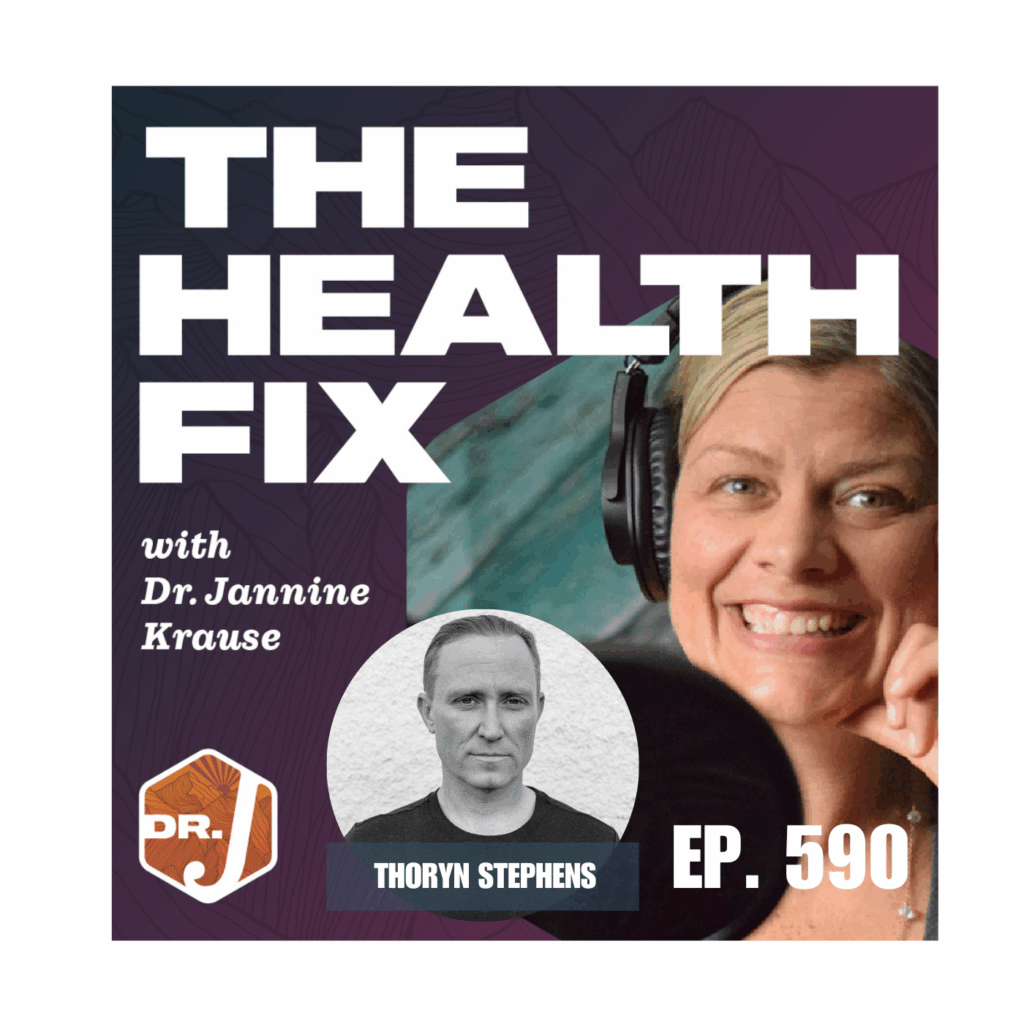
In this episode of the Health Fix Podcast, Dr. Jannine Krause sits down with Thoryn Stephens, founder of BRAIN.ONE and leading expert in neurotechnology, AI, longevity, and behavioral analytics, to explore how technology can help us optimize brain health, behavior change, and long-term cognitive performance.
With a background in molecular and cell biology, Thoryn shares his journey from biotech research into AI-driven health optimization and why behavior change is the hardest (and most important) part of improving health.
This conversation dives into how microhabits, supported by data, wearables, and AI, can strengthen the brain, improve HRV, support endurance training, and reduce the risk of cognitive decline and dementia. Thoryn explains how BrainOne creates personalized health protocols by integrating scientific research, behavioral analytics, and real world data making brain health actionable instead of overwhelming.
Dr. Krause’s Protocols
Instructions Included
Traveling soon? Looking to detox or reset your gut? Try one of Dr. Krause’s Fullscript plans.

What You’ll Learn In This Episode:
• How AI interprets wearable data like HRV
• The role of microhabits in long-term brain health
• Preventing cognitive decline through lifestyle optimization
• Wearables, accessibility, and cost in health tech
• Data privacy concerns in AI-powered healthcare
• Why women’s health is a major frontier for innovation
• How to start optimizing your brain and biology in your 30s and 40s
Resources From The Show:
- Brain.one website
- Learn more about Thoryn: https://brain.one/profile/THORYN
This episode is for anyone interested in brain health, AI in healthcare, longevity, personalized medicine, wearable technology, and sustainable lifestyle change.
🎧 Listen now to learn how small, strategic habits guided by data can create massive improvements in cognitive health and overall performance.
Our Partners

Podcast Transcript
Chapters
00:00 Introduction and Technical Difficulties
00:42 Thoryn’s Background and Journey to AI
02:51 Understanding Human Behavior and Change
04:24 Cardiovascular Research and Ironman Training
06:09 Wearables and HRV Technology
08:35 Innovations in Non-Invasive Health Monitoring
10:03 Introduction to BrainOne
11:38 BrainOne’s Approach to Dementia Prevention
14:18 Customization and Personalization in Health Protocols
17:05 The Role of AI in Health Data Management
20:26 Brain Health and Microhabits for Optimization
23:08 Optimizing Brain Health Through Lifestyle Choices
24:28 The Power of Micro Habits in Health
26:22 Customizing Health Protocols for Individual Needs
28:23 Integrating Wearable Technology for Better Tracking
30:14 Navigating Costs and Accessibility in Health Tech
32:38 Ensuring Data Privacy in Health Applications
34:44 Training Protocols for Endurance Athletes
38:30 Experimenting with Health: The N=1 Approach
40:53 Future Directions: Women’s Health Innovations
Jannine Krause (00:01.562)
Thorne Stevens, welcome to the Health Fix Podcast.
Jannine Krause (00:09.166)
Why am I not hearing you all of a sudden? What’s happening?
Well, we better figure this out first. Suddenly lost you. Say something again.
Let’s see.
Jannine Krause (00:32.144)
Speaker is this and
THORYN (00:38.334)
Check, check, check one, two, ooh.
Jannine Krause (00:39.545)
Now I hear you.
THORYN (00:44.318)
Good to know.
Jannine Krause (00:44.526)
I’ve got, yeah, I got you back here. Whoop these. And you can hear me okay. Okay, perfect. I’ll just reboot, we’ll do it again. We’ll edit that part out, no big deal. Alrighty. Thoryn Stevens, welcome to the Health Fix Podcast.
THORYN (00:55.506)
Yeah, sounds good.
THORYN (01:09.16)
Janine, thank you so much for having me. I am excited to be here.
Jannine Krause (01:12.974)
Well, since I saw what you are up to, of course, as we said before we hit record, like, my goodness, if we can help people with the stuff that happens in their head when it comes to adapting new behaviors, I’m all for it. So of course, I’m guessing there’s a little bit of backstory here in terms of why you were like, I need to do this. So give us a little of your backstory. What inspired you to come to AI and use AI in this particular manner of helping folks with their behaviors?
THORYN (01:43.186)
Yeah, awesome, great, thank you. That’s a wonderful question. So first off, my background’s in molecular and cell biology. Began my career in biotech as a bench scientist. We were the generation that really sequenced the human genome, and it was under the hypothesis that we could help really solve human disease. But what we found out, it wasn’t just about your genetic blueprint, it’s also about your gene expression, epigenetics, your proteome, everything in between. And…
And that was really my foray though into drug development and really using analytics at scale. I then transitioned into a career as a data scientist. So building digital systems of measurement for large brands, really focused in on optimization of different, what we call journeys or pathways and so forth. And then…
In parallel, I’m also an Ironman distance triathlete. And so I have been using data to optimize biology for really decades now. Normally I have multiple wearables on. But the idea of again using a wearable to…
know, attenuate your lactic threshold or ultimately change your biology such that you can race longer or harder, you know, with more power and things like that. so BrainOne is really a culmination of a lot of those years of research, both in biotechnology and biology, molecular biology, as well as data science using data sets at scale to help predict human behavior and then ultimately optimize it if they are looking to do a particular thing. So that’s some of the background.
Jannine Krause (03:17.42)
Nice, nice. So it’s kind of like getting into your brain in the areas that sometimes you can’t necessarily tap into in that subconscious area or may take years to kind of learn what to tap into.
THORYN (03:29.042)
Yeah, it certainly could be. on one hand, on one side of the model, we have all the inputs into who the human is, why they are.
those pieces, but the hardest part is the change. It’s actually not the technology, it’s not the data, it’s quite literally getting the human to do the thing and that’s one thing per day. It can be very challenging. So we have been really working on that model. What does that look like to help, again, using cognitive behavioral therapy as an example, CBT type of frameworks of cues and rewards and so forth, to not just get a human to do the thing, but to understand why and actually want to do it and see the value in those pieces.
Jannine Krause (04:08.981)
It’s kind of like gamifying it at another level of sorts.
THORYN (04:12.912)
It can be, yeah, but ideally not like kind of the sleazy gamification, you you see when you’re going to, you know, whatever it might be to use like a loyalty program. But yeah, definitely some similar principles.
Jannine Krause (04:25.914)
Good way, I didn’t even think about loyalty programs and all that, but yeah, I guess, I mean, that makes sense, that makes sense. So now you have some background in cardiovascular research as well. Now with the Iron Man training and the cardiovascular research, I’m always gonna geek out on HRV and those kind of things. Did you do some work there and does that play into a little, does that overlap with brain one and anything you brought to that?
THORYN (04:51.068)
Yeah, yeah, absolutely. So really what changed for me, I was very much an athletic human in my younger ages, but more on the skiing, snowboarding side. I went to school here in Colorado.
and then in my twenties, I began running and I began, never was really a runner, but you know, my mother, one day I was like, let’s go do a Susan Jacomen 10 K. And that was like the impetus that drove me into half marathons and marathons. And then she got into Ironmans and she actually got me into Ironmans. But the concept of again, optimizing your biology. So when you’re racing a long distance, like Ironmans, you are constantly optimizing your hydration, your electrolytes, your proteins. you know, everything.
really in this like, you know, kind of multi-faceted, multi-variable equation. And if you get any one of those variables off, you’re not going to finish the race. And so it was through that experience I began to use a structured framework, what we call health, a health protocol essentially. But it’s really just a routine. What are the things that you do while you’re training and you’re optimizing each of those dimensions essentially simultaneously and ideally, you know, having a baseline and getting stronger and faster and, you know, and really seeing that progress over time. So that was the initial impetus for
one really came out of that type of training where again you’re following a training plan of micro habits as well as nutrition, supplementation, then putting it into practice. then layering in data on top of that was game-changing because then you could see relative, and back then it was the big chunky garments, they were like these massive, massive things on your wrist. And the metrics were also pretty limited back then. And now you can get HRV out of nearly any wearable on the market. We just did some really
Jannine Krause (06:22.938)
Yeah.
THORYN (06:35.277)
cool testing with some facial scanning that gave HRV that was within 5 % of my core wearables. So you don’t even need a device now by the way, know that’s some of the testing that we’re doing at BrainOne. So if you don’t have a wearable then you can get HRV essentially directly out of your phone. So really really cool stuff in the pipeline there as well.
Jannine Krause (06:53.998)
Wow, you know, that leads me to thinking of a couple different things, just because I’ve done all the wearables, the garment, I laughed because I’m like, I remember being on marathons thinking like, my arm feels so heavy, you know, it gets to those last mile 19 plus and you’re like, everything, you know, but also thinking about just, you know, we’re in a world of EMFs, right? And the more wearables we have in our body, the more I think that we probably need some breaks. So being able to get data without having it on.
THORYN (07:03.576)
Haha, yeah.
Sure.
THORYN (07:19.166)
Sure. Yep.
100 % and yeah, I couldn’t agree more. I try to limit as much EMF as I can. That said, I ran into some friends the other day and they’re like, Thorne, are you okay? And I was like, yeah, I’m great, what’s going on? And they’re like, you’re wearing two watches. And I literally had my Apple watch and a Garmin because we were doing a time series and comparing the variance between HRV. So when I sleep, I generally sleep with an Aura and with the Aura Ring, it’s the least invasive relative to EMF and then you can actually turn Bluetooth off. So very, very limited there.
I do think sleep trackers are very helpful for most humans. Of course, there’s the whoop, which is just a band. That’s another good one. But generally, I sleep with Aura, and then I train with Garmin. It’s kind of my working method, utilizing both so you don’t have to sleep with a big bulky watch or whatever that.
Jannine Krause (08:10.692)
Yeah, yeah, I found that was ripping my whoop off in the middle of the night, subconsciously being like, it’s going off of me. So strange. But then the aura, yeah, I would keep the aura on. So it’s interesting. I know that a lot of people are into optimizing and really getting the data. It can be a journey to figure out what works best.
THORYN (08:21.607)
Yeah.
THORYN (08:30.164)
Yep.
100 % yeah, actually we’re working on a white paper right now I can share with you and your listeners and we’re actually looking at HRV across the the different wearables and then actually looking at new modalities like I mentioned face and then voice so voice is a biometric signal that is an indication of both of HRV as an example and Some of the preliminary research looks really interesting there so again if you don’t have a wearable at all you could just do a quick voice note and then that would transcribe your voice into you know, essentially a understanding of
stress as an example or HRB as a correlation.
Jannine Krause (09:06.192)
so fascinating to think about the hurts that are coming out of us and how we can read that. But I’ve seen different tools in the alternative medicine space where you speak and then now we can also tell all the different things in balanced in the body and stemmed with the channels in one.
THORYN (09:23.07)
Right now. Yeah, we actually have it in Brain 1. We’re testing a system as we speak. And they get very specific. And I don’t know. Anyway, we’re still evaluating. And we have seen high and medium correlations between voice and HRV. So that looks good. When it gets down to like mineral deficiencies or bacteria, I get a little bit woo-woo. But the data at some point, I think we’ll get there.
Yeah, so it’s interesting. And also to have those non-invasive, essentially, outcome measures, it’s ultimately will go more mainstream, and so more people can get data that can hopefully help their health. So that’s the best.
Jannine Krause (10:03.448)
Absolutely, absolutely. I think people are really starting to wake up to AI in terms of data and in terms of interpretation, helping them out, kind of the different ways to move the needle forward. So let’s talk a little bit about BrainOne. Let’s talk a little bit about all of the capabilities and you have the ability to share some stuff with us. For those of you who are watching on YouTube, you guys can see that. Those of you who are listening, you gotta come back and check it out.
THORYN (10:23.474)
Yeah.
Jannine Krause (10:29.936)
So yeah, share with us a little bit more on Brain 1. Let’s kind of walk through it and however you want to guide that. Let’s go.
THORYN (10:33.149)
Yeah.
Great, yeah, let’s do it. So again, the impetus for this came while I was doing some pro bono work in the brain space. what I found is, again, we as humans are not really taught much about the brain and the nervous system. And so from that perspective,
where we really started was initially in brain optimization. And, what we did that was different was we would take a scientific, paper and then run it through our AI. actually let me just shift for one second and I will just show you this. so here’s an example. you can see my screen. So, whoops. So you,
Here we go. So in this example, you have a paper such as the Lancet 2020. Let me just start there. And if you’ve ever heard the hypothesis that dementia is preventable, it’s generally based on this paper. And…
And why is that so pronounced? Well, in this paper, they cite, again, it’s called The Lancet 2024. It’s been republished now. This is the third time. And they are essentially identifying modifiable risk factors. So these are things that you can likely change, modify, again, relative to a microhabit that could ultimately help prevent. And in this paper specifically, it’s 30 to 40 % of global dementia cases. There’s about 55 million global that people could ultimately
THORYN (12:05.036)
you know, prevent dementia. And that’s based on modifiable risk factors, just behaviors, things you can do every day. And so what this paper does is it outlines what the different risk factors are. And then what we do is we put that into BrainOne as an editorial. And so here’s an example here where we outline again these.
in case, 12 risk factors. And then what we do is we put it into a easily digestible, importable health plan, basically. Health routine, we call it a protocol, same thing. And what it outlines are, again, in this case, these 12 modifiable.
essentially micro habits. And so what’s a micro habit? Could be something as simple as making art once a week. And then over here you have an outline of what that type of micro habit could be, the benefits, how to incorporate it, and so forth. And you literally just do two clicks and then the protocol is available in the BrainOne dashboard. And that’s it. And that’s the idea. We’re primarily B2B right now, so we’ve been focusing on large.
health networks and so forth. And we’re going to have a DTC offering in Q1, actually, of this next year. But that’s the concept is you can come and you can download a protocol and you could share it with your parents and your parents could ultimately follow a structured framework to help prevent a predominant number of dementia cases.
And that’s the concept and so this is what an example of the dashboard looks like so you you know come in in the morning and you’ve got these different What we call micro habits that comprise the protocol And maybe if you don’t know what one is cut out caffeine Maybe you want some more information you can click on it And then you could you know have again this overview of what it is and why and all these pieces and then you can add it to your protocol You can change it. You know once you do all the things You know for the day
THORYN (13:59.27)
So you essentially have your game plan there. And then we have a full education module that we’re working on. And this, again, has bite-sized, adjustable daily things relative to the microhabits or behavior change, ultimately. And why are you doing the thing, not just saying, hey, do the thing, but ultimately do
This is the data around it. And then those follow essentially a protocol over the period of 12 weeks. And then for every week, you have a different foundation, sleep, movement, nutrition, gut, brain. We’ve really analyzed every longevity protocol, every health protocol ever published. And that’s ultimately where we derive these different types of protocols and then ultimately the educational content. Any questions on that so far?
Jannine Krause (14:44.356)
Yeah, so I noticed you had had the Lancet and then you now just said that there was other things. So I’m like, is this on one research article or multiple? I know I’ll get that question. And then what about, besides research, do you have any medical advisors, people that are bringing in data, even from across like healthcare systems or whatever’s been tracked anywhere else in terms of
THORYN (14:54.44)
Sure. Yeah.
THORYN (15:08.816)
Yeah, absolutely. Yeah, we’ve got some really exciting partnerships that we’re going to be announcing over these next few weeks with some large medical groups and universities. So we, in this instance, this one protocol was based on that one paper.
just answer the question directly. Now, we have ingested thousands and thousands of papers and we’re looking at actually ingesting millions, you know, quite literally. So the scale that we’ve built behind this, and that’s one of the ways we’re using AI, we’re trying to use it, you know, intelligently as well as judiciously. We have a human in the loop that really approves everything. We had an Oxford PhD who was like going through all the content. But the health protocol could be based on a
Jannine Krause (15:27.34)
Okay. Okay.
THORYN (15:57.152)
a research paper in that example, it also could be based on a specific researcher’s research, an influencer, really it’s up to the individual or the practitioner at the end of the day. We do however, again, since we’ve indexed thousands and thousands of research papers, we have pulled them in and then we do have a series of…
Let show you what the library looks like. So in our library, we have hundreds and hundreds of these protocols, TBI support, brain optimization, that people can come and utilize essentially. Another big area of focus is women’s health. So in this example, PCOS, endometriosis, perimenopause, menopause, I this stuff’s coming up on a daily basis. So in that instance, we may take multiple studies essentially and then amalgamate into one protocol.
Here’s an example of one for PCOS. So it started in brain, and now we’re really seeing the applications across all aspects of human health. And women’s health is also top of that list.
Jannine Krause (16:59.568)
Sure, sure. Yeah, I mean, it seems, you know, now that we’re in the space of different protocols being run for our patients, and I mean, I’ve had people go to chat GPT and kind of take what I’ve given them and create protocols for themselves, which is cool, you know, and then ask me, like, you know, does this sound legit? I think the biggest question a lot of people are gonna have is like, okay, with these kinds of programs, if your doctor’s gonna use them, can the doctor input their own?
tidbits, is there going to be variability to use anything customized within this.
THORYN (17:32.094)
Yeah. So yes, I mean.
Absolutely, that’s what we’re seeing in the market is that humans are set up with their normal doctor, their primary care, and they are absolutely uploading all of their medical information into chat GPT, which is terrifying actually, because again, there’s zero governance around privacy. that data ultimately, mean HIPAA doesn’t even apply in that context when it’s you uploading your medical data, your health data into an LLM.
Jannine Krause (17:49.646)
Yep. Yep.
THORYN (18:05.63)
Goes out the window. So there’s zero protection relative to governance and just privacy. And then you don’t also necessarily know if the data is really evidence-based. mean, you think it is, but you don’t necessarily know. So that’s what we’ve done that’s a little bit different is, again, and it’s not a perfect system, but starting with the scientific papers, at least there’s a basis. You know where it’s coming from. And then putting it into a digestible, easy, trackable piece. That’s the thing you’ll never get out of chat GPT. that’s where we, but we’re absolutely
seeing that use case. mean right now today is people are coming to BrainOne and we have that ability now you can upload PDFs and again we’re working on the privacy piece and putting that really to the forefront because it’s it’s fairly terrifying but it also is an indication of humans not getting you know their needs met relative to nutrition, micro habits, looking at more personalized plans at the end of the day you know the fact that we still have a food pyramid you know we’re
All Americans get the same concentration of carbohydrates and it doesn’t even break it down differently between men and women. I mean, it’s just absurd, ultimately. So this is the first step in a truly personalized healthcare protocol. You can download a protocol, you can use it today, and then you can also have the AI updated on a weekly basis based on things like your adherence and your biometrics. You can also share it with your doctor, and then your doctor can make recommendations, ultimately, relative to
you know, for any of these, you know, high protein, like maybe, you know, they could come in the protocol and then actually add how much protocol, I’m sorry, how much protein you would be getting, you know, based on your weight and gender and all those things. So a high degree of customization is built into the system. to, you know, whatever degree the human is looking for. Some of them want to share it with their doctors. Some of them, as you are aware, don’t, you know, they just are looking for a quick, easy answer. So.
Jannine Krause (19:47.405)
open.
Jannine Krause (19:59.835)
Sure.
THORYN (20:00.424)
But it’s definitely interesting times. again, the whole LLM thing with the health data is fairly terrifying for that reason.
Jannine Krause (20:07.574)
It is, I mean it’s definitely, I don’t feel threatened whatsoever that my job is in jeopardy just because of the way I work, but at the same time when people will bring over the stuff, I’m like, what is, you know, okay. Yes, this is a great idea, but let’s talk about a couple of things that are on here that, you know, based on your specific health condition that you didn’t type into ChatTPT and it doesn’t know. So.
THORYN (20:15.228)
Yeah.
THORYN (20:33.535)
That’s it, yeah. mean, 100 % contraindications. mean, yeah, unless the LLM has that data, it’s not gonna know. But again, the trade-off is most doctors are not really taught things like nutrition, and that’s also a bit of a travesty.
Jannine Krause (20:52.368)
Mm-hmm. It certainly is. It certainly is. I feel blessed that I had over a year of nutrition in my practice to be able to do this. nevertheless, I’m curious. Do you get the Brain Body Reset program? Because know, Brain 1, obviously, foundations in brain. And as we get older, it is something that a lot of folks will come to me and be like, especially in the perimenopause menopause space, like…
Doc, I’m having word salad, I’m forgetting certain words, I walk in the rooms all the time, I can’t remember why I was going there. And of course everyone’s like, I think I’m getting dementia. So let’s talk about how we can help the brain, because a lot of people are thinking, I’ll get asked, do I need like, lumosity, or do I need some kind of brain game, or do I need to be doing something that helps keep me with micro habits, things of that nature for my brain? So I’m gonna let you take over here and give us a little bit.
THORYN (21:43.73)
Yeah. Yeah.
Jannine Krause (21:46.286)
of insight into the brain body programs that you have.
THORYN (21:49.458)
Yeah, 100%. mean, we are, our generation, we’re thinking about our parents’ brain health. We’re thinking maybe about our grandparents if they’re still alive, as well as ourselves, our partners, potentially children. And we generally don’t think about the brain as a organ that can be strengthened, or like a muscle, any other muscle in your body. And now there’s more more evidence, really since the,
beginning of neuroplasticity in the late 80s, essentially, when that became more and more widely accepted, the idea that your brain can be strengthened, ultimately. so those are, so how does it get strengthened? Well, through things like microhabits, like you see here. We have a series of different microhabits that we may look at for whatever it is you’re looking to help optimize. And it is,
On one hand, think it’s a great opportunity. And my background in molecular biology, again, the idea that DNA makes RNA makes proteins, in between your DNA and your protein, your gene expression is ultimately epigenetics. And there’s different studies on this, but let’s say roughly 30 to 60 % of your gene expression is dependent on your environment.
And those are the things that you do. And so we call them microhabits. A microhabit could be cold plunging. And then within cold plunging, you could have things like the temperature of the water, their duration, the frequency per week. And so we look at each of those, essentially, as independently. So this is an example of how we think about it. And you could do striking and things like just for whatever the given microhabit might be. And.
And so from that perspective, we actually do have some control relative to our brain and our biology.
THORYN (23:43.518)
gene expression and ultimately our lives. So while you have this genetic blueprint, you can continue to optimize that. And so our perspective is again looking at it multimodal. So it’s not just doing lumosity. And lumosity of all of them probably is the lowest on the list. A lot of their science never really checked out. But there are great brain training games that you and we and our parents should be doing ultimately. And starting now, you don’t want to start, that’s one of the problems of modern Western
medicine is that it’s oftentimes when you have the onset of the tau proteins and an amyloid and
and you really start to see the negative consequences of dementia, it could be too late. And so these are activities. That’s why this Lancet paper is a really good, easy, digestible example. These are things we can be doing now in our 30s or 40s or 50s to lay the foundation for our 60s, 70s, and so forth. So I think that’s a really important part. And something like brain training games could be helpful independently, but also in the context of broader lifestyle and behavioral modifications. And that’s where we’re really starting
to see some awesome work.
Jannine Krause (24:54.32)
Makes sense, makes sense. Yeah, it’s really fascinating to really understand that a lot of what moves the needle is micro habits. And of course, you’re highlighting on that. And I think a lot of people think we need to do some drastic things. We need to do the big things, you know, it’s little, little things.
THORYN (25:13.17)
Yeah, exactly, it’s these small incremental changes, you know, ultimately. I think a funny real world example is Noom. So Noom is a CBT-based, you know, a weight loss.
system essentially based on cognitive behavioral therapy and it’s just interesting to me because they are doing so well in part to the GLP-1 explosion but also because their system is more rooted in science and behavior change at the end of the day. you contrast that to Weight Watchers, which Weight Watchers has been around a lot longer, they just went bankrupt, four or five months ago now, and you have Noom now worth four to six billion. And why is that? It’s because of the behavior change
the optimization, these small micro habits, these things essentially, that’s the hardest part. You can give the human a blueprint, but ultimately they have to see the value and they have to take the time and do the thing that they commit to doing. So that’s the secret sauce, but ultimately we’re really working.
Jannine Krause (26:13.988)
Yeah.
Jannine Krause (26:20.368)
I hear it so often, know patients will come in, I feel like I’m like a Catholic priest some days because it’s like confession. They’re like, doc, I didn’t do anything, you know, or I didn’t do this or I didn’t do that. And you’re like, okay. You know, and part of it for me, and I think for a lot of docs like myself, we’re trying to figure out what’s gonna resonate with someone. And so with BrainOne, what I see in there is that you have the customization where it’s like, if this didn’t particular microhabit.
THORYN (26:33.598)
Sure.
Jannine Krause (26:49.776)
series didn’t work, we can change things up. Will you walk us through a little bit of like thought process there in terms of tweaking the set of protocols for folks?
THORYN (26:58.3)
Yeah, absolutely. So we have it both from a…
human interventions to your point yourself, you can go in and what you could look at immediately is adherence. So that’s the primary metric that we optimize against. Did the human do the thing that they said they’re gonna do and did they track it? You know, that’s the other piece too. So both are challenging, getting them to do the thing and then getting them to track it. Now we’re working more towards algorithmic tracking. So if you have a wearable and then we know if you went on a run, know, dah, dah, dah, because the tracking piece is really challenging for some humans.
Adherence is one of the pieces that we look at and then the doctor can be like hey It looks like you didn’t do your cold plunging for the week. Do you want to try a different type of autonomic reset? You know, why don’t we look at cold plunge to help your parasympathetic, you know get into a more relaxed state
And so that would be an example of using the data. You could be looking at HRV and then ultimately the adherence data, looking at, you know, did they do the thing and then coming up with a plan, you know, essentially. And so the practitioner can go in and make changes. Where we’re working is also the AI. You can come in on a Monday and just click a button and be like, yeah, let’s check out the new health protocol. And it would actually change based on your adherence, based on your biometrics, and actually recommend things like, okay, Janine, you you haven’t been doing your cold plunging.
Jannine Krause (28:15.268)
Thank you.
THORYN (28:19.846)
how about breath work? Yeah, so that would be a very real world example of where we’re going. Still early testing, but you know it’s interesting.
Jannine Krause (28:28.718)
I can see how that would be really incredible because I I spend as a doc, a couple hours a day on email troubleshooting and trying to help people tweak their different protocols that they’re on. And so I’m seeing that like, that would be very helpful in my space, but also because it’s taking real time data from someone else. So, you know, I can see that. The other big thing that I’m curious about because I have some patients who…
THORYN (28:34.835)
I believe it. Yep.
Jannine Krause (28:50.832)
are like me data nerds and they track a lot. They’re tracking like through chronometer what they’re eating, they’re tracking, you know, the aura, they’re tracking this, that and the other. And what ultimately the biggest question I will get over and over again is, is there some way that we can integrate everything into one platform so that it can give an ultimate protocol? And this kind of sounds like that’s what you’re doing.
THORYN (28:58.376)
Hope. Yeah.
THORYN (29:15.678)
Yeah. Yeah, we have over 300 wearables integrated today. So nearly everyone you can imagine from
Jannine Krause (29:21.914)
Okay.
THORYN (29:25.286)
you know, from whoop, Garmin, Strava, Fitbit, women’s health, Flow, I mean, we’re, really like the broad array. And so yeah, we could potentially do that right now. We haven’t wanted to intentionally become like the, you know, wearable integrations of them all because people have certainly tried that and not been successful. You know, that was also a bit earlier, kind of in the adoption of wearables. But we could certainly do that now. Actually, Janine, we do have those capabilities. So yeah, if you’re, you know, more and more interested
Jannine Krause (29:43.79)
Yeah. Yeah.
Jannine Krause (29:53.168)
person.
THORYN (29:55.2)
that’s something that we can absolutely add. We do have all the inputs. And I’m the perfect example. Again, I use sleep for one, I use activity for another. And then also, I didn’t really show the full breadth, but again, the concept of using something like your voice to actually get the signal. So if you don’t have a wearable at all, that’s another option.
Jannine Krause (29:59.089)
Wow.
Jannine Krause (30:14.52)
Yeah, I really like that. I really like that. You know, it reduces the cost and subscription amount for certain folks. And of course, you know, my next question is gonna be like what other folks are gonna ask like, okay, Thorne, you know, where are we at with cost here? How does this integrate? Do you integrate into electronic health record systems as well? You know, how does that look for someone who may be interested in trying to figure it out?
THORYN (30:20.574)
Yeah.
THORYN (30:42.342)
Yeah, so we have our primary focus again is B2B. So working with large health network systems, know, of users basically. also have the D2C side, which again, you we haven’t launched, you know, we’re.
we’re working on, essentially. And so we’ll keep the monthly costs low. I we’re still looking at the pricing, but anywhere from $10 to $20 a month, something along those lines, depending on the features, potentially lower. So we’re testing all of that now. And then the clinician can essentially utilize the system. We have a full white labeled version.
They can use it essentially with their client bases and either not charge or charge, you know, just depending. But that’s the basic model.
Jannine Krause (31:31.978)
okay. Okay, I was curious about, yeah, on my end, because I don’t have like epic in terms of like the big electronic health record system.
THORYN (31:37.447)
Yeah.
Well, I don’t blame you. And that’s one of the challenges is, EHRs, I’ve built them in the past. They’re notoriously unstandardized. There’s certain APIs like FHIR where they’re, anyway, it’s just a bit of a mess, which is, it’s that lack of interoperability that’s really slowed down, I think, some innovation in general, actually. Side note. But we intentionally, we can integrate into EHRs, and we definitely have the capability. But we intentionally didn’t build a medical,
we’re not getting medical advice, you know, ultimately it’s coming through the practitioner. But yeah, these are definitely the things that we’re thinking about when we deal with cysts.
Jannine Krause (32:15.77)
Sure, sure.
Jannine Krause (32:21.232)
And so, you know, I can imagine that if you’re working in the next couple weeks coming out with new stuff, I’m imagining that probably with some of the insurance companies, it’s discounts for people that work through these programs as well. And so they may be hearing about it through their business. Okay.
THORYN (32:34.793)
Getting there, Exactly. Yeah, exactly. So we’re looking, there’s a whole corporate route exactly for HFA, SFA, those pieces, reimbursement, all of that. And my goal is to actually give away a percent of these protocols, dementia reduction, you can get for free. You can come, can utilize the basic system for tracking. We will just give those away. Women’s health, there’s a number of protocols. And then we have the advanced, essentially features around the AI and then the…
Jannine Krause (32:46.968)
cool.
THORYN (33:04.409)
ability to.
Jannine Krause (33:10.212)
Very cool, very cool. So when should folks be able to expect the direct to consumer stuff available? Okay, okay, so next year early.
THORYN (33:16.604)
Yeah, Q1 for sure. And they’re welcome to sign up for the waitlist now. And we’ll put a note if they want to mention your name as well. And happy to give your listeners first access.
Jannine Krause (33:29.012)
Awesome. I’m looking forward to this. think this is really neat. definitely helps me. I know a lot of people right now are afraid of AI a little bit and they’re afraid of sharing information to China. And of course, I can’t leave this conversation without ensuring folks that this is not being sent over to other countries to use it against us, et cetera, et cetera, whatever the thoughts may be. And so privacy policies.
THORYN (33:39.4)
sure.
Jannine Krause (33:58.661)
please give us the rundown so folks understand how, if they use this program, how this is gonna be protected for them.
THORYN (34:07.462)
Yeah, relative to the data collection piece. Yeah. Yeah. I’ve been in the health space quite a while. And then as a data scientist, I’ve really seen how our behavioral data has been.
know, ultimately commoditized and resold. And it’s an area that I have a lot of passion around in general. And it’s something we put to the forefront. So we have very open privacy and data governance policies that we’re happy to share. The data is not resold. You know, we’re using it for very specific purposes, but it’s not an area that I take lightly. Period.
Jannine Krause (34:46.288)
Yeah, yeah, fair enough. I mean, it’s an interesting world. Now let’s turn to something fun, because of course I have a lot of really fit folks that like to listen to the podcast and they may be thinking like, okay, so we said he was an Iron Man. So was there a training protocol that you’ve got that folks could mimic? I know that a lot of people, especially in ultra marathons, Iron Man, we wanna know like what are the secrets? What kind of things should we be focusing on? Because some people might be dreaming of things of that nature.
THORYN (35:02.29)
Bye.
Jannine Krause (35:15.664)
So I imagine things to be much like training peaks in the beginning stages of when things came out. Yeah, so give us a scoop. Could we ask it to help us train to be in an Ironman?
THORYN (35:15.902)
Sure.
THORYN (35:22.878)
Yeah, 100%. Yeah. Yeah, 100%. mean, zooming out for a second, the way we think about the world, again, is like micro habits. What are the things that you do? And then a breakdown of nutrition. And then within nutrition, it’s your day to day and then supplementation as a essentially subcategory of nutrition.
I have different protocols when I’m here in Colorado and when it’s the winter versus the summer or when I’m traveling basically those are kind of the big buckets. And again a protocol is just your daily routine. It’s the things that you do. You don’t need to over complicate it. You when you wake up in the morning is it direct sunlight, hydration, you know what does that look like relevant relevant.
relative to supplementation and so forth. So that’s the general context. And then when I’m training, then I layer in the additional micro habits focused again in swim, bike, run, if I’m training for a triathlon. And then similar to a training peaks, but really have the additional layers essentially across nutrition and the things.
So that’s generally how we think about it and bucket it. Now we’re pretty regimented routine. I live here in Colorado, you know, try to ski as much as possible in the winters. I do hot pilates almost every day. And so that combination of core with weights with a sweat is game changing. What I found was that when I began to utilize hot pilates in the context of my skiing and snowboarding, I actually was getting hurt less because of, you know, all of these like, you know, just the tightening of
really across the board.
THORYN (37:01.382)
little bit of a hack. We also use different types of frequency modalities. So things like Tesla coils, Rife, you know, different Tesla coil here in my living room. It’s called the biocharger and do that on a daily basis. Healthy blend of cold plunging. So I have one here in the house and then actually we go in the rivers in the winter. So that’s pretty cold in the snow, break the ice and jump in. So
Those are the different micro habits that I do on a regular basis and yeah, but I’d be happy to share my protocol with you and the listeners and you can see what that looks like on a daily basis and that’s also what we’re building that’s supposed to be fun and social is the ability that I can just share my health protocol with you and you can take a look and if you’re interested you can download it and use it So it’s kind of where we’re adding a social nature to all of this too
Jannine Krause (37:53.643)
fun. I’m like thinking like the Strava for for health junkies of sword in in this case.
THORYN (37:57.758)
I’m a big fan of Strava. So as you can imagine, yeah, they’ve done a really good job on their community front and leaderboards. And so as opposed to doing leaderboards for, you know, King of the Hill, we’re looking at leaderboards for heart rate variability. You know, like who among your friends has the lowest HRV and, you know, the least amount of screen time. You know, those are the metrics that we want to over index on getting people out of the house and working out and in nature and,
community, all those pieces.
Jannine Krause (38:29.424)
That’s really cool. That’s really cool. And yeah, for the listeners that haven’t seen Strava, I the King of the Hill is a big deal, especially when my husband lived in Brackenergia with me. mean, was, everybody’s trying to, I mean, it was fun. And like you’d see people at the grocery store and you’d be like, I’m two minutes behind you, dang it, you know, or something like that. you know, bringing it into geeking out on your health and really.
You know, the way I see this, I mean, this is feeds into my geekiness of really teaching people how to experiment with their health and learn what works best for them and take the power back, you know, when it comes to their health.
THORYN (39:04.392)
Yeah, that’s it. And that’s a big part of it. We are in ends of one, right? We’re all doing these changes, and ideally you have some measurement behind it. It’s insane. Some of these stacks that we see people are on, we had one woman, she’s on eight different peptides. And I was like, why are you on eight peptides? That’s insane. And the majority are injections. then the…
the liver toxicity on lot of these things. we’re trying to provide a safe structured framework that people can manage these different essentially interventions, variables that they’re, we’re all essentially experimenting on ourselves. And at least with this system, there’s some data behind it. But at some point, you’re doing 12 different variables. You have no idea what the NAD is doing versus the glutathione versus the hyperbaric.
Jannine Krause (39:54.084)
Yes.
THORYN (39:54.14)
But that’s the goal, is ultimately at least we start to have some of the tracking behind it. that’s the true vision.
Jannine Krause (40:00.305)
I love it, I love it. I mean, this makes my life a lot easier. It makes my own personal health journey a lot easier because I don’t have them all here where I’m at, but I have notebooks. Like I’m old school, I still write my workouts in notebooks and there’s a lot of them.
THORYN (40:16.391)
A hundred percent actually. I, you know, as a scientist myself, I think I have like 70 of these I downloaded in my library. I use notebooks for everything. And actually something we are working on relative to Prane One is you can just print the protocol and get a cute notebook and essentially just take your notes and have it in a printed form and then upload it essentially at the end of the week. there’s absolutely a use case for that. And as people rightly should not always be on their digital devices, you know, this could help essentially provide a solution.
Jannine Krause (40:21.593)
Yeah
THORYN (40:46.375)
for that too.
Jannine Krause (40:47.6)
Oh my gosh, I love it. You have the same exact type of notebooks I have. I just like something about those ones with the hardcover on them. Oh my goodness. So yes, now everybody knows a little bit more about my geekiness and how I absolutely love to track data. And really, like you said, N01, we’re trying to figure this out. So.
THORYN (40:51.208)
Yeah.
yeah.
Jannine Krause (41:08.528)
Looking forward, sounds like, direct to consumer, we’re gonna, know, January 2026. So this podcast is coming out the end of 2025. So I’m thinking like, folks, you know, stay on it. The next thing I’m thinking is like, okay, so brain one, you’re gonna, you said you’ve expanded to, is it body one? What’s next for you guys when you expand fully?
THORYN (41:27.43)
Yeah, we own Women’s Health.one. So that’s probably going to be the next one actually just because there’s such a need within women’s health. mean, every woman I know is dealing with autoimmune or thyroid. I had a woman the other day, she’s like, yeah, autoimmune is the new cancer. And that was like mind blowing to hear that. I
It’s so prevalent. Why does every woman I know have an issue with her thyroid? So we’re really trying to look at that. Also related perimenopause, menopause, that side of the cycle, all of it. So that’s very, very exciting for us and all the amazing women in our lives.
Jannine Krause (42:02.085)
I look forward to seeing that, you and you said you had quite a few integrations. I’m like, okay, Mira, Fertility, is that integrated? Temp drop?
THORYN (42:11.28)
No, we should chat about them though. I’d love to hear some of your favorites and yeah, mean, Flow Health out of the gate and yeah, all the other major ones. But yeah, I’d love to hear any recommendations you might have.
Jannine Krause (42:22.32)
We, if you get a couple minutes, we are gonna geek out. Well, Farron, welcome. mean, this is just so welcome to the health junkie community, because I think folks are definitely gonna wanna hear more from you. And I look forward to hearing when the women’s health.one comes out, because I think that will be a really good intro for folks to really hear what’s going on. So I definitely wanna bring you back to chat more about that.
THORYN (42:42.91)
Please. Yeah, I appreciate your work. you’re the perfect example of a practitioner that really gets this new framework of health. Like, this is the future. Again, standardize human health protocols, and then personalize from there. I is, I truly believe the direction. Appreciate the work you’re doing in supporting this.
Jannine Krause (43:02.938)
Hey, my pleasure. Thanks again for coming on. I sincerely appreciate all this info.
THORYN (43:07.952)
Yeah, thank you so much. Appreciate you and your audience.
Jannine Krause (43:11.279)
All right.